
BY:SpaceEyeNews.
The calcium in your bones and the iron in your blood carry traces of an ancient cosmic history. Scientists already know that stars created many of these elements before spreading them across space. Yet the precise nuclear pathways remain difficult to reconstruct. Two new studies now offer a clearer view of that hidden process. They show how stellar explosions forge elements through reactions that unfold too quickly and too far away for direct examination.
The studies focus on two very different events. One examines titanium-44 inside core-collapse supernovae. The other investigates a nuclear cycle during X-ray bursts on neutron stars. Together, they give researchers better data for testing models against observations.
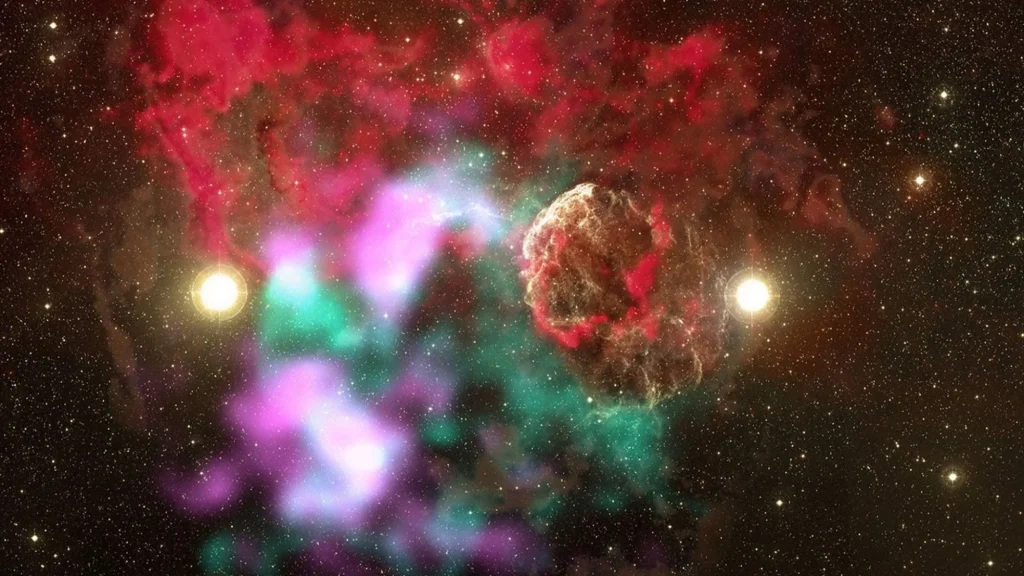
How Stellar Explosions Forge Elements in Extreme Conditions
Telescopes can record light, spectra and radioactive emissions from distant stellar events. However, they cannot follow every reaction occurring inside hot, dense material. Scientists must recreate key nuclear processes in laboratories and place the results into computer models.
Even one uncertain reaction rate can change a model’s predictions. It may alter the expected abundance of an isotope or the shape of an X-ray light curve. Better measurements therefore help researchers connect observations with the physics behind them.
The studies refine two important parts of a much larger story.
Titanium-44 Reveals the Interior of a Supernova
A radioactive fingerprint
The first study examined titanium-44, a radioactive isotope created in core-collapse supernovae. These events occur when the central region of a massive star can no longer support itself. The collapse launches an energetic event that creates and distributes chemical material.
Titanium-44 gives astronomers a rare view of conditions near the star’s former center. Its radioactive signal remains detectable after the initial light fades. Observatories can therefore map where the isotope sits within a supernova remnant.
Scientists compare those maps with simulations. This test can expose errors involving temperature, density, material movement or asymmetry.
A slower reaction changes the prediction
Researchers studied a reaction in which vanadium-45 captures a proton and becomes chromium-46. It affects the network controlling the final titanium-44 yield. At Argonne National Laboratory, the team measured crucial resonant states in that process.
The experiment identified ten previously unknown, proton-unbound states in chromium-46. It also found that one resonance dominates the reaction across the relevant temperature range. The resulting rate proved slower than earlier estimates.
When researchers inserted the revised rate into their models, predicted titanium-44 production rose by up to 35%. That figure needs careful wording. The team did not observe one supernova creating 35% more titanium-44. Instead, the improved nuclear measurement changed what simulations predict.
This result may help explain differences between modeled supernovae and titanium-44 observations. It also gives astronomers a stronger tool for probing the internal development of these events.
The Nickel-Copper Cycle Shapes X-Ray Bursts
A recurring flash on a neutron star
The second study investigated Type-I X-ray bursts. In a binary system, a neutron star draws gas from its companion. The gas collects on the neutron star’s surface until pressure and heat trigger a thermonuclear flash.
The event releases a bright pulse of X-rays. However, it does not destroy the neutron star. Material can accumulate again, allowing another burst to occur later.
This distinction corrects an error in the original Space.com coverage. The event is a Type-I X-ray burst, not a Type I supernova. Those names sound similar, but they describe different phenomena.
Testing a possible nuclear loop
During an X-ray burst, rapid proton capture can build heavier nuclei. Scientists suspected that the nickel-copper cycle traps some material instead of letting it progress.
The strength of this cycle matters because it can change the release of energy. That change would affect the burst’s light curve, which shows how its X-ray brightness rises and falls.
Researchers at the Facility for Rare Isotope Beams used unstable copper-59 to study the process. They identified 15 proton-unbound states in zinc-60 that govern a critical reaction rate. Their work reduced uncertainty in that rate by more than a factor of ten.
The results indicate that the nickel-copper cycle does operate. However, it probably traps only a small share of the reacting material. This finding rules out a strong cycle while confirming that the process can still influence observed light curves.
Better Nuclear Data Connects Models With Observations
The studies examine separate environments. The titanium-44 work concerns core-collapse supernovae. The nickel-copper research concerns recurring flashes on an existing neutron star. Treating them as one event would distort the science.
Their shared value lies in reducing uncertainty. Astronomers interpret cosmic events through models built from hundreds of nuclear reactions. More precise rates allow those models to produce clearer, testable predictions.
For supernova research, improved titanium-44 predictions can sharpen comparisons with radioactive maps of remnants. For neutron stars, a better nickel-copper rate can help scientists interpret X-ray light curves. Both cases show how terrestrial experiments can reveal processes unfolding far beyond Earth.
What This Means for the Elements in Our Bodies
The idea that people contain material processed by stars remains scientifically sound. Carbon, oxygen, calcium and iron all connect to generations of stellar activity. Different elements and isotopes formed in different environments, however. Hydrogen largely came from the early universe, while stars, supernovae and stellar mergers contributed other material.
These two experiments do not solve that entire history. Nor do they prove that X-ray bursts supplied the elements found in humans. Their importance is more precise: they improve the nuclear framework scientists use to trace how cosmic matter changes.
The new findings show that understanding how stellar explosions forge elements requires both astronomy and laboratory physics. Telescopes reveal the signals, while nuclear experiments explain what those signals mean. Each improved reaction rate adds another reliable piece to the history of matter. That history ultimately connects distant stellar events with the chemical ingredients that later became planets, oceans and living bodies.
Main Sources:
- University of Surrey: Scientists gain new insight into stellar explosions
- Physical Review Letters: Titanium-44 study
- Physical Review Letters: Nickel-copper cycle study
- Facility for Rare Isotope Beams