SpaceEyeNews.
Astronomers have detected a genuine four-carbon sugar inside a molecular cloud near the center of the Milky Way. The discovery offers striking evidence that complex organic chemistry can develop before stars and planets even exist.
The sugar found in interstellar space is called erythrulose. It is a simple sugar that contains four carbon atoms. Scientists identified it inside the molecular cloud G+0.693−0.027, about 26,700 light-years from Earth.
This finding does not mean astronomers discovered life, DNA, or RNA inside the cloud. Instead, it reveals something more fundamental. Some ingredients linked to prebiotic chemistry may already exist within the material that later forms stars, asteroids, comets, and planets.
The peer-reviewed discovery appeared in Nature Astronomy. Researchers used two powerful radio telescopes in Spain to identify the molecule through its unique spectral fingerprint. Their results push interstellar chemistry to a new level of complexity.
Sugar Found in Interstellar Space Is a Scientific First
The newly detected molecule is erythrulose, a four-carbon monosaccharide. It belongs to a family of sugars known as ketoses.
Erythrulose occurs naturally on Earth, including in red raspberries. However, its familiar terrestrial source is not what makes the discovery important. Scientists are interested in the molecule because of its chemical structure and its possible role in pathways that produce more biologically relevant compounds.
According to the study, erythrulose represents the first confirmed monosaccharide, or “true sugar,” detected in the interstellar medium. It is also the most chemically complex sugar identified beyond the Solar System so far.
That distinction matters because astronomers had already detected simpler sugar-related molecules in space.
Glycolaldehyde, for example, is often called the simplest sugar. However, chemists do not always classify it as a complete monosaccharide. The detection of erythrulose therefore marks a larger step in the known ladder of interstellar chemical complexity.
What Is Erythrulose?
Erythrulose has the molecular formula C4H8O4. Its four-carbon structure makes it more complex than several previously detected sugar-related molecules.
It is also chiral. That means the molecule can exist in forms that mirror one another, much like a left hand and a right hand.
Chirality matters in biology because living organisms often favor one molecular orientation over another. Amino acids and sugars used by life usually appear in specific configurations.
The new study did not determine which form of erythrulose exists in the cloud. Still, its detection proves that a relatively complex chiral sugar can form and survive under interstellar conditions.
Why This Sugar Matters to Prebiotic Chemistry
Sugars play central roles in known biology. Ribose forms part of RNA, while deoxyribose forms part of DNA.
Erythrulose itself is not a component of either molecule. Therefore, scientists are not claiming that RNA or DNA exists inside G+0.693.
However, erythrulose can transform into related sugars under certain conditions. In a watery environment, it can rearrange into molecules such as threose and erythrose.
Threose has attracted attention in origin-of-life research. Scientists have studied threose nucleic acid, or TNA, as a possible simpler chemical relative of RNA.
Laboratory experiments have also shown that chemical mixtures containing erythrulose can contribute to reactions that create ribonucleotide precursors. These findings do not prove a direct path from interstellar erythrulose to life. Yet they show why the molecule interests astrobiologists.
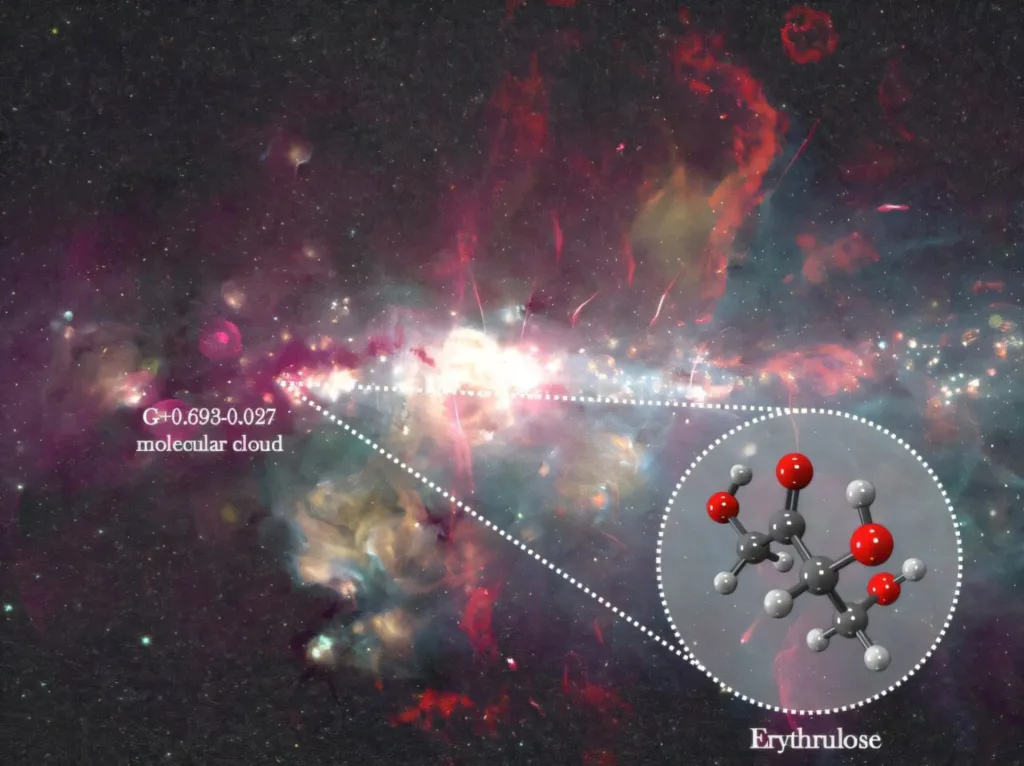
Astronomers Detect Sugar in Interstellar Space for First Time.
Where Astronomers Detected the Interstellar Sugar
Researchers found erythrulose inside the molecular cloud G+0.693−0.027. The cloud lies in the Galactic Center region, roughly 8.2 kiloparsecs from Earth.
That distance equals about 26,700 light-years.
G+0.693 is already famous among astrochemists. It contains an unusually rich collection of complex organic molecules. Researchers have modeled more than 180 molecular species and isotopic variants within its radio spectrum.
The cloud also provides an ideal environment for studying chemistry before active star formation begins.
It contains gas, dust, molecular ice, and organic compounds. Yet the region does not host the same intense star-forming activity seen in many hot molecular clouds.
As a result, scientists can study the chemistry of relatively primitive material before it becomes part of a young stellar system.
Chemistry Before Stars and Planets
This setting gives the discovery its greatest significance.
Stars and planets form when parts of molecular clouds collapse under gravity. Dust grains and molecules within those clouds can later enter protoplanetary disks.
Over time, that material may become part of asteroids, comets, moons, and planets.
Finding erythrulose in such an early environment suggests that planetary systems may inherit a complex chemical inventory from the clouds that create them.
In other words, young planets may not begin with chemically simple material. Some organic building blocks could already be present before planet formation starts.
How Scientists Detected Sugar in Deep Space
Astronomers did not photograph an individual sugar molecule. They also did not collect a physical sample from the cloud.
Instead, they identified erythrulose through radio spectroscopy.
The researchers used the Yebes 40-meter radio telescope and the IRAM 30-meter telescope in Spain. Together, the observatories collected an ultrasensitive broadband survey covering more than 91 gigahertz of radio frequencies.
The observations included the 7-millimeter, 3-millimeter, and 2-millimeter atmospheric windows.
A Molecular Fingerprint in Radio Waves
Every molecule interacts with electromagnetic radiation in a distinct way.
Gas molecules rotate through space. As they change rotational energy levels, they absorb or emit radiation at precise frequencies.
Those frequencies produce a pattern that acts like a molecular barcode.
Scientists first need accurate laboratory measurements of a molecule’s expected frequencies. They can then search astronomical data for the same pattern.
The team searched the spectrum of G+0.693 for erythrulose’s predicted rotational signature.
They identified 12 groups of spectral features linked to the molecule. Those groups represented 17 individual transitions.
Six sets appeared predominantly free from interference, with contamination levels of 25% or less. Other lines overlapped with known or unidentified molecules, but they still matched the complete spectral model.
Why Multiple Spectral Lines Matter
A single radio signal would not provide enough evidence for a confident discovery.
Chemically rich molecular clouds produce thousands of spectral lines. Some signals overlap. Others may appear close together by chance.
Researchers therefore search for several transitions from the same molecule. Each line must appear at the expected frequency, strength, and velocity.
In this case, the six cleanest erythrulose features offered strong statistical support.
The researchers calculated only a 0.2% probability that all six unblended signals aligned by chance. The remaining predicted transitions also agreed with the observed spectrum.
Together, those results created a robust identification.
The Sugar Found in Interstellar Space Was Surprisingly Abundant
The researchers also measured how much erythrulose exists within the cloud.
They estimated an erythrulose column density of approximately 8.7 × 10¹³ molecules per square centimeter along the telescope’s line of sight.
Its abundance relative to molecular hydrogen reached around 6.4 × 10⁻¹⁰.
Those figures may sound extremely small. However, interstellar molecules often exist at very low concentrations.
More surprisingly, the four-carbon sugar appeared at least eight times more abundant than comparable three-carbon sugars.
The researchers searched for glyceraldehyde and dihydroxyacetone, which both contain three carbon atoms. They did not detect either molecule.
Based on the observational limits, erythrulose was between eight and 17 times more abundant than those smaller sugars.
More Complex Does Not Always Mean Rarer
That result challenged a common expectation.
Within many chemical families, abundance falls as molecules gain additional carbon atoms. Larger molecules often require more steps to form. They may also break apart more easily.
However, the new findings show that molecular complexity does not always follow a simple ladder.
A favorable reaction between smaller ingredients may create a four-carbon compound more efficiently than a three-carbon alternative.
The abundance pattern therefore offers clues about how erythrulose formed.
How Erythrulose Could Form on Interstellar Ice
The research team explored several possible chemical pathways.
Their models suggest that erythrulose can form on the icy surfaces of microscopic dust grains.
These grains move through molecular clouds with coatings made from frozen water, carbon monoxide, methanol, and other simple compounds.
Radiation and energetic particles can modify those ices. They can break molecular bonds and create reactive fragments.
Those fragments may then recombine into larger organic molecules.
Two-Carbon Molecules May Build a Four-Carbon Sugar
The proposed pathway begins with two relatively abundant two-carbon molecules: glycolaldehyde and ethylene glycol.
Both molecules already exist in G+0.693.
Energetic processing can remove hydrogen atoms and turn them into reactive molecular fragments. Two of those fragments can then combine to produce erythrulose.
The researchers tested this mechanism using kinetic Monte Carlo simulations. The models showed that the reaction could efficiently produce the observed amount of erythrulose under realistic interstellar conditions.
The models also reproduced the unusual abundance pattern. They created more erythrulose than several smaller three-carbon sugars.
That result supports the idea that chemical pathways, rather than molecular size alone, determine which compounds become abundant.
How the Molecule Entered the Gas
Chemical reactions may create erythrulose inside icy grain coatings. However, radio telescopes detect molecules in the gas phase.
Something must therefore release the sugar from the ice.
G+0.693 experiences processes that can disturb and heat dust grains without requiring active star formation. Shocks, cosmic rays, and other energetic events may free molecules from their frozen surfaces.
Once released, the molecules rotate in the gas and produce the radio signals detected by telescopes.
What This Discovery Means for Planet Formation
The discovery strengthens the idea that prebiotic chemistry can begin before planetary systems emerge.
When a molecular cloud collapses, some of its dust and ice may survive the earliest stages of star formation.
That material can enter a protoplanetary disk. It may later become incorporated into comets, asteroids, and young planets.
As a result, newly forming worlds could inherit complex organic compounds from an earlier interstellar phase.
A Possible Link to Asteroids and Meteorites
Scientists have already found sugars in meteorites and asteroid samples.
Researchers identified ribose and other sugars in carbon-rich meteorites. More recent analyses of material returned from asteroid Bennu revealed a wide range of organic compounds.
These findings show that primitive Solar System bodies can preserve complex chemistry.
The interstellar detection pushes the possible origin of some compounds even further back.
Instead of forming only inside asteroids, certain sugars or their precursors may begin forming in the molecular cloud that existed before the Solar System.
The new study also notes similarities between the organic inventories of comets and presolar environments. This connection supports the possibility that small bodies inherited part of their chemistry from interstellar space.
However, scientists cannot yet trace a specific molecule from a distant cloud to an individual asteroid or planet.
The proposed connection remains a chemical pathway, not a direct historical record.
Does Interstellar Sugar Mean Life Is Common?
The detection does not prove that life exists elsewhere.
It also does not show that life began in molecular clouds.
Erythrulose is only one organic ingredient. A living system requires far more than a collection of sugars.
Life as we know it needs information-carrying molecules, membranes, energy sources, catalysts, stable environments, and self-replicating chemistry.
Scientists still do not fully understand how those components first formed a functioning biological system on Earth.
The new discovery addresses an earlier stage. It shows that nature can build complex organic ingredients in extremely cold and distant environments.
That may improve the chances that young planets receive useful chemical materials. Still, delivery alone does not guarantee biology.
The universe may produce many ingredients, but an ingredient list is not the same as a finished biological recipe.
Why Scientists Will Search for Ribose Next
Erythrulose may not remain the most complex interstellar sugar for long.
Researchers now plan to search for larger molecules, especially ribose.
Ribose contains five carbon atoms and forms a key structural part of RNA. Detecting it in an interstellar cloud would create a more direct chemical connection to known genetic systems.
However, ribose will be difficult to find.
Large molecules produce many weak rotational transitions. Their signals spread across a wide frequency range and often overlap with emissions from other compounds.
Laboratories must also measure those frequencies accurately before astronomers can search for them.
Future progress will therefore require several coordinated efforts:
More sensitive radio surveys must target chemically rich clouds. Laboratory teams must improve molecular spectral databases. Astrochemical models must also identify the most promising formation pathways and environments.
Scientists may search not only in Galactic Center clouds, but also in pre-stellar cores, young stellar systems, protoplanetary disks, comets, and asteroid samples.
What the Discovery Proves—and What It Does Not
The research supports several major conclusions.
A four-carbon monosaccharide can form or survive under interstellar conditions. Complex prebiotic chemistry can occur before active star and planet formation. Reactions on icy dust grains can also create molecules larger than their starting ingredients.
The result further suggests that planetary systems may inherit organic compounds from their parent molecular clouds.
However, the study does not prove that RNA, DNA, or life exists in G+0.693.
It does not show that erythrulose automatically becomes a biological molecule. It also does not prove that life on Earth arrived from space.
Instead, the research expands the known chemical possibilities of the interstellar medium.
Conclusion: Sugar Found in Interstellar Space Changes the Timeline
The sugar found in interstellar space reveals that complex organic chemistry can begin earlier than scientists once assumed.
Erythrulose existed inside a molecular cloud before that material formed a mature star-and-planet system. This means future worlds may inherit useful organic compounds from the earliest stages of their formation.
The discovery does not provide evidence of extraterrestrial life. Yet it moves some of life’s chemical preparation away from planetary surfaces and into the cold space between stars.
Astronomers now want to know how far that chemistry can progress.
Finding ribose or other larger sugars could reveal whether molecular clouds produce isolated organic ingredients or a much broader chemical foundation for future planetary systems.
Main Sources:
Nature Astronomy — Detection of a four-carbon sugar in interstellar space
https://www.nature.com/articles/s41550-026-02905-7
Nature — First “true sugar” molecule found in space, offering hints to life’s origins
https://www.nature.com/articles/d41586-026-02173-5
Nature Astronomy — Asteroids, comets and Kuiper Belt research and commentary
https://www.nature.com/subjects/asteroids-comets-and-kuiper-belt
Original Gizmodo report
https://gizmodo.com/astronomers-detect-sugar-in-interstellar-space-for-the-first-time-2000784781