
BY:SpaceEyeNews.
🚀 Introduction: The Hidden Power Behind Cosmic Beams
Some of the largest structures in the universe are not galaxies. They are jets—narrow beams of energy that stretch across millions of light-years. These streams originate near supermassive black holes and carry enormous power far beyond their host galaxies.
At first glance, this seems paradoxical. Black holes are known for trapping everything, including light. Yet, they are linked to some of the most energetic outward flows ever observed.
The explanation lies just outside the event horizon. Extreme conditions transform surrounding matter into focused streams of energy. These cosmic beams do more than impress. They influence how galaxies grow, evolve, and stabilize over time.
🌌 Cosmic Jet Structures on a Galactic Scale
Beams That Extend Beyond Their Galaxies
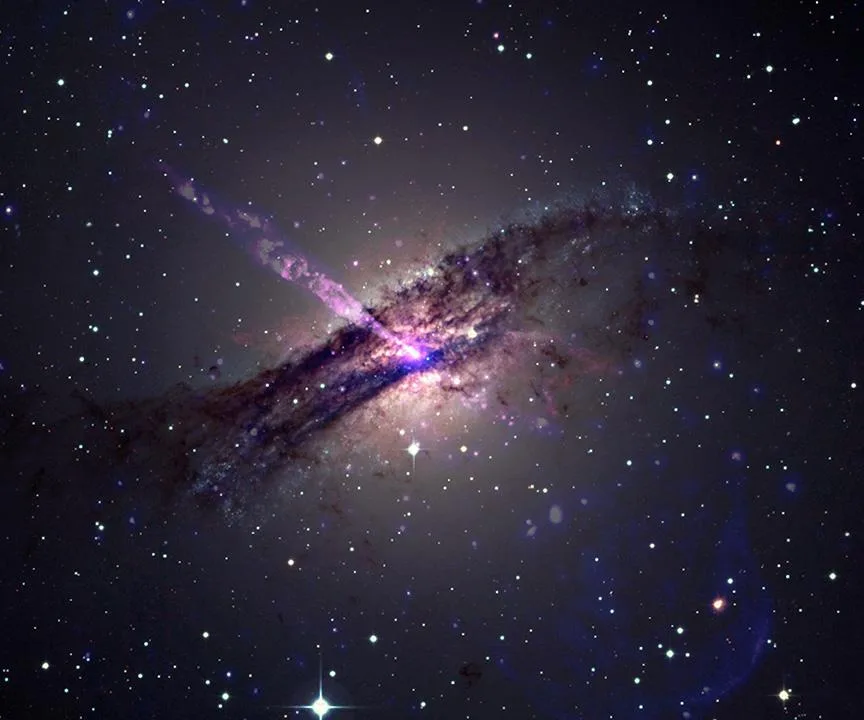
Jets associated with supermassive black holes can extend far past the visible edges of their galaxies. In some cases, they travel millions of light-years into intergalactic space. Their scale alone places them among the largest known features in the cosmos.
Nearby systems provide clear examples. The galaxy Centaurus A shows bright, energetic jets that stretch outward from its core. More distant systems reveal even larger structures, with beams that dwarf entire galaxies.
A Repeating Pattern Across the Universe
These jets are not limited to one type of object. They appear in:
- Active galactic nuclei
- Quasars in the early universe
- Smaller stellar systems on reduced scales
This consistency points to a shared physical process. Wherever dense matter gathers and rotates around a massive object, jets can emerge.
Why These Jets Stay So Focused
Unlike chaotic outflows, these beams remain tightly collimated. Magnetic fields guide the material into narrow paths. This allows them to maintain structure over vast distances.
The repeated appearance of these features suggests a universal mechanism at work—one that scales from young stars to the largest black holes.
⚙️ The Physics Behind Supermassive Black Hole Jets
The Process Begins Outside the Event Horizon
A common misconception persists. These jets do not originate from inside black holes. Instead, they form in the region just beyond the event horizon, where matter still interacts with its surroundings.
Accretion Disks Drive the System
Matter falling toward a black hole forms a rapidly spinning disk. Gas and dust move at extreme speeds. Frequent collisions heat the material to very high temperatures.
As energy increases, atoms lose electrons. The material becomes ionized, forming a plasma of charged particles.
Magnetic Fields Shape the Outflow
This charged environment generates strong magnetic fields. Rotation twists these fields into organized structures. The black hole’s spin can enhance this effect, creating a powerful electromagnetic system.
From Plasma to Relativistic Jets
Particles accelerate along magnetic field lines. They move outward at speeds close to light. This produces the narrow, high-energy beams observed across the universe.
One of the clearest examples comes from Messier 87. Its jet has been studied across multiple wavelengths, offering direct insight into how these systems operate.
A Conversion of Energy
Rather than emitting matter directly, black holes act as converters. Gravitational energy transforms into electromagnetic energy. This process powers the jets and sustains them over long periods.
🌠 Observational Evidence Across the Spectrum
Seeing Jets in Different Forms of Light
Astronomers rely on multiple wavelengths to study these systems. Each reveals a different layer of the process:
- Radio observations trace structure and length
- X-ray data highlights high-energy regions
- Gamma-ray signals reveal extreme particle interactions
Together, they form a complete picture of how these beams evolve.
Signs Within the Milky Way
Our galaxy also shows evidence of past activity. The central black hole, Sagittarius A*, produces occasional flares. These events hint at ongoing energetic processes near the core.
Large structures known as the Fermi bubbles extend above and below the galactic center. Their shape and energy suggest they formed from earlier outflows.
Jets in Motion
Recent observations have captured changes in jet structure over time. Some features move at a significant fraction of light speed. This confirms that these systems are dynamic rather than static.
Magnetic Precision at Work
Radio data reveals thin filaments near galactic centers. These features align with magnetic fields, showing how precisely they guide the outflow. The result is a highly organized structure rather than a random plume.
🌍 Galactic Impact of Relativistic Jets
Regulating Star Formation
Jets play a crucial role in controlling how galaxies evolve. They heat surrounding gas, making it harder for that gas to collapse into new stars. This slows star formation and prevents rapid overgrowth.
Maintaining Galactic Balance
Without this feedback, galaxies could form stars too quickly. Jets provide a stabilizing influence. They help maintain a balance between growth and energy output.
Transporting Energy Across Vast Distances
These beams carry energy far from the galactic core. Regions that would otherwise remain unaffected can experience significant changes. This redistribution of energy shapes the broader environment.
A Feedback Loop Between Core and Galaxy
A clear connection exists between black holes and their host galaxies. As matter feeds the central region, the resulting jets influence the galaxy’s structure. This feedback helps explain why black hole size often correlates with galactic properties.
Influence Beyond Individual Systems
Jets do not stop at the edge of a galaxy. They can extend into intergalactic space, affecting gas between galaxies. This suggests their role reaches far beyond their origin.
🔭 A Universal Mechanism Across the Cosmos
Found in Systems of All Sizes
Jets appear in a wide range of environments. They are not exclusive to supermassive black holes. Smaller black holes and even young stars can produce similar structures on reduced scales.
This pattern points to a scale-independent process. The same physics operates across very different conditions.
Key Questions Still Unanswered
Despite progress, several questions remain:
- Why do some systems produce jets while others do not?
- How strongly does spin influence jet power?
- What determines the exact structure of magnetic fields?
These questions continue to drive research in astrophysics.
Looking Ahead
Future observatories will provide sharper images and more detailed data. Improved measurements will refine existing models and test new ideas. Each discovery brings us closer to a complete understanding of these powerful systems.
🧾 Conclusion: Rethinking Black Holes and Cosmic Energy
Supermassive black holes are not just endpoints for matter. They are engines that reshape their surroundings. The jets they help generate transport energy across immense distances and influence the evolution of galaxies.
The key processes occur outside the event horizon. Accretion disks, magnetic fields, and charged particles combine to produce focused, high-energy beams. These systems reveal how extreme physics operates on the largest scales.
Understanding these jets offers more than insight into black holes. It provides a deeper view of how the universe organizes energy, structure, and growth over time.
🔗 Main Sources:
- https://bigthink.com/starts-with-a-bang/supermassive-black-holes-launch-powerful-jets/
- https://www.nasa.gov
- https://chandra.harvard.edu
- https://esa.int