
BY:SpaceEyeNews.
For decades, supermassive black holes have been known as some of the most extreme objects in the universe. They consume gas, dust, and even stars that wander too close. Their immense gravity shapes entire galaxies and influences cosmic evolution on a grand scale.
Yet a new study suggests a surprising possibility. Supermassive Black Holes Creating Billions of Planets may not be science fiction. Researchers now believe that the giant disks of gas and dust surrounding active black holes could become enormous planet-forming regions. If confirmed, these environments may produce more planets than any other known location in the universe.
The idea challenges one of astronomy’s oldest assumptions. Instead of acting only as cosmic consumers, supermassive black holes may also play a major role in creating new worlds.
Supermassive Black Holes Creating Billions of Planets Begins in Giant Cosmic Disks
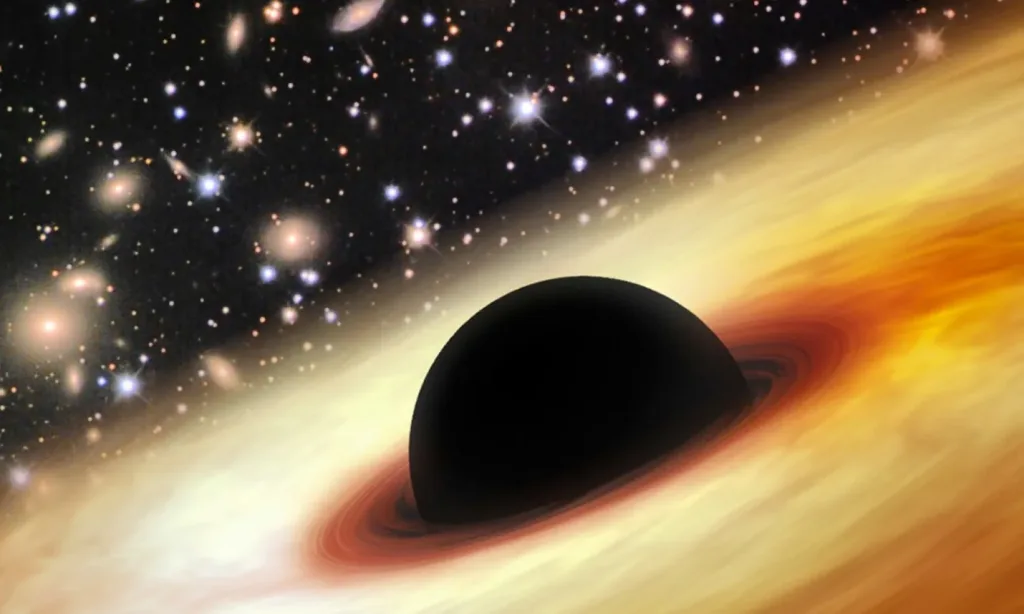
The centers of many galaxies contain active supermassive black holes. These objects sit inside vast structures made of gas and dust. Scientists call these environments active galactic nuclei, or AGN.
Most attention focuses on the inner regions near the black hole. Those areas contain intense radiation, powerful magnetic fields, and extremely high temperatures. Planet formation cannot easily occur there.
However, conditions change farther away from the center.
The Outer Regions Look Surprisingly Familiar
The outer regions of AGN disks are cooler. Dust grains can survive for long periods. Gas densities also remain high enough to support growth processes.
These conditions resemble what astronomers observe around young stars.
In traditional planetary systems, dust particles collide and stick together. Over time, they form larger structures. Eventually, those structures become planetesimals and planets.
Researchers realized that a similar process might occur inside the outer regions of AGN disks.
Earlier Research Opened the Door
The concept is not entirely new.
Several studies over the past decade proposed that planet formation could happen near active galactic nuclei. Scientists noticed similarities between stellar protoplanetary disks and the outer parts of AGN environments.
Still, many questions remained unanswered.
Could planets truly survive there?
Could they grow efficiently?
And how many planets could form in such extreme environments?
A new modeling effort attempted to answer those questions.
How Researchers Tested the Planet Formation Scenario
The latest study was led by astrophysicist Barry McKernan and his colleagues.
The team developed computer simulations based on conditions inside the outer regions of AGN dust tori. They incorporated information about gas density, temperature, dust growth, and material accretion.
Their goal was simple. They wanted to determine whether planets could form and grow under these unusual circumstances.
Building a Virtual AGN Environment
The researchers created a simplified but physically realistic model.
The simulation tracked how dust particles accumulated over time. It also measured how much surrounding material developing planets could capture from their environment.
Planet formation is a slow process. Therefore, the calculations examined evolution over millions of years.
The model focused on long-term growth rather than short-term changes.
The Results Were Surprising
The simulations produced a remarkable outcome.
Planet formation did not merely appear possible. It appeared highly efficient.
Dust particles survived long enough to combine into larger objects. Those objects continued collecting gas and dust from their surroundings.
As growth continued, increasingly massive planetary bodies emerged.
The findings suggest that active galactic nuclei could support sustained planet formation on enormous scales.
Why These Could Be the Largest Planet Nurseries in the Universe
The most important finding may not be that planets can form near black holes.
Instead, it may be the sheer size of the environment.
AGN Disks Are Vast Beyond Comparison
A typical protoplanetary disk around a young star extends across a relatively small region.
AGN structures operate on a completely different scale.
Some dust tori surrounding supermassive black holes stretch across several light-years. They contain enormous amounts of material.
That means they provide far more raw ingredients for planet formation than ordinary stellar systems.
A Potential Population of Billions
Because these regions are so large, researchers estimate that vast numbers of planets could emerge over cosmic timescales.
The study suggests that a single active galactic nucleus may produce huge populations of planetary bodies.
Across the universe, the total number could become staggering.
This possibility explains why the concept of Supermassive Black Holes Creating Billions of Planets has attracted so much attention among astronomers.
If observations support the theory, AGN environments may represent the largest planet nurseries ever identified.
Rethinking Planet Formation Across the Cosmos
Astronomers traditionally search for planets around stars.
Most confirmed exoplanets fit within that framework.
This new model expands the search dramatically.
It suggests that planet formation may be far more adaptable than previously believed.
Worlds could emerge in environments once considered completely unsuitable.
Giant Worlds and Exotic Objects May Also Exist
The study revealed another intriguing possibility.
Planets formed inside AGN environments may grow far larger than planets typically found around stars.
Rapid Growth in Dense Regions
The outer AGN disk contains abundant material.
Young planets moving through this environment can continuously gather gas and dust.
That process may allow them to gain mass much faster than planets in ordinary systems.
As a result, some worlds could exceed Jupiter in size.
Such planets would rank among the largest planetary objects ever predicted.
When a Planet Becomes a Star
Growth may not stop at planetary scales.
Some objects could accumulate enough material to trigger stellar processes.
If that happens, the line between planet and star becomes less clear.
Researchers suggest that certain AGN-born objects may eventually evolve into stars themselves.
This possibility highlights the extraordinary nature of these environments.
Exotic Objects Unlike Anything Known
The model also points toward unusual possibilities.
Some bodies may consist primarily of dust and accumulated material rather than familiar planetary structures.
Scientists currently know of no direct equivalent within our Solar System.
If discovered, these objects could represent entirely new categories of astronomical bodies.
Their existence would expand our understanding of how matter organizes itself throughout the universe.
The Biggest Challenge: Finding Evidence
Despite the excitement, the study remains theoretical.
No telescope has directly observed planets forming around a supermassive black hole.
That means observational confirmation remains essential.
Future Observations Will Be Critical
Astronomers hope to use advanced observatories to search for signatures of these hidden worlds.
The James Webb Space Telescope continues to reveal details about dusty cosmic environments. Future instruments may provide even greater sensitivity.
Researchers will look for evidence of dust concentrations, planetary growth patterns, and unusual structures inside AGN disks.
Each observation could help determine whether the model reflects reality.
A New Frontier in Astronomy
Even if only part of the theory proves correct, the implications would be profound.
Planet formation would no longer be limited to environments surrounding stars.
Instead, astronomers would need to consider active galactic nuclei as potential planetary ecosystems.
That shift would change how scientists estimate the number of planets across the cosmos.
It could also reshape future searches for planetary systems in distant galaxies.
Conclusion
The idea of Supermassive Black Holes Creating Billions of Planets may sound counterintuitive, but modern astronomy often advances through unexpected discoveries. The same structures long associated with destruction may also provide the conditions needed to build entirely new worlds.
According to the new model, the outer regions of active galactic nuclei contain the right ingredients for large-scale planet formation. Their immense size, abundant material, and long lifetimes could allow them to produce vast populations of planets across the universe.
Observations will ultimately decide whether the theory is correct. Yet if future evidence confirms these predictions, supermassive black holes may earn a surprising new title: the largest planet-forming engines in the cosmos.
Main Sources:
- Universe Magazine:
https://universemagazine.com/en/supermassive-black-holes-give-rise-to-billions-of-planets/ - NASA – Active Galactic Nuclei Overview:
https://science.nasa.gov/universe/black-holes/ - NASA Hubble / STScI AGN Resources:
https://hubblesite.org - Original Research Coverage (Phys.org):
https://phys.org/news/2026-05-supermassive-black-holes-universe-biggest.html - City University of New York (CUNY) Research Information:
https://www.cuny.edu