
BY:SpaceEyeNews.
Supernova Athena could soon appear again, giving astronomers a chance to study cosmic expansion through the timing of its light. Hubble is watching for that return while celebrating 200,000 orbits around Earth. The connection makes this milestone especially fitting. After more than 36 years, the telescope continues to investigate one of astronomy’s biggest questions: how fast is the universe expanding?
The expected appearance would bring another view of an event astronomers have already seen. Its arrival could reveal valuable information about the galaxy cluster between Athena and Earth.
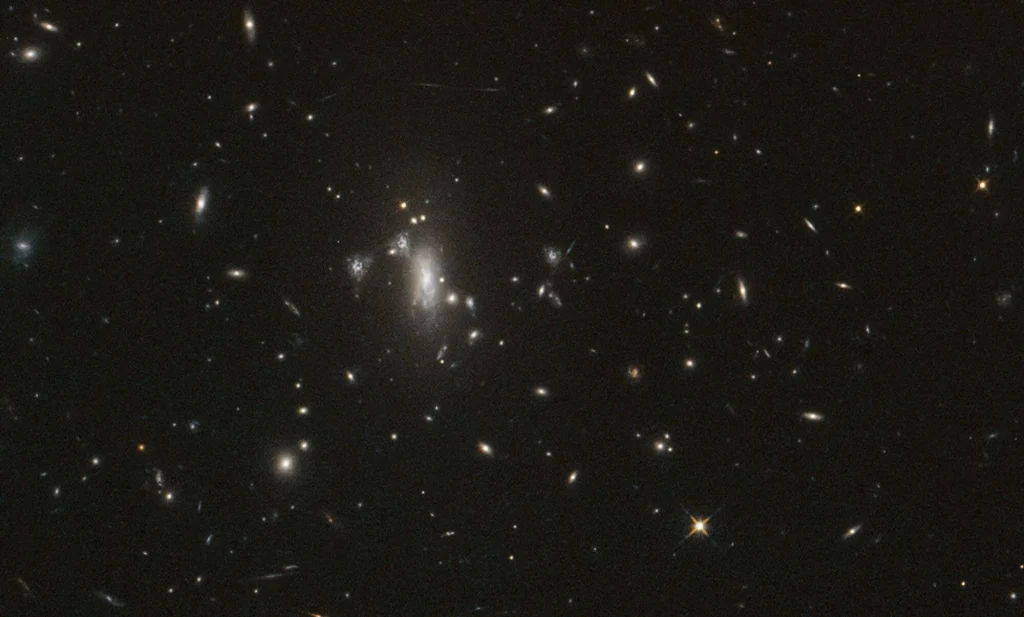
An image from NASA’s Hubble Space Telescope of galaxy cluster MACS J0417 is part of repeated observations to monitor for the reappearance of supernova Athena, which can help astronomers measure the expansion rate of the universe.
When Could Supernova Athena Reappear?
NASA’s James Webb Space Telescope discovered Athena in 2025. Now, researchers predict another appearance between September 2026 and early March 2027. NASA outlined that window in its September 23 mission update.
Hubble is repeatedly observing the region around MACS J0417, a massive foreground galaxy cluster. Its gravity redirects light from distant objects, including Athena, toward Earth along multiple routes.
That arrangement gives astronomers something unusual: an opportunity to anticipate a supernova’s next appearance. However, the prediction covers several months. It does not identify one guaranteed date.
The distinction matters when reading the latest news. NASA’s announcement describes an ongoing search, without confirming that Athena has already returned. Researchers also have yet to announce a new expansion-rate measurement from this monitoring.
For now, the scientific opportunity depends on catching the delayed image and measuring its timing.
Why Athena’s Light Can Arrive Again
The cluster’s gravitational lens changes how we see objects behind it. In Athena’s case, light from the same stellar event can follow different paths and reach us at different times.
Consequently, observers can see multiple appearances separated by months or years. The star does not need to repeat its original event. Instead, another portion of its light completes a different journey to Earth.
Hubble Has Seen This Before
A previous supernova, Refsdal, provides a useful comparison. Hubble spotted four images of it in November 2014. Another image appeared in December 2015 at a location astronomers had predicted.
That success showed how models of a gravitational lens can forecast a later appearance. Athena offers another opportunity to connect such predictions with observations.
The value extends beyond seeing an unusual image. Each arrival carries information about the lens that shaped the light’s journey.
What Supernova Athena Could Reveal About Expansion
The interval between appearances gives researchers a measurable quantity. Combined with a model of the foreground cluster, that timing can help them investigate cosmic expansion.
NASA identifies two connected goals for Athena: mapping the mass of MACS J0417 and refining our understanding of the universe’s expansion rate.
Those goals belong together because the cluster’s mass shapes its gravitational lens. Astronomers must understand that lens when interpreting the delayed light. Timing alone does not provide a complete answer.
Gravitational lensing also helps scientists investigate matter that telescopes cannot see directly. Much of a galaxy cluster’s lensing mass consists of dark matter. By studying distortions in background light, researchers can infer how that otherwise invisible matter spreads through the cluster.
A Fresh Clue to the Hubble Tension
The broader question concerns the Hubble constant, which describes the universe’s present expansion rate. Different approaches to estimating it produce results that do not fully agree.
Measurements involving stars and supernovae in the relatively nearby universe differ from estimates inferred from the early universe. Astronomers call this discrepancy the Hubble tension.
Athena could contribute useful evidence to that investigation. However, its predicted return does not guarantee a solution. Researchers first need observations, careful modeling, and an assessment of uncertainty.
The immediate promise is therefore specific: another way to study expansion while examining the foreground cluster’s mass distribution.
Hubble Reaches 200,000 Orbits Around Earth
Hubble completed its 200,000th orbit on September 19, 2026. Across its lifetime, it has traveled more than 5 billion miles around Earth and recorded over 1.7 million observations.
An observation on the milestone day formed part of the search for Athena. That links the anniversary directly to the telescope’s longstanding work on cosmic expansion.
These figures also highlight the value of continuity. A single image captures one moment. Repeated observations let researchers compare a region over time and identify changes.
For this project, that ability is central. Astronomers are watching a particular field for an anticipated change, making Hubble’s continuing observations part of the measurement process.
Why Hubble Still Matters Alongside Webb
Athena illustrates how different observatories can contribute to the same scientific question. Webb discovered the supernova. Hubble is now monitoring the region for its predicted reappearance.
Hubble’s ultraviolet and visible-light capabilities remain valuable alongside the capabilities of other space telescopes. Different wavelength coverage gives astronomers complementary ways to investigate celestial objects.
NASA also notes strong demand for Hubble’s schedule. Each year, astronomers request roughly seven times as much observing time as the telescope can provide.
That demand reflects its continuing scientific usefulness after more than three decades in space. Athena’s monitoring campaign offers a concrete example of that role.
The Importance of Returning to the Same Field
For a changing source, observing time involves more than obtaining one striking picture. Scientists need to revisit the target and compare what they see.
Here, those comparisons support the search for delayed light. The resulting observations could connect Athena’s appearance with a better understanding of MACS J0417.
Together, discovery and follow-up give the project its scientific direction.
Supernova Athena’s Next Appearance Could Bring a New Clue
Supernova Athena gives Hubble a compelling target as it passes a remarkable orbital milestone. Its delayed light could help researchers examine a massive galaxy cluster and refine studies of cosmic expansion.
The next step remains observational: watch the field, identify the expected image, and measure its timing. Any wider conclusions will depend on the evidence and the lens model.
After 200,000 orbits, Hubble is still looking for answers. In this case, an important clue may lie in exactly when distant light arrives.
Main sources:
- NASA: NASA’s Hubble Seeks Lensed Supernova, Marks 200,000 Orbits
- NASA: Hubble Gravitational Lenses
- NASA: Hubble Constant and Tension