
BY:SpaceEyeNews.
NASA’s Swift Observatory is nearing the end of its time in orbit, yet its scientific contribution remains vividly visible. A new collection of galaxy images highlights what the spacecraft helped astronomers uncover over more than two decades.
Released on October 8, 2026, the images combine Swift observations with data from Chandra and other telescopes. They arrive as NASA prepares for Swift’s expected atmospheric re-entry following an unsuccessful rescue mission.
The collection celebrates a remarkable partnership, while the spacecraft’s remaining time raises questions about what comes next.
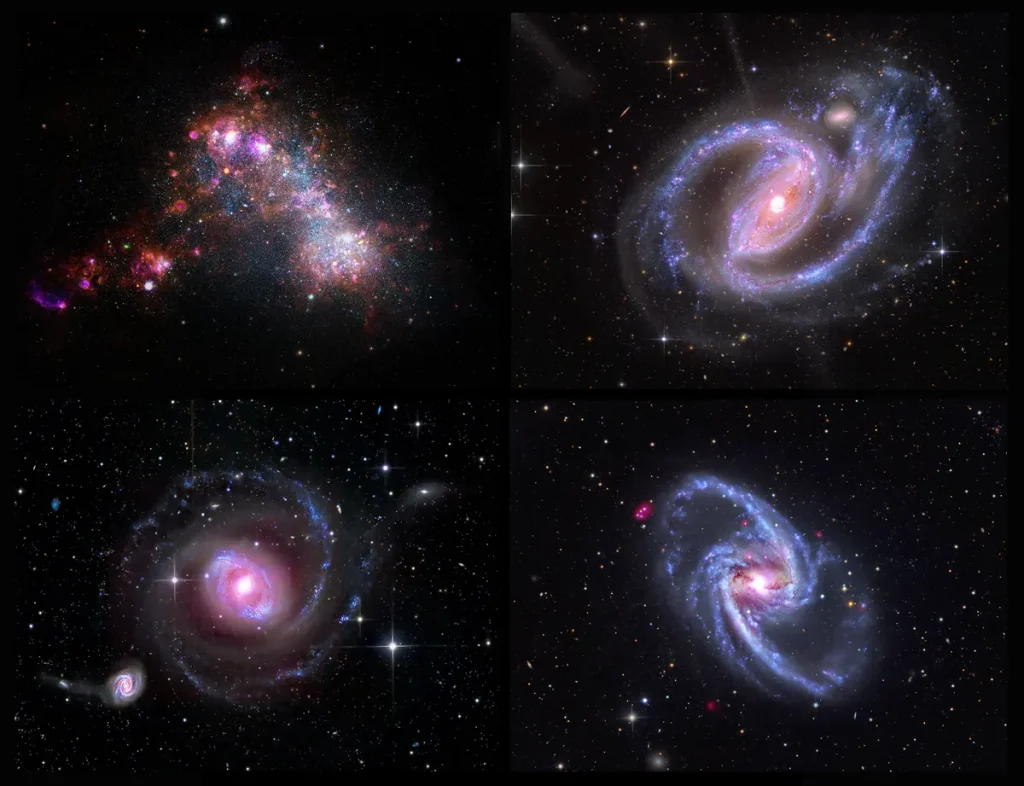
Swift Observatory and Chandra Reveal Four Stunning Galaxies.
Swift Observatory Images Reveal a Richer Universe
Four galaxies, multiple perspectives
The collection features the Small Magellanic Cloud, NGC 1097, NGC 4151, and NGC 1365. Each image brings together different kinds of light, revealing features that a single telescope cannot capture alone.
About 200,000 light-years away, the Small Magellanic Cloud offers a nearby view of stellar activity. Its composite image combines ultraviolet, X-ray, optical, and infrared observations.
Meanwhile, NGC 1097 contains a central black hole with roughly 140 million times the Sun’s mass. Material near that black hole reaches extreme temperatures and emits X-rays.
NGC 4151 and NGC 1365 also contain active central black holes. Their images highlight how observations across wavelengths help researchers examine these energetic environments.
Newly released does not mean newly captured
These are new composite presentations, rather than confirmed final photographs from Swift. Some contributing observations date back many years.
That distinction matters. The release showcases the observatories’ shared achievements, rather than documenting a single farewell observing session. Chandra’s detailed X-ray vision complements Swift’s ability to investigate rapidly changing sources. chandra.si.edu
Why Swift’s Orbit Is Shrinking
Swift’s greatest challenge now comes from its surroundings. Even hundreds of kilometers above Earth, a spacecraft encounters traces of atmospheric gas.
Those encounters create drag, gradually lowering its orbit. Increased solar activity worsens the problem by heating and expanding Earth’s upper atmosphere. Consequently, spacecraft can encounter more gas at their orbital altitude.
Swift lacks propulsion to lift itself back into a higher orbit. As its altitude decreases, maintaining a long operational future becomes increasingly difficult.
Buying time through careful pointing
Flight controllers adjusted the observatory’s orientation to reduce drag while teams prepared the rescue mission. However, they also needed to protect its instruments from unsuitable viewing directions.
The strategy required compromises between preserving altitude and conducting observations. It bought valuable time, but could not permanently solve the orbital problem. science.nasa.gov
Why the LINK Rescue Could Not Proceed
Katalyst Space’s LINK spacecraft offered a possible extension to Swift’s working life. The plan called for LINK to approach the observatory, capture it, and raise its orbit.
A successful boost would have reduced atmospheric drag and allowed more time for science. However, LINK developed communications difficulties and problems controlling its orientation.
NASA and Katalyst subsequently dropped the planned capture and boost. Therefore, describing the outcome as a failed physical capture would misrepresent what happened. The spacecraft never completed that stage of the rescue.
Technology demonstrations continued
Instead, the teams redirected LINK toward testing spacecraft servicing capabilities. Those activities included exercising its propulsion system and robotic arms.
NASA formally ended its involvement on September 3. LINK later re-entered Earth’s atmosphere on September 25, 2026.
The mission provided experience for future servicing efforts, although it delivered no orbital lift for Swift. For the observatory, that left atmospheric drag as the deciding factor in its remaining lifetime. science.nasa.gov
When Will the Swift Observatory Re-enter?
NASA’s late-September assessment anticipated Swift’s re-entry before the end of 2026. However, the official update did not establish a fixed November date. science.nasa.gov
An exact countdown remains difficult because atmospheric conditions change. Solar activity and spacecraft orientation can also influence how quickly an orbit declines.
As Swift reaches denser air, heating and aerodynamic forces will eventually end its operation. The spacecraft has no design provision for an intact return.
Still, predicting whether particular components could reach the surface requires a specific technical assessment. The cited NASA update does not provide that information.
For now, a forecast window offers a more accurate description than a precise date or location.
Swift’s Return to Science
Despite the shrinking orbit, Swift resumed observations in late August. On September 25, NASA announced the restoration of its third science instrument and automatic repointing.
That update matters because rapid response sits at the heart of Swift’s scientific role. The observatory can turn toward newly detected high-energy flashes and investigate their changing emission.
Its instruments work together across gamma-ray, X-ray, ultraviolet, and optical observations. This approach helps astronomers follow events whose appearance changes quickly.
However, NASA also expected science observations to stop near an altitude of 300 kilometers. Its September forecast placed that threshold in early to mid-October. The return to observing therefore represented a limited opportunity, rather than a guarantee of operations until re-entry. NASA Science
More than two decades of discoveries
Since its November 2004 launch, Swift has helped researchers study gamma-ray bursts and their fading afterglows. Its broader work also includes black holes, supernovae, comets, and active galaxies.
The mission’s value extends beyond individual discoveries. Swift’s observations frequently complement measurements from other instruments, allowing researchers to compare different aspects of the same source.
For example, a bright galactic center can look very different in ultraviolet light and X-rays. Combining those views helps scientists connect the structures they see with the physical processes producing the radiation.
The new galaxy collection makes that collaborative approach visible. Each composite brings separate observations together into a richer scientific picture.
Swift Observatory Leaves a Lasting Scientific Record
Swift’s approaching re-entry will close an exceptional chapter in space astronomy. Yet the measurements it gathered will remain valuable after the spacecraft stops operating.
Researchers can revisit those observations, compare them with future findings, and ask questions that earlier studies never considered.
The Swift Observatory image collection captures that enduring value. Its colorful galaxies celebrate years of shared investigation, while the mission’s final phase demonstrates how much useful science can outlast a spacecraft’s physical lifetime.
Main sources:
- NASA Chandra X-ray Observatory: Celebrating NASA’s Chandra and Swift Exploring Space Together — October 8, 2026.
- NASA: NASA Highlights Lessons Learned From Swift Boost Mission — September 28, 2026.
- NASA: NASA’s Swift Powers On Third Instrument, Restarts Automated Slewing — September 25, 2026.