BY:SpaceEyeNews.
A spacecraft launched to save NASA’s Neil Gehrels Swift Observatory has developed a major problem of its own. The Swift rescue spacecraft, called LINK, is spinning in low Earth orbit after failures affected its attitude-control system. Communication with the ground has also become sporadic.
NASA says two of LINK’s three reaction wheels are currently not operable. The spacecraft has also lost some functionality in its cold-gas thruster system. Engineers are now trying to stop the spin with LINK’s electric propulsion thrusters.
Only then can they decide whether the spacecraft can safely continue toward Swift. The unexpected setback has changed the mission’s immediate goal. Before LINK can rescue Swift, controllers must first recover stable control of LINK itself.
Why the Swift Rescue Spacecraft Was Needed
NASA launched Swift in 2004, but the observatory lacks a propulsion system capable of raising its own orbit.
Atmospheric drag has gradually pulled Swift closer to Earth. The decline became more serious after strong solar activity expanded the planet’s upper atmosphere. That expansion increased the resistance acting on spacecraft in low Earth orbit.
By January 2025, most NASA models indicated that Swift could re-enter the atmosphere by summer 2026. The agency then began looking for a commercial solution. In September 2025, NASA awarded Katalyst Space a $30 million contract to attempt an orbit boost.
NASA also changed Swift’s operations to slow the descent. Controllers began selecting pointing directions that reduced drag. In February 2026, observations with the X-ray and ultraviolet/optical telescopes stopped. The team paused Burst Alert Telescope observations in April.
Those changes helped keep Swift above 185 miles, or 300 kilometers, where an orbit boost becomes harder. Swift’s instruments had not failed. NASA limited science operations to preserve altitude and give LINK more time to complete the rescue attempt.
How LINK Was Designed to Rescue Swift
Katalyst built LINK in less than a year. The spacecraft stands about 6 feet tall and weighs roughly 880 pounds. It carries three robotic arms, three xenon-fueled thrusters and two large solar arrays.
After orbital testing, LINK would travel toward Swift and photograph it. Engineers would then study the images and confirm safe capture points.
Following a slow approach, LINK would attach its robotic arms to Swift. Its xenon thrusters would gradually push the combined spacecraft into a higher orbit. NASA expected that lifting process to take several months.
LINK would later detach, allowing NASA to restart Swift’s instruments. Returning the observatory to full science operations could take another month or longer.
Swift lacks a docking port or standard servicing interface. LINK therefore needs precise control to capture an “unprepared” spacecraft. Any instability in orientation, navigation or communication could complicate that delicate operation.
A Successful Launch Followed by Warning Signs
LINK launched on July 3, 2026, aboard Northrop Grumman’s Pegasus XL rocket. The rocket was released from the modified L-1011 aircraft Stargazer about 40,000 feet above Kwajalein Atoll in the Marshall Islands.
Initial operations appeared successful. Controllers established communication, deployed the solar arrays and began checking the power, avionics and propulsion systems.
However, early tests revealed communication and attitude-control anomalies. One issue involved a reaction wheel. Katalyst responded with flight-software patches and operational changes.
By July 15, NASA and Katalyst reported that reliable communication and three-axis control had returned. LINK had also fired its xenon thrusters during propulsion checks. At that stage, the mission seemed to be progressing through commissioning.
The situation later worsened. NASA reported on July 28 that attitude-control issues had caused LINK to spin. Communication became intermittent as the spacecraft rotated.
A preliminary investigation found two reaction wheels inoperable and reduced functionality in the cold-gas system. Other major subsystems still worked. LINK also remained power positive and in contact with Katalyst.
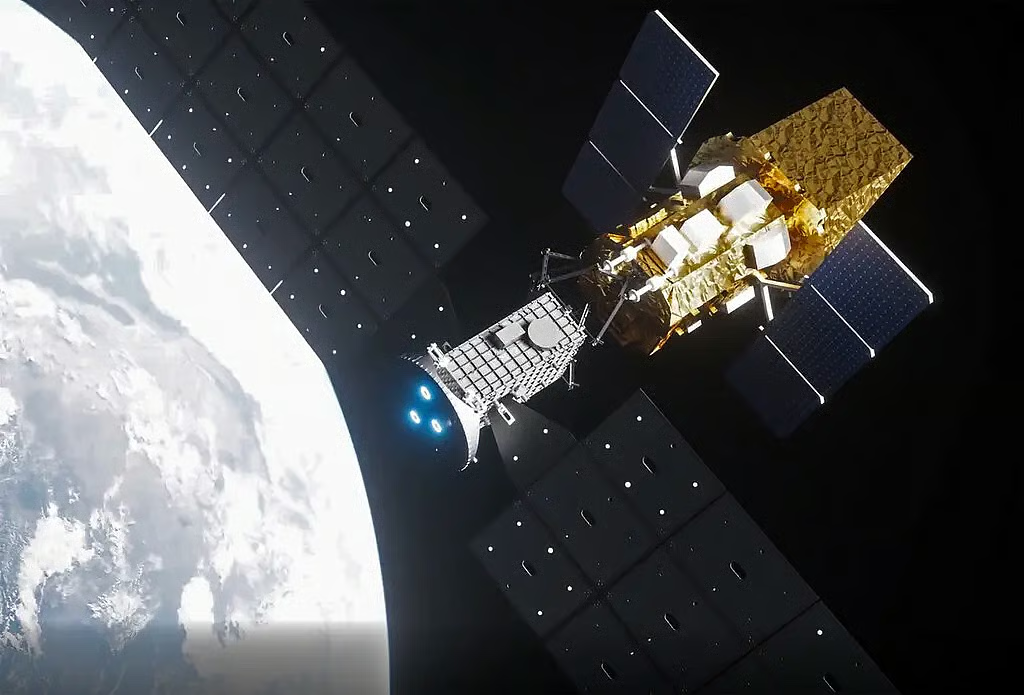
Cosmic Rescue: NASA scrambles to save a falling space telescope
Reaction Wheels, Not Gyroscopes
Some reports described the failed components as gyroscopes. NASA’s official update identifies them as reaction wheels.
The distinction matters. Sensors determine a spacecraft’s orientation, while reaction wheels turn the vehicle or hold its pointing direction.
Reaction wheels contain rotating masses that create controlled torque. By changing a wheel’s speed, engineers can rotate a spacecraft without continuously firing thrusters.
When two of three reaction wheels become unavailable, normal three-axis control becomes much harder. The weakened cold-gas system adds another complication because those thrusters also support attitude control.
However, NASA has not called the components permanently lost. Its July 28 statement describes them as “currently not operable.” Engineers may still find a software workaround using the remaining hardware.
This wording is important. The investigation remains preliminary, and the final cause of the problems has not yet been announced.
Can Engineers Recover the Swift Rescue Spacecraft?
Katalyst’s immediate task is to stop LINK’s rotation. NASA says the team plans to use the spacecraft’s electric propulsion thrusters for that effort.
After stabilization, engineers will examine LINK’s condition in greater detail. They also plan to modify its guidance, navigation and control software. The new configuration must account for the unavailable reaction wheels and reduced cold-gas capability.
Restoring control would not automatically clear LINK to approach Swift. Close operations require dependable pointing, navigation and communication.
Controllers must prove that LINK can hold a stable orientation and respond predictably. They must also confirm that its remaining systems provide enough control for a safe rendezvous.
NASA and Katalyst will therefore review a revised approach and capture plan. Their decision will depend on LINK’s health and the safety of operating near Swift.
For now, the mission has not been declared lost. LINK still has electrical power, communication and functioning major subsystems. Yet the original schedule will likely change while recovery work continues.
Why the LINK Setback Matters
The Swift rescue spacecraft represents more than an attempt to preserve one observatory. It could demonstrate how commercial robotic vehicles may extend the lives of older satellites that lack docking hardware.
Katalyst has described the operation as an attempt to conduct the first commercial capture of an unprepared government spacecraft. A successful mission could support future satellite servicing, relocation and life-extension projects.
Either outcome could also offer lessons about redundancy, autonomous control and spacecraft capture. Future servicing vehicles may require more backup options for pointing, propulsion and navigation.
For Swift, however, time remains important. NASA has already limited science operations to reduce drag and preserve altitude. The longer LINK remains in recovery mode, the less margin the mission may have.
Swift Rescue Spacecraft Mission Remains Uncertain
The Swift rescue spacecraft reached orbit with an ambitious goal: capture a declining NASA observatory and move it to a safer altitude. Instead, LINK is now spinning after attitude-control failures affected two reaction wheels and part of its cold-gas system.
Engineers are working to restore stable control and redesign how LINK operates. If they succeed, the mission could still continue toward Swift.
If they cannot prove that a close approach is safe, NASA may need to reconsider the rescue plan. The next official updates will reveal whether LINK can recover and complete one of the most unusual servicing missions attempted in low Earth orbit.
Main Sources:
NASA — Commissioning Update for Spacecraft to Boost NASA’s Swift:
https://science.nasa.gov/blogs/swift/2026/07/28/commissioning-update-for-spacecraft-to-boost-nasas-swift/
NASA — Spacecraft Commissioning On Track for Mission to Boost NASA’s Swift:
https://science.nasa.gov/blogs/swift/2026/07/15/spacecraft-commissioning-on-track-for-mission-to-boost-nasas-swift/
NASA — What to Expect: Commercial Mission to Boost NASA’s Swift:
https://science.nasa.gov/blogs/swift/2026/06/29/what-to-expect-commercial-mission-to-boost-nasas-swift/
NASA — Swift Boost Mission Timeline:
https://science.nasa.gov/mission/swift/swift-boost-mission/timeline/
Katalyst Space — LINK Advances Through On-Orbit Commissioning:
https://www.katalystspace.com/news/katalysts-link-advances-through-on-orbit-commissioning