BY:SpaceEyeNews.
A newly identified signal may have brought astronomers closer to understanding one of the sky’s longest-running puzzles. Researchers examining NASA TESS observations found a symmetrical dip in KIC 8462852, better known as Tabby’s Star. Unlike the star’s famous irregular fading events, this signal resembles a transit by one large object.
The possible Tabby’s Star hidden companion could be a giant planet or brown dwarf. Its gravity may disturb comets and planetesimals, sending dusty material across our line of sight. However, the object remains a candidate. Scientists need more observations before calling the mystery solved.
The New TESS Signal Looks Different
NASA’s Kepler mission recorded dramatic changes in the brightness of Tabby’s Star. Some dips reached about 20 percent. They appeared at irregular intervals and had different shapes and depths.
Those features made an ordinary planetary transit unlikely. A planet usually creates a repeated and broadly symmetrical pattern. Uneven dust clouds, however, can produce complex dips that change from one event to another.
Researchers have now identified a different event in TESS data collected in 2019. The dip reduced the star’s brightness by slightly more than 1 percent. It lasted about 21 hours and formed a smooth, largely symmetrical light curve.
That shape stands apart from the chaotic events seen by Kepler. Instead, it fits the profile expected when a relatively compact body crosses the star.
The team tested exocomet structures and other alternatives. Those models produced weaker fits or required unrealistic conditions.
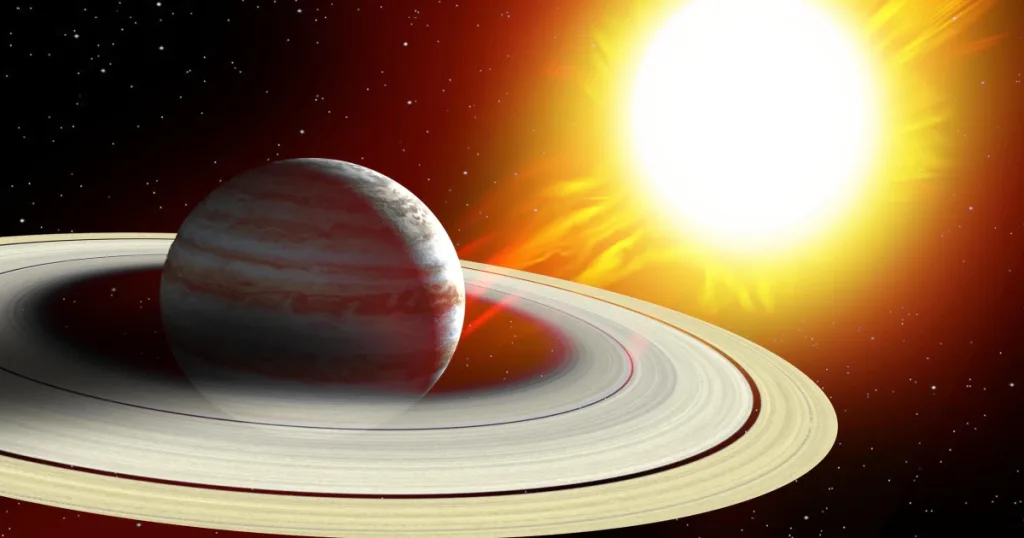
Has Tabby’s Star Mystery Finally Been Solved?
Tabby’s Star Hidden Companion Could Be Enormous
The transit model suggests an object with a radius of about 1.7 times Jupiter’s radius. Radial-velocity measurements also provide a tentative mass estimate of 9.4 Jupiter masses. The uncertainty extends from about 5.3 to 14.3 Jupiter masses.
Some coverage describes the object as weighing 14 Jupiters. However, 14.3 Jupiter masses marks the upper side of the study’s uncertainty range, not a fixed measurement.
A three-sigma calculation places the upper mass limit below 28 Jupiter masses. The candidate may therefore sit in the overlapping region between a massive gas giant and a brown dwarf.
Astronomers estimate that its orbital period must be at least around 1,030 days. Only one clear transit-like event appears in the TESS observations. Kepler and other surveys did not capture matching events at many possible periods.
The researchers narrowed the orbit to five possible period windows, although the exact orbit remains unknown.
A long period may explain why the object escaped earlier detection. A companion that takes years to complete one orbit offers very few transit opportunities.
How a Massive Companion Could Create the Dips
The candidate does not directly explain every strange fading event. Its symmetrical TESS transit differs sharply from the dusty, asymmetrical dips that made Tabby’s Star famous.
Instead, the Tabby’s Star hidden companion may provide the gravitational mechanism behind them. A massive planet or brown dwarf can reshape the paths of smaller bodies. Over time, it may disturb comets, asteroids or planetesimals in distant parts of the system.
Some objects could then move inward, fragment or release dust. When those uneven clouds cross our line of sight, they would block different amounts of light. Their changing size and density could produce dips with varying depths and shapes.
This idea strengthens an explanation that astronomers have considered for years. Multiwavelength observations show that Tabby’s Star dims more strongly at shorter wavelengths. Large solid objects would block wavelengths more evenly. Fine dust creates a stronger color-dependent effect.
Dust Explained the Fading, but Not Its Origin
NASA observations using the Spitzer and Swift missions supported dust as the cause of the long-term fading. Yet dust alone left one major question unanswered: what repeatedly sends so much material into view?
A large companion could fill that gap. Its gravity may redirect comet-like objects or destabilize a belt of smaller bodies. The resulting debris could create the irregular dimming without requiring one permanent structure around the star.
Why the Evidence Remains Tentative
Astronomers have not confirmed the companion. The radial-velocity signal reaches only 2.3 sigma. Researchers normally require much stronger evidence before announcing a secure discovery.
The data suggest a companion, but noise or stellar activity could still influence the result.
The single transit also limits the analysis. A second symmetrical event would reveal the orbital period more clearly. It would also test whether the depth and duration remain consistent.
Scientists must also demonstrate the connection with the dusty dips. Even if the companion exists, its orbit must allow it to disturb smaller bodies effectively. That link currently rests on dynamical reasoning, not direct observation.
Tabby’s Star also has a known distant red dwarf companion. However, it lies about 885 astronomical units away in projected separation. That star cannot produce the short TESS transit-like event.
What Astronomers Need to Observe Next
Continued radial-velocity monitoring could show whether Tabby’s Star moves in response to an orbiting giant object. More photometric observations may also capture another transit during one of the remaining orbital windows.
A repeat event with a similar shape would strengthen the hypothesis and help identify the object.
Future Gaia measurements could offer another test. Gaia Data Release 4 may reveal a small change in the star’s position caused by the companion’s gravitational pull. That astrometric signal could clarify its mass and orbit.
Researchers could then model whether the object redirects enough cometary material to reproduce the historic dimming.
Conclusion
The possible Tabby’s Star hidden companion offers a promising way to connect the system’s unusual clues. TESS recorded a smooth 1 percent dip that may come from a giant planet or brown dwarf. Its gravity could disturb smaller bodies and generate the dust clouds behind the deeper, irregular fading.
Still, the evidence remains preliminary. Astronomers need stronger radial-velocity data, another transit and future Gaia measurements. The mystery remains open, but researchers may finally have identified the object that keeps this distant system so unpredictable.
Main Sources:
Monthly Notices of the Royal Astronomical Society — Evidence for a Giant Companion Orbiting Tabby’s Star:
https://academic.oup.com/mnras/article/550/3/stag1273/8725767
Preprint of the scientific study:
https://arxiv.org/abs/2607.20643
NASA Science — Tabby’s Star Illustration and Dust Evidence:
https://science.nasa.gov/photojournal/tabbys-star-illustration/
NASA Jet Propulsion Laboratory — Mysterious Dimming of Tabby’s Star May Be Caused by Dust:
https://www.jpl.nasa.gov/news/mysterious-dimming-of-tabbys-star-may-be-caused-by-dust/
Original reference shared for the topic:
https://universemagazine.com/en/scientists-find-key-to-explaining-the-mysterious-tabbys-star/