BY:SpaceEyeNews.
For decades, astronomers believed Terzan 5 was a typical globular star cluster orbiting deep inside the Milky Way. New observations from NASA’s James Webb Space Telescope and Hubble Space Telescope have now changed that picture dramatically. Researchers have discovered that the Terzan 5 Milky Way fossil is not an ordinary cluster at all. Instead, it appears to be one of the oldest surviving building blocks of our galaxy.
The discovery offers a rare look into the Milky Way’s earliest history. It also provides new evidence for how the galaxy’s central bulge formed more than 12 billion years ago. By combining Webb’s infrared observations with Hubble’s long-term measurements, scientists uncovered a complex stellar system that preserved its identity while much of the young Milky Way evolved around it.
Why the Terzan 5 Milky Way Fossil Stands Out
Astronomers first discovered Terzan 5 in 1968. For many years, it looked like a globular cluster. These systems usually contain stars that formed during a single ancient burst of star formation.
That assumption began to change in 2009.
Researchers found evidence that Terzan 5 contained two distinct groups of stars. This was unusual because globular clusters generally host stars with similar ages and chemical compositions. The discovery suggested that Terzan 5 had experienced a far more complicated history.
Questions remained. Scientists needed better data to understand what really happened inside this crowded stellar system.
Looking Through the Dust
The challenge came from Terzan 5’s location.
The object lies within the dense central region of the Milky Way. Dust clouds fill this area and block much of the visible light coming from distant stars.
This is where Webb became essential.
Its infrared instruments can penetrate dust far more effectively than visible-light telescopes. As a result, astronomers identified many faint stars that previous observations could not detect.
Meanwhile, Hubble supplied another critical piece of the puzzle.
Researchers used observations separated by 12 years to measure tiny stellar motions. These measurements helped them determine which stars truly belong to Terzan 5 and which belong to the surrounding Milky Way bulge.
Together, the two observatories produced the clearest view of the system ever obtained.
Four Generations of Stars Rewrite the Story
The biggest surprise emerged when scientists analyzed the ages of the stars.
Instead of finding one or two generations, they identified evidence for four distinct stellar populations.
The Oldest Population
The first generation formed approximately 12.5 billion years ago.
That period coincides with the earliest stages of Milky Way assembly. These stars date back to a time when the galaxy itself was still taking shape.
The Second Generation
Researchers found another stellar population that formed roughly 4.7 billion years ago.
This age is remarkable because it falls long after the formation of the oldest stars.
A typical globular cluster would not experience such a large gap between star-forming episodes.
Two More Surprises
Webb observations revealed two additional populations.
One formed around 3.8 billion years ago.
The youngest group formed approximately 2.5 billion years ago.
The presence of four separate generations completely changes the understanding of Terzan 5.
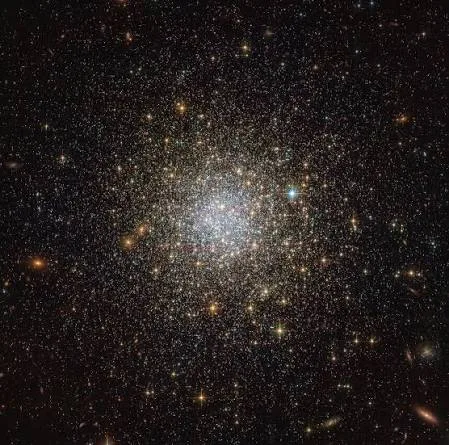
Close-up: Terzan 5—A Milky Way Bulge Fossil Fragment | Webb & Hubble Telescopes FriendsofNASA.org: New observations from the James Webb Space Telescope combined with multiple observations from the Hubble Space Telescope demonstrate.
Why the Terzan 5 Milky Way Fossil Stands Out
Astronomers first discovered Terzan 5 in 1968. For many years, it looked like a globular cluster. These systems usually contain stars that formed during a single ancient burst of star formation.
That assumption began to change in 2009.
Researchers found evidence that Terzan 5 contained two distinct groups of stars. This was unusual because globular clusters generally host stars with similar ages and chemical compositions. The discovery suggested that Terzan 5 had experienced a far more complicated history.
Questions remained. Scientists needed better data to understand what really happened inside this crowded stellar system.
Looking Through the Dust
The challenge came from Terzan 5’s location.
The object lies within the dense central region of the Milky Way. Dust clouds fill this area and block much of the visible light coming from distant stars.
This is where Webb became essential.
Its infrared instruments can penetrate dust far more effectively than visible-light telescopes. As a result, astronomers identified many faint stars that previous observations could not detect.
Meanwhile, Hubble supplied another critical piece of the puzzle.
Researchers used observations separated by 12 years to measure tiny stellar motions. These measurements helped them determine which stars truly belong to Terzan 5 and which belong to the surrounding Milky Way bulge.
Together, the two observatories produced the clearest view of the system ever obtained.
Four Generations of Stars Rewrite the Story
The biggest surprise emerged when scientists analyzed the ages of the stars.
Instead of finding one or two generations, they identified evidence for four distinct stellar populations.
The Oldest Population
The first generation formed approximately 12.5 billion years ago.
That period coincides with the earliest stages of Milky Way assembly. These stars date back to a time when the galaxy itself was still taking shape.
The Second Generation
Researchers found another stellar population that formed roughly 4.7 billion years ago.
This age is remarkable because it falls long after the formation of the oldest stars.
A typical globular cluster would not experience such a large gap between star-forming episodes.
Two More Surprises
Webb observations revealed two additional populations.
One formed around 3.8 billion years ago.
The youngest group formed approximately 2.5 billion years ago.
The presence of four separate generations completely changes the understanding of Terzan 5.
Why Multiple Generations Matter
Star formation requires gas and dust.
In most small stellar systems, powerful supernova explosions push these materials away. Once that happens, new stars cannot form.
Terzan 5 followed a different path.
Its original structure appears to have been massive enough to retain the material expelled by dying stars. Heavy elements remained trapped within the system and later contributed to new rounds of star formation.
This process continued for billions of years.
As a result, Terzan 5 became a self-enriching stellar environment rather than a simple star cluster.
The Chemical Evidence Behind the Discovery
The age measurements tell only part of the story.
Researchers also examined the chemical composition of stars within Terzan 5.
Observations from the W. M. Keck Observatory and the European Southern Observatory’s Very Large Telescope revealed significant differences among the stellar populations.
A Record Written in Heavy Elements
When massive stars reach the end of their lives, they create heavier elements.
These elements spread into the surrounding environment and become part of future generations of stars.
Terzan 5 preserves this history.
Each stellar population contains different chemical signatures. These signatures reveal a steady process of enrichment over billions of years.
Scientists can essentially read the object’s evolutionary history by studying these chemical patterns.
That makes the Terzan 5 Milky Way fossil one of the most valuable stellar archives in our galaxy.
Ruling Out Earlier Explanations
Previously, some astronomers suggested that Terzan 5 may have interacted with another cluster or a giant molecular cloud.
Such an encounter could have introduced fresh gas and triggered a second period of star formation.
The new results make that explanation much less likely.
Four separate stellar populations point toward a long internal evolutionary process rather than a single external event.
The evidence strongly supports the idea that Terzan 5 evolved largely on its own.
Terzan 5 Milky Way Fossil May Be a Galactic Building Block
The new findings led researchers to a striking conclusion.
Terzan 5 may be the surviving remnant of a much larger stellar system that formed during the birth of the Milky Way.
What Is a Bulge Fossil Fragment?
Astronomers now classify Terzan 5 as a bulge fossil fragment.
This term describes an ancient stellar structure that contributed to the formation of the Milky Way’s central bulge.
The bulge is the dense concentration of stars located at the galaxy’s center.
Modern models suggest that the young Milky Way contained giant gas-rich clumps. These clumps formed stars and gradually migrated inward.
Many merged together.
Over time, they created the bulge that dominates the central region of our galaxy today.
Terzan 5 appears to be one of the rare clumps that survived this process.
A Survivor From the Early Milky Way
Most ancient building blocks lost their identities long ago.
They mixed together as the galaxy evolved.
Terzan 5 did not.
For reasons scientists still investigate, it remained intact while preserving evidence of its original structure.
This survival makes the system extraordinarily valuable.
Instead of relying only on theoretical models, researchers can study an actual relic from the Milky Way’s formative era.
What This Means for Galaxy Formation
The implications extend beyond our own galaxy.
Webb has already observed numerous young galaxies in the distant universe. Many contain large star-forming clumps similar to those predicted by galaxy formation models.
Connecting the Early Universe to Today
Astronomers believe these clumps played a major role in building galactic bulges.
Until recently, direct evidence remained limited.
Terzan 5 may provide that missing link.
Its structure closely resembles the kinds of primordial fragments that researchers expect to find in young galaxies.
By studying this nearby object, astronomers gain a clearer understanding of processes that occurred throughout the universe billions of years ago.
Searching for More Fossil Fragments
Terzan 5 may not be unique.
Another object known as Liller 1 has already received a similar reclassification.
Researchers now plan to examine dozens of additional clusters located within the Milky Way bulge.
Some estimates suggest that 40 to 50 candidates deserve further study.
Future observations could reveal that several ancient fossil fragments still exist inside our galaxy.
If so, astronomers may uncover an entire population of long-hidden relics from the Milky Way’s earliest era.
Conclusion
The Terzan 5 Milky Way fossil has transformed from a seemingly ordinary globular cluster into one of the most important stellar relics known today.
Observations from Webb and Hubble revealed four generations of stars spanning roughly 10 billion years of cosmic history. The system retained gas, enriched itself with heavy elements, and continued forming stars long after most clusters would have stopped.
These findings suggest that Terzan 5 is not simply a cluster. It is likely one of the original building blocks that helped create the Milky Way’s central bulge.
More importantly, it offers a rare opportunity to study a surviving fragment of our galaxy’s birth. As astronomers search for additional fossil fragments, Terzan 5 may become the first member of an entirely new class of objects that reshapes our understanding of how galaxies form and evolve.
Main Sources:
NASA Article:
https://science.nasa.gov/missions/webb/nasa-webb-hubble-reveal-history-of-relic-of-milky-ways-formation/
Space Telescope Science Institute (STScI):
https://www.stsci.edu/contents/news-releases/2026/news-2026-123
Astronomy & Astrophysics Research Publication:
https://www.aanda.org
NASA Webb Space Telescope:
https://science.nasa.gov/webb
NASA Hubble Space Telescope:
https://science.nasa.gov/hubble