BY:SpaceEyeNews.
Introduction: A Discovery Hidden in Plain Sight
The TESS 10,000 planets discovery is reshaping how we explore the universe. Scientists revisited archived data from Transiting Exoplanet Survey Satellite expecting small updates. Instead, they uncovered more than 11,000 candidate planets in a single sweep.
No new mission launched. No new telescope entered orbit. The breakthrough came from smarter analysis. That shift makes this discovery stand out. It suggests the universe still hides answers inside data we already collected.
If thousands of worlds remained unseen for years, the bigger question becomes unavoidable. How many more are still waiting to be found?
TESS 10,000 Planets Discovery Unlocks Hidden Data
Revisiting Data with Smarter Tools
Researchers reanalyzed TESS’s early observations using improved techniques. They combined multiple measurements instead of studying them in isolation. This approach revealed weaker signals that earlier methods missed.
The result was striking. Scientists identified 11,554 planet candidates, including over 10,000 new detections. This marks the largest extraction of exoplanet candidates from a single dataset.
The data did not change. The tools did. That difference explains why the TESS 10,000 planets discovery matters far beyond its headline number.
Why These Worlds Stayed Hidden
Earlier searches focused on strong, repeatable signals. Faint signals often blended into background noise. That limitation reduced the telescope’s effective reach.
Now, refined algorithms filter noise and strengthen subtle patterns. They also combine light signals across multiple observations. This method increases detection sensitivity without requiring new hardware.
As a result, archived data has become a new frontier. Discoveries once thought impossible now emerge from information already collected.
TESS 10,000 Planets Discovery Expands the Galactic Map
Pushing Deeper into the Milky Way
The newly identified candidates extend up to 6,800 light-years into the Milky Way. This distance nearly doubles the telescope’s previous effective range.
Such expansion changes how scientists map planetary systems. It adds depth to our understanding of how planets distribute across the galaxy.
Exploration no longer focuses only on nearby stars. Instead, it reaches deeper into dense stellar regions that were harder to study before.
From Discovery to Population Science
Astronomy is entering a new phase. Early research focused on finding individual planets. Today, large datasets allow scientists to compare thousands of systems at once.
This shift matters. With a broader sample, researchers can study patterns across planetary systems. They can examine how planet size, orbit, and host star type interact.
The TESS 10,000 planets discovery supports this transition. It enables scientists to move from isolated findings to large-scale analysis.
A Growing Planetary Census
Confirmed exoplanets already number in the thousands. This discovery adds a vast pool of candidates awaiting verification.
Even if only a portion proves real, the total count will rise significantly. That trend reinforces one conclusion. Planets are common across the galaxy.
For more on how exoplanet discoveries evolved over time, explore our deep dive on planetary detection methods on SpaceEyeNews.
Extreme Worlds Dominate the TESS Dataset
Why Hot Jupiters Appear So Often
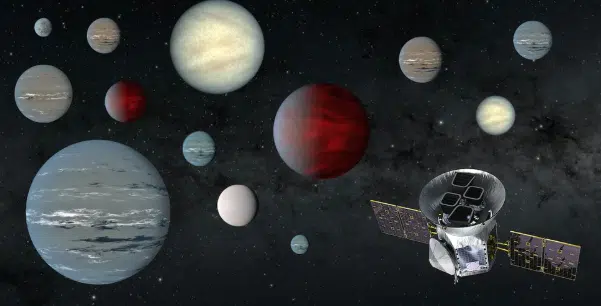
Most candidates fall into one category: hot Jupiters. These large gas giants orbit very close to their stars. Many complete an orbit in just a few days.
Their dominance does not reflect reality. It reflects detection bias. Larger planets block more light during transit. Short orbits produce frequent signals. Both factors make them easier to detect.
The Missing Smaller Worlds
Smaller planets appear less often in the dataset. These include super-Earths and Neptune-sized worlds. Their signals are weaker and harder to detect.
Because of this limitation, many smaller planets remain hidden. The current dataset highlights what we can detect, not the full picture.
The galaxy likely contains far more small planets than large ones. Future observations will help close that gap.
Correcting the Bias
Understanding detection bias is essential for accurate analysis. Scientists must adjust their models to reflect the limits of current methods.
Large datasets help refine these corrections. They provide enough information to estimate how many planets remain unseen.
This process will shape future research and guide upcoming missions.
Sorting Real Planets from False Signals
The Challenge of Confirmation
Not every candidate will become a confirmed planet. Some signals come from binary stars or measurement noise.
Estimates suggest that a significant fraction of detections may be false positives. However, even conservative projections leave thousands of real planets within the dataset.
This makes the TESS 10,000 planets discovery one of the most impactful expansions of known planetary candidates.
Why Large Samples Still Matter
Even with uncertainty, large datasets provide value. They allow scientists to test theories on a broader scale.
With thousands of candidates, researchers can compare planetary systems in detail. They can explore how different stars produce different types of planets.
This level of analysis was not possible with smaller samples.
A Long Road to Verification
Confirming each candidate requires additional observations. Ground-based telescopes and future missions will play a role.
This process takes time. Yet every confirmed planet strengthens our understanding of the galaxy.
In the meantime, candidate lists guide research and shape future exploration strategies.
A Data-Driven Future for Astronomy
When Algorithms Drive Discovery
Modern astronomy depends on advanced data analysis. Improved algorithms now unlock discoveries that once seemed out of reach.
The TESS 10,000 planets discovery shows how powerful this approach has become. It proves that innovation in data processing can rival new hardware.
Archives as a Scientific Goldmine
Space missions generate vast archives of data. Much of it remains underexplored.
This discovery highlights the value of revisiting those archives. It turns past observations into new opportunities.
For more insights into how modern telescopes continue to reshape discovery, read our latest coverage on next-generation space observatories on SpaceEyeNews.
What Comes Next
Future missions will focus on confirming these candidates. They will also target smaller and more distant planets.
At the same time, scientists will continue reanalyzing existing data. Combining both strategies will accelerate discovery.
This dual approach defines the next era of astronomy.
Conclusion: A Universe Filled with Worlds
The TESS 10,000 planets discovery reveals a universe more crowded than expected. Thousands of potential worlds emerged from data that scientists already had.
This outcome changes how we think about exploration. Discovery is no longer limited to new missions. It also depends on how we analyze existing information.
Even after accounting for uncertainty, the scale remains impressive. Each confirmed planet adds to our understanding of planetary systems.
The next breakthrough may not come from launching something new. It may come from looking at familiar data in a completely different way.
Main Sources:
- https://dailygalaxy.com/2026/04/nasa-telescope-data-reveals-10000-planets/
- https://arxiv.org/ (Search: TESS exoplanet candidate reanalysis Joshua Roth)
- https://www.nasa.gov/ (TESS mission overview and exoplanet archive)