BY:SpaceEyeNews.
NASA’s planet-hunting spacecraft just switched roles in a big way. During a special January 2026 campaign, TESS tracks interstellar comet 3I/ATLAS across a crowded starfield, collecting steady brightness measurements that scientists can mine for rotation and activity clues. The comet is faint to human eyes. Still, TESS can watch it for long stretches without blinking. That’s exactly the kind of dataset comet researchers love, especially for a rare interstellar visitor that won’t be around forever.
This SpaceEyeNews breakdown focuses on what TESS actually captured, what “spin from brightness” really means in practice, and why NASA made time for this object even while the mission was busy scanning for exoplanets.
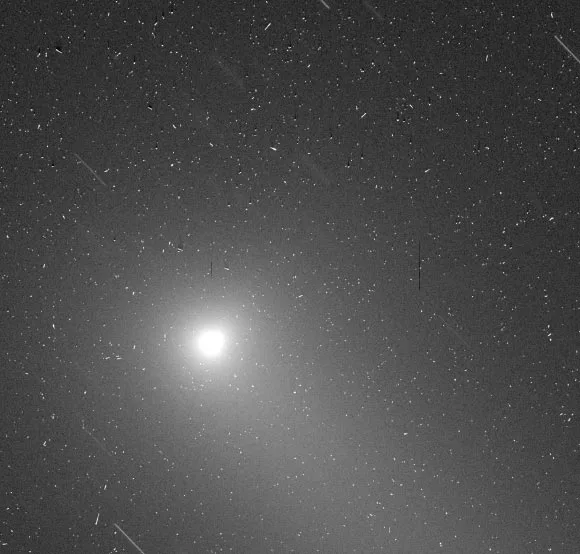
This image of the interstellar comet 3I/ATLAS was captured by Hubble’s WFC3 instrument on January 22, 2026, at 13:10 UTC. Image credit: NASA / ESA / Hubble / Man-To Hui, Shanghai Astronomical Observatory.
What happened in January 2026
From Jan. 15 to Jan. 22, 2026, TESS repeatedly observed comet 3I/ATLAS in a targeted run. NASA describes the goal clearly: scientists want to study the comet’s activity and rotation using TESS data.
A wide-field satellite watching a moving target
TESS usually stares at huge patches of sky to catch tiny dips in starlight caused by planets. That same “always watching” approach works surprisingly well for solar system objects too. When TESS tracks interstellar comet 3I/ATLAS, it effectively builds a continuous record of how the comet brightens and fades as it moves and vents material.
The quick headline numbers
NASA reports the comet’s brightness at roughly apparent magnitude ~11.5 in the early calibrated TESS measurements used for the brightness estimate and the video. That’s about 100 times fainter than naked-eye visibility, but well within reach of telescopes.
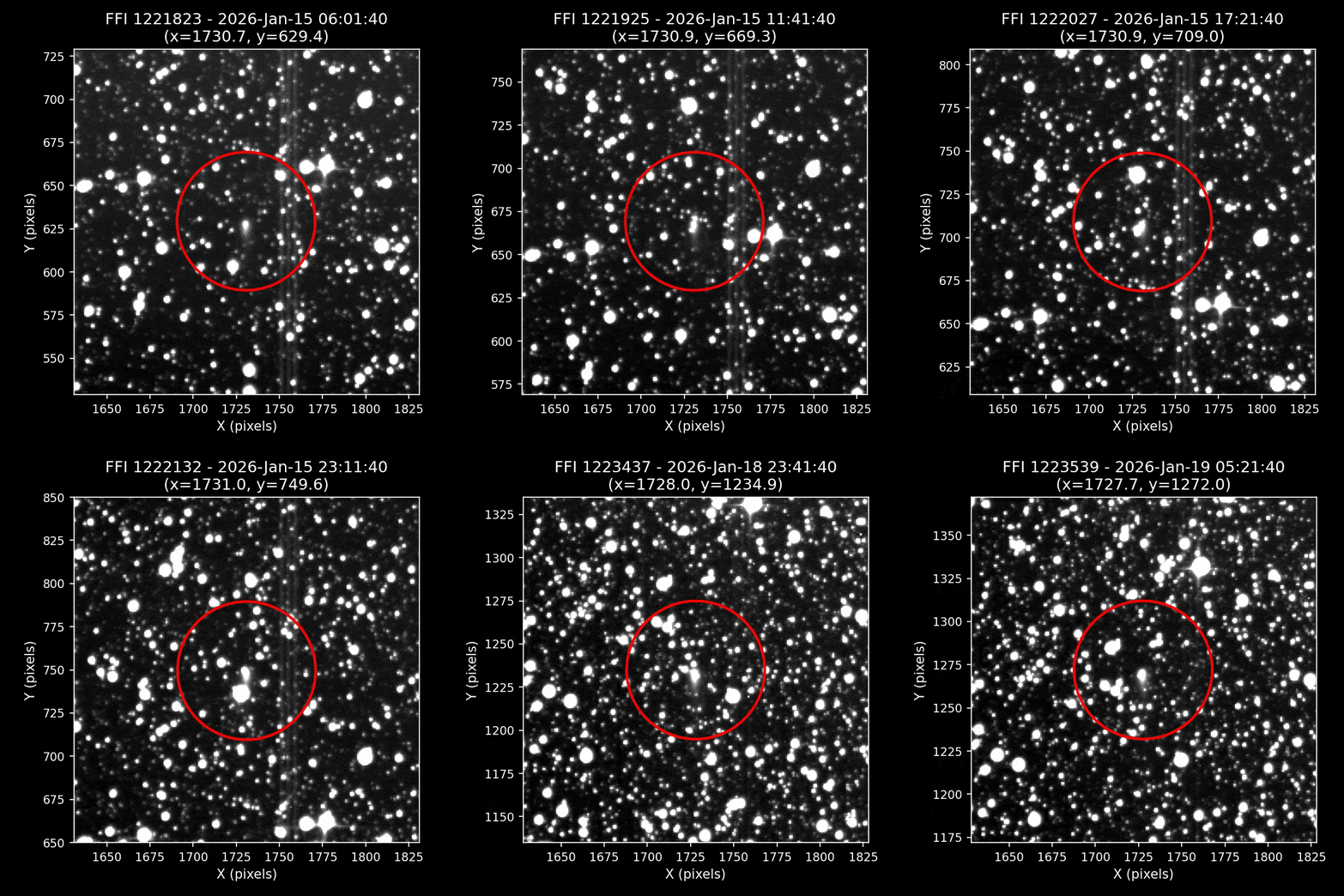
Interstellar comet 3I/ATLAS (circled) is a bright dot with a tail passing through a field of stars in this video from NASA’s TESS (Transiting Exoplanet Survey Satellite). The sequence uses 28 hours of TESS full frame images collected over Jan. 15 and Jan. 18 to 19. The time jump from Jan. 15 to Jan. 18 occurs 11 seconds into the video. (Image credit: NASA/Daniel Muthukrishna, MIT)
The 28-hour video: what it shows, and why it matters
A key “proof” product from this observation run is a short video assembled from TESS full-frame images. MIT researcher Daniel Muthukrishna compiled a sequence using about 28 hours of imagery from Jan. 15 and Jan. 18–19, showing 3I/ATLAS as a bright moving dot with a faint tail.
This isn’t just pretty footage
The video does more than look cool. It demonstrates that TESS captured the comet cleanly enough for detailed analysis. You can see motion against dense star fields, which tells you the tracking and image processing worked. That’s essential for extracting a reliable light curve.
Why there’s a time jump in the clip
If you noticed a jump, it’s real. NASA explains that TESS temporarily paused the run when it entered safe mode from Jan. 15 to Jan. 18 after a solar-panel-related issue. The published video reflects that gap, with the jump appearing about 11 seconds in.
The science payoff: using brightness to estimate spin
Here’s the main reason this campaign matters. When TESS tracks interstellar comet 3I/ATLAS, it gathers continuous photometry. That’s a fancy way to say “precise brightness over time.” With enough hours, scientists can search for repeating patterns that hint at rotation.
How a comet’s spin shows up in light
Comets aren’t perfect spheres. Their surfaces vary. Jets turn on and off. Dust production changes with sunlight and orientation. As the nucleus rotates, active regions can face toward or away from the observer. That can produce a repeating rise-and-fall pattern in brightness. Space.com notes scientists hope to use this dataset to study the comet’s activity and rotation, looking for repeating brightness signatures that reveal how fast the core spins.
Activity and rotation are linked
Rotation doesn’t just tell you “how fast it spins.” It also shapes the comet’s behavior. A faster spinner can spread heating more evenly, or it can stress the nucleus if jets produce torque. A slower rotation can let one hemisphere dominate activity. TESS won’t answer every question alone. But it can deliver the clean timing signal that anchors many other observations.
The second payoff: measuring how “alive” the comet is
Comet researchers often talk about activity like it’s a personality trait. They mean something specific: how vigorously the comet sheds dust and gas as it warms. NASA says scientists will use TESS data to study the comet’s activity.
What TESS can measure well
TESS won’t sniff molecules. It won’t replace spectroscopy. Instead, it excels at:
- Detecting smooth brightening or fading trends over days
- Catching short-lived surges if activity changes fast
- Building a consistent baseline for comparison with ground telescopes
Why interstellar comets raise the stakes
Interstellar comets matter because they formed around another star. They bring “foreign” building blocks into our neighborhood. Even if we can’t easily trace their exact origin, we can still compare their behavior to comets born here. This is why NASA scheduled a special observation that temporarily interrupted the regular sector plan: it’s a rare target with limited time on stage.
The interruption: safe mode, and what it does to the dataset
TESS did not run perfectly end-to-end. NASA reports the observations were temporarily interrupted when the spacecraft entered safe mode following a solar-panel issue.
Does the gap ruin the science?
Not necessarily. A gap can make it harder to confirm a precise rotation period if the period is close to the missing window. But the dataset still includes multiple long segments. Researchers can also combine TESS photometry with other observatories’ timing information. In practice, scientists often work with imperfect coverage. They focus on what the data can still support.
Why this detail matters for readers
Space stories sometimes gloss over spacecraft hiccups. Here, the hiccup is part of the story. It explains the time jump in the video. It also highlights how valuable uninterrupted monitoring is. When you have it, you can separate rotation signatures from random activity changes with much higher confidence.
The hidden bonus: TESS saw 3I/ATLAS before discovery
The January run wasn’t the first time TESS captured this object. NASA says TESS’s wide field of view previously observed 3I/ATLAS in May 2025, nearly two months before astronomers discovered it.
How “pre-discovery” data works
After an object gets discovered, astronomers often go back to older sky survey data to see if it appeared earlier. The trick is that the comet was faint. So researchers stacked multiple observations to bring it out of the noise and track its motion. NASA describes exactly that approach for the May 2025 TESS data.
Why this changes modern comet science
This is one of the biggest quiet revolutions in astronomy: we can “rewind the sky.” With archives like TESS, you can test how fast an object brightened, when activity started ramping up, and whether there were early outbursts. For interstellar objects, that backward look can be as valuable as new imagery.
Where the data is published, and why that’s a big deal
NASA says the TESS data from Jan. 15 through Jan. 22 is publicly available through the Mikulski Archive for Space Telescopes (MAST).
A public dataset speeds up discovery
Public access means more eyes and more methods. Some teams will focus on rotation period extraction. Others will look for subtle brightness trends. A few will try advanced image processing to better isolate the coma and tail signal. When TESS tracks interstellar comet 3I/ATLAS, it creates a resource that the broader community can analyze quickly, not months later.
MAST also points to “special observations”
MAST’s TICA page specifically notes that, in January 2026, TESS completed special observations of interstellar comet 3I/ATLAS, and it links to a mission-office update for context.
What to watch for next
The January TESS campaign sets the stage for follow-on results. Here are the outcomes most likely to show up in the near term.
1) A rotation period estimate (or tight limits)
If the light curve shows repeating peaks, researchers may publish a period. If the signal stays messy, they may publish limits or multiple candidate periods. Either outcome helps.
2) Evidence of changing activity
A comet can brighten due to geometry, or it can brighten because it becomes more active. TESS’s consistent monitoring helps separate those effects, especially when paired with other telescopes.
3) Better context from multi-observatory comparisons
TESS provides timing and continuity. Other observatories provide sharper images, color information, or spectra. Together, they can build a fuller picture of what kind of comet 3I/ATLAS is, and how it compares to our local comet population.
Conclusion: why this TESS run matters for 3I/ATLAS
This story isn’t just “NASA made a new comet video.” It’s about a repurposed exoplanet mission acting like a high-end comet monitor. In January 2026, TESS tracks interstellar comet 3I/ATLAS in a special observation run designed to reveal rotation and activity clues through precise brightness measurements. NASA also confirmed the data is public, which invites rapid analysis across the community.
Even with a safe-mode interruption, the dataset remains valuable. It captures a rare visitor on its way out, while it still has a few secrets left to give up. For SpaceEyeNews readers, the next milestone is simple: watch for the first solid spin estimate, and for any surprises in how this interstellar comet behaves under our Sun.
Main sources:
NASA – “NASA’s TESS Reobserves Comet 3I/ATLAS”
https://science.nasa.gov/blogs/3iatlas/2026/01/27/nasas-tess-reobserves-comet-3i-atlas/
Space.com – “NASA exoplanet probe tracks interstellar comet 3I/ATLAS to gauge its spin”
https://www.space.com/astronomy/comets/nasa-exoplanet-probe-tracks-interstellar-comet-3i-atlas-to-gauge-its-spin
NASA – “TESS Special Observation of Interstellar Comet 3I/ATLAS in January 2026”
https://science.nasa.gov/astrophysics/programs/physics-of-the-cosmos/community/tess-special-observation-of-interstellar-comet-3i-atlas/
MAST (STScI) – TICA page noting the January 2026 special observations
https://archive.stsci.edu/hlsp/tica