BY:SpaceEyeNews.
The Whippet black hole event appeared as a brilliant blue flash unlike an ordinary supernova. Officially named AT2024wpp, it briefly reached a power output hundreds of billions of times greater than the Sun. Its light also revealed an unexpected clue weeks later. Fast-moving helium suggested that a stable structure remained after the main event. Researchers think a black hole may have disrupted a massive companion star and drawn its material into a hot disk. Yet that scenario remains an interpretation rather than a direct observation. The strange helium signal now offers a possible window into what happened.
The Whippet black hole event appeared almost overnight
The Zwicky Transient Facility first detected AT2024wpp on September 25, 2024. The initial signal was faint. By the following night, however, the object had brightened dramatically. Its rapid rise and intense blue color immediately attracted attention.
Astronomers classified the source as a luminous fast blue optical transient, or LFBOT. Scientists also call these objects “Cow-like” transients after AT2018cow. They evolve much faster than typical supernovae.
AT2024wpp stood out even within that unusual group. A peer-reviewed study measured a redshift of 0.0868. That makes it the fourth-nearest known example of its class.
Rapid detection allowed observatories to follow the event before it reached maximum brightness. The campaign used the Liverpool Telescope, NASA’s Swift observatory, Hubble, Keck, the Very Large Telescope, the Very Large Array, and ALMA. Together, they recorded ultraviolet, optical, X-ray, radio, and millimeter signals.
Why scientists suspect a black hole powered AT2024wpp
At its peak, AT2024wpp reached a bolometric luminosity of about 2 × 10^45 ergs per second. Its total radiated energy approached 10^51 ergs. No known supernova has matched that peak output at a similarly early stage, excluding nonthermal gamma-ray burst afterglows.
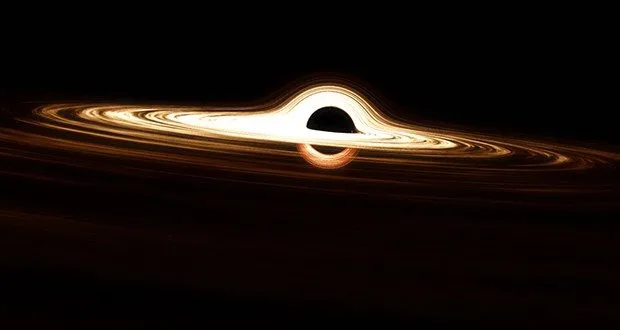
The observations point to a compact central engine. Researchers favor a rapidly feeding black hole. In their model, the black hole encountered a massive companion star. Stellar material then formed a hot accretion disk around the black hole.
As the material moved inward, the disk produced intense X-rays. It also generated a fast wind traveling at roughly 20% of light speed. This outflow met dense gas that the star had released before the event. Their interaction likely created the brilliant blue, ultraviolet, radio, and millimeter emissions.
Radio measurements indicate that the surrounding gas became less dense farther from the source. The signal changed when the disturbance reached this region.
What astronomers observed—and what remains a model
“Super sun” is not an astronomical classification. Here, it simply means a star more massive than the Sun.
More importantly, astronomers did not directly image the disruption. They measured how AT2024wpp changed across several wavelengths. Researchers then tested which physical scenario could explain those measurements.
Black-hole accretion explains the extreme luminosity, X-rays, rapid evolution, and high-speed wind. A merger could also connect two sets of clues. Some resemble a massive star’s final stages. Others resemble a tidal disruption event.
Still, the precise origin remains uncertain. Scientists have considered an unusual stellar collapse, a tidal disruption involving another type of star, and other compact-object scenarios. The current evidence supports a black-hole-powered engine, but it does not establish every step of the proposed encounter.
A delayed helium signal changes the mystery
During the first month, the Whippet showed an unusually smooth spectrum. Astronomers found few recognizable chemical features associated with the transient itself. The team suggests that intense X-rays ionized the surrounding material. Extreme motion may also have broadened features until they became difficult to identify.
After about 35 days, weak hydrogen and helium lines emerged. Their profiles contained two distinct components. One remained near the velocity of the host system. The other was blueshifted by around 6,600 kilometers per second, meaning that material was moving rapidly toward Earth.
These components remained comparatively stable for several weeks. That stability matters. A simple, expanding spherical cloud would not easily produce the same pattern. Instead, the observations suggest separate streams or clumps of dense material moving in different directions.
The helium does not prove that the original star’s core remained intact. It shows that some concentrated structure persisted long enough to create a clear spectral signature.
Did anything survive the Whippet black hole event?
Researchers offer two leading possibilities. First, the signal may come from a tidal stream created during the star’s disruption. Some material could have escaped while another stream remained bound and moved toward the black hole. Separate streams could explain the two velocity components.
The second possibility is more speculative. A surviving companion may sit outside the brightest region. X-rays and the fast wind could remove its outer material. That gas might produce the observed lines.
Neither explanation has secured confirmation. A surviving companion would also need to lie far enough from the central source for its emissions to remain visible. More late-time observations and improved computer models will help researchers test these ideas.
For now, “something survived” should not be read as proof of an intact star. The survivor may instead be a dense stream, a compact clump, or another companion in the system.
Why the Whippet black hole event matters
The Whippet black hole event gives astronomers one of their clearest multiwavelength views of a Cow-like transient. Its remarkable brightness points to an efficient and powerful central engine. Meanwhile, the delayed helium signal reveals structure hidden during the earliest phase.
The evidence strongly favors rapid accretion onto a black hole. The proposed massive-star merger remains the most compelling reconstruction, not a directly recorded sequence. That distinction makes the result more accurate and no less fascinating. By finding more events like AT2024wpp, astronomers may learn how black holes grow, how massive stellar systems change, and why these rare blue flashes become so luminous.
Main Sources:
- ScienceDaily — A black hole shredded a “super sun” — but something strange may have survived
- Liverpool John Moores University — Colossal explosion as distant “super sun” shredded by black hole
- Monthly Notices of the Royal Astronomical Society — AT2024wpp: An extremely luminous fast ultraviolet transient powered by accretion onto a black hole