
BY:SpaceEyeNews.
Astronomers have found compelling evidence of three black holes in one galaxy from the early universe. It is the first evidence of three active black holes within one distant galaxy. The system, named J0148-4214, appears as it existed about 1.2 billion years after the Big Bang. Two active black holes occupy its central region, while a third sits much farther out. The discovery offers a rare view of how interactions, rapid feeding and mergers may have created massive black holes so early.
Three Black Holes in One Galaxy at Cosmic Dawn
J0148-4214 lies more than 12.5 billion light-years from Earth. Its measured redshift is z = 5.0167. The light recorded by the James Webb Space Telescope began its journey when the universe was still young.
The three objects are all actively accreting matter. That activity creates bright regions of heated gas around them, making the otherwise invisible black holes detectable.
Researchers estimate that the largest black hole contains about 80 million times the Sun’s mass. A smaller central companion has roughly 600,000 solar masses. The third object, located outside the nucleus, has an estimated mass of about two million Suns.
The published mass uncertainties are substantial, especially for the two smaller objects. Still, the results indicate an unusual concentration of growing black holes.
How JWST Uncovered the Hidden Trio
JWST did not photograph three dark spheres. Astronomers identified their effects on gas with the telescope’s Near-Infrared Spectrograph. Its Integral Field Unit mode, or NIRSpec-IFU, studied light across different parts of the galaxy.
The key evidence came from broad hydrogen-alpha emission. Its shape indicated gas moving at speeds from roughly 430 to 2,920 kilometres per second. Such rapid motion can arise close to an actively feeding massive black hole.
The signal near the galaxy’s center was unusually complex and asymmetric. Researchers used spectro-astrometry to measure tiny changes in the signal’s position at different velocities. This method revealed two separate broad-line regions. They sit around 620 light-years apart in projection.
JWST could not resolve the pair as two separate points in a conventional image. Without spatially resolved spectroscopy, observers would probably have counted only one active black hole.
The team found another broad hydrogen signal about 5,500 light-years from the center. Its spectral signature indicated the presence of the third active black hole.
Why Other Explanations Were Rejected
Broad hydrogen emission can have more than one cause. The researchers tested whether supernovae, stellar winds, shocks or extremely massive stars could explain the observations. However, those ideas did not match the wider set of spectral features.
Active black holes provided the most consistent explanation for all three sources. The study therefore describes observational evidence for three massive, accreting black holes. This is more accurate than saying JWST directly photographed them.
A Fast Path to Early Black Hole Growth
The discovery of three black holes in one galaxy may help address a major cosmic question. Astronomers have found very massive black holes at surprisingly early times. Growing them through ordinary gas feeding alone can challenge simple models.
J0148-4214 suggests another route. Young galaxies frequently interacted and combined. Each incoming galaxy could bring a central black hole. Those objects could then move toward the shared center and eventually combine.
Mergers would add mass directly. Meanwhile, the surrounding gas could continue feeding the black holes. Both processes may therefore have accelerated their growth.
The smaller central object makes this picture even more interesting. Researchers estimate that it is accreting faster, relative to its size, than the 80-million-solar-mass primary. Its estimated rate exceeds the simplified Eddington limit, a theoretical balance between inward gravity and outward radiation pressure. Real accretion systems are complex, so exceeding that basic limit is possible.
The host galaxy has an estimated stellar mass of about 1.3 billion Suns. Its black holes represent a notable fraction of that total. Black hole growth may have moved ahead of stellar growth at this stage.
What Could Happen to the Central Pair?
The two central black holes have a projected separation of about 190 parsecs, or 620 light-years. “Projected” is important because the observation shows their spacing across the sky, not their complete three-dimensional distance.
A simple dynamical-friction calculation suggests that the pair could combine within about 700 million years. This is a model-based estimate, not a scheduled event. Their future path depends on the galaxy’s structure, surrounding gas and unseen orbital details.
If they eventually merge, the process would produce gravitational waves. Future space observatories such as LISA aim to detect signals from massive black hole mergers. Systems like J0148-4214 may help scientists estimate how often such events occurred across cosmic history.
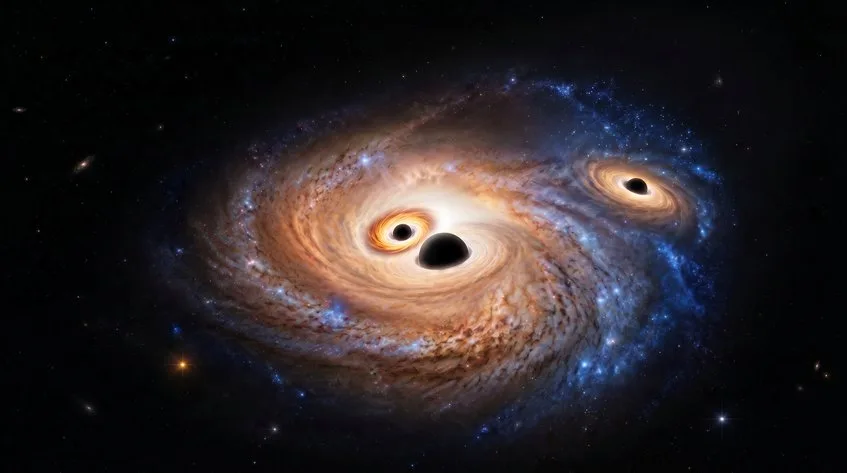
Triple Black Holes Found in One Galaxy First Time.
The Third Black Hole Remains a Mystery
The outer object raises a different question: is it approaching the center or moving away from it?
One possibility is that a smaller galaxy joined J0148-4214 and delivered the third black hole. The object may now be migrating inward and could later join another merger.
Alternatively, an earlier merger or three-body interaction may have displaced it from the center through gravitational recoil. In that scenario, the black hole retained enough surrounding material to remain active after the interaction.
Current data cannot determine which explanation is correct. Higher spatial and spectral resolution could reveal the gas motion around the object and clarify its direction.
Conclusion: Why Three Black Holes in One Galaxy Matter
The evidence for three black holes in one galaxy provides a remarkable snapshot of early cosmic growth. It shows that young galaxies could gather several active black holes within a compact system. It also supports the idea that rapid feeding and mergers may have operated together. However, several details remain uncertain, especially the third object’s history and the central pair’s future. Further observations will test whether J0148-4214 is exceptionally rare or the first visible example of a once-common early-universe system.
Main Sources:
Max Planck Institute for Extraterrestrial Physics:
https://www.mpe.mpg.de/8218247/news-20260812
Astronomy & Astrophysics study:
https://www.aanda.org/articles/aa/full_html/2026/08/aa57419-25/aa57419-25.html
BlackTHUNDER research manuscript:
https://arxiv.org/abs/2509.21575