BY:SpaceEyeNews.
Three-Lobed Asteroid 44 Nysa May Be a Solar System First
Astronomers have uncovered an extraordinary new side of asteroid 44 Nysa. Sharp ground-based images suggest it may consist of three connected sections rather than one ordinary body. Researchers also spotted a tiny moon traveling nearby.
If scientists confirm its unusual shape, the three-lobed asteroid 44 Nysa would become the first known object of its kind in our solar system.
However, the result remains carefully worded. Nysa may be a contact trinary made of three joined components. It could also be one extremely irregular, coherent object.
Either way, the asteroid now gives researchers a rare chance to study how small worlds assemble, change, and survive over billions of years.
New Images Expose Nysa’s Hidden Shape
Nysa is not a new discovery. German-French astronomer Hermann Goldschmidt first identified it in 1857. Yet its true form remained unclear for almost 170 years.
Earlier light-curve studies and distant observations suggested an elongated or possibly two-part body. Even images from the Hubble Space Telescope could not fully reveal its structure.
The latest observing campaign changed that picture.
Researchers used SHARK-VIS on the Large Binocular Telescope in Arizona. They also used the SPHERE instrument and its ZIMPOL polarimeter on the European Southern Observatory’s Very Large Telescope in Chile.
Both observatories used advanced adaptive-optics systems. These systems correct much of the blurring caused by Earth’s atmosphere.
The observations revealed a highly irregular body measuring about 75 kilometers across at its widest point. More importantly, scientists identified two deep valleys that appear to extend around its surface.
The team interprets these valleys as possible “colli.” In planetary science, that term describes neck-like regions connecting separate parts of an object.
Together, the two valleys give Nysa a striking three-part appearance.
Still, the researchers have not claimed absolute confirmation. Their study describes the primary body as either a contact trinary or an exceptionally irregular single object.
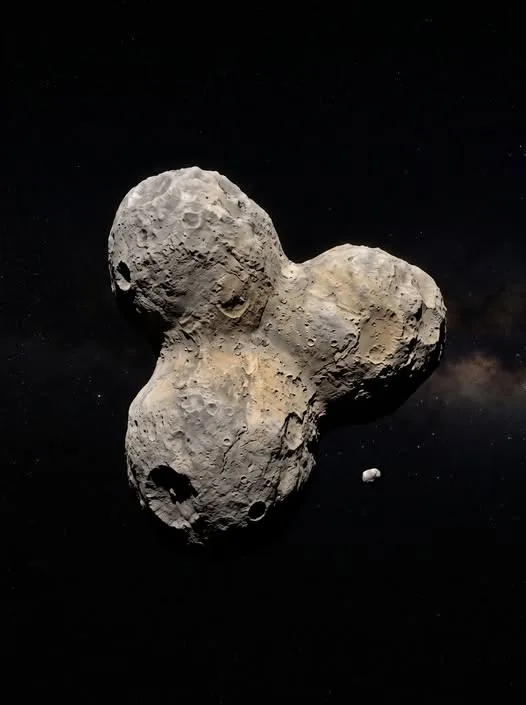
Astronomers discover asteroid 44 Nysa with three lobes and tiny moon.
How Astronomers Revealed the Three-Lobed Asteroid 44 Nysa
Capturing this level of detail from Earth required more than powerful telescopes. Nysa appears extremely small in the sky, while atmospheric turbulence constantly distorts incoming light.
Adaptive optics corrected much of that distortion in real time. Researchers then applied specialized image-processing methods to sharpen the asteroid’s outline.
Those methods also reduced the bright halo surrounding Nysa. Without that step, faint surface details and nearby objects could remain hidden.
The team combined several images and viewing angles to examine features that appeared repeatedly. Researchers also created a three-dimensional shape model using the new images and existing brightness measurements.
The two major valleys appeared across several datasets. They were not limited to one uncertain frame or one viewing angle.
As Nysa rotated, its unusual structure remained visible from different perspectives. That consistency strengthened the case for a genuine three-lobed form.
The result also shows the growing power of ground-based astronomy. Modern instruments can now reveal structural details on distant asteroids that once appeared only as points of light.
In Nysa’s case, scientists resolved a measurable world with an unusual shape, complex surface features, and a previously unknown companion.
A Tiny Moon Emerges from Nysa’s Glare
The observations produced another surprise. Researchers found a faint object moving close to Nysa during separate observing sessions.
Its apparent motion remained centered on the asteroid. That behavior supported the conclusion that it was an orbiting satellite rather than an unrelated background object.
The moon currently carries the temporary designation S/2026 (44) 1.
Scientists estimate that it measures around one kilometer across. During the observations, it appeared at a projected distance of roughly 170 to 180 kilometers from Nysa.
Finding such a small object proved difficult. The moon is much fainter than the primary asteroid, while Nysa’s bright halo can easily overwhelm its signal.
To solve that problem, the researchers used high-contrast imaging techniques. Astronomers often apply similar methods when searching for faint objects beside much brighter targets.
The team detected the moon in multiple datasets and during two separate observing campaigns. That repeat detection strengthened the evidence that the satellite is real.
However, astronomers have not yet mapped its complete orbit. Further observations must determine its orbital period, speed, and three-dimensional path. Connected Bodies or One Irregular World?
The most exciting explanation suggests that Nysa formed from three large fragments that gradually came together.
A slow meeting may have allowed the pieces to connect without separating again. Their combined gravity could then keep the structure intact.
Scientists call such an object a contact trinary.
Astronomers already know several contact binaries, which contain two touching lobes. The distant world Arrokoth and comet 67P/Churyumov-Gerasimenko offer well-known examples of double-lobed bodies.
A confirmed three-part asteroid would extend that category in a new direction.
Yet another possibility remains open. Nysa may be one coherent object with an exceptionally distorted shape.
Ancient collisions could have carved the two deep valleys. A close gravitational encounter with a larger body might also have stretched or reshaped the asteroid.
However, that explanation creates another mystery.
A major disruptive event would normally produce several related fragments. Scientists might expect those objects to remain in similar orbits and share a comparable composition.
Researchers have not identified a clear nearby family of enstatite-rich fragments linked to Nysa. In fact, studies suggest Nysa may be an interloper within the asteroid family that carries its name.
That absence may point toward a more complex origin. Nysa could have formed elsewhere before moving into its current region of the asteroid belt.
Nysa’s Moon Could Solve the Mystery
The newly discovered moon may offer the best way to distinguish between the competing formation theories.
By tracking the moon’s orbit, astronomers can calculate Nysa’s mass. They can then compare that mass with the asteroid’s estimated volume.
The result will reveal Nysa’s bulk density. That measurement can provide important clues about its composition and internal structure.
A relatively low density could indicate empty spaces between loosely connected components. Such a result would support the idea that several fragments gradually reassembled.
A higher density could favor a more compact and coherent body.
The moon’s orbital path may also show whether the satellite formed during the same event that shaped Nysa.
Therefore, the tiny companion is more than an added curiosity. It acts as a natural measuring tool for investigating the larger asteroid.
Why the Three-Lobed Asteroid 44 Nysa Matters
The three-lobed asteroid 44 Nysa also attracts attention because of its unusual surface composition.
Nysa ranks among the largest and brightest E-type asteroids. These objects have highly reflective surfaces associated with the silicate mineral enstatite, which contains very little iron.
Scientists link similar materials to meteorites known as aubrites and enstatite chondrites.
These rocks may preserve evidence from the hot inner region of the young solar system. Some studies connect enstatite-rich material with the ingredients that helped form Earth and the other rocky planets.
Nysa now travels in the main asteroid belt between Mars and Jupiter. However, its material may have originated much closer to the young Sun.
Its strange shape adds another layer to that history.
Nysa may preserve evidence of ancient mergers, fragmentation, gravitational reshaping, or gradual reassembly. Each possibility connects its present structure to the larger story of solar system development.
Conclusion
The three-lobed asteroid 44 Nysa has changed from a familiar catalog entry into one of the most unusual small worlds ever imaged from Earth.
New observations reveal two deep valleys, a possible three-part structure, and a tiny orbiting moon. Scientists still need more data before confirming whether Nysa truly contains three connected components.
Tracking the satellite should reveal the asteroid’s mass and density. Those measurements may finally explain how this remarkable object formed and what it preserves from the solar system’s earliest era.
Main Sources:
Lowell Observatory:
https://lowell.edu/press-release-asteroid-44-nysa-may-be-the-first-known-three-lobed-world/
Research paper abstract:
https://arxiv.org/abs/2607.25786
Full research manuscript:
https://arxiv.org/html/2607.25786v1