
BY:SpaceEyeNews.
A coordinated group of tiny satellites could one day circle China’s Tiangong Space Station and inspect it from several angles. A new study explores how such a cluster could maintain formation while adapting to the station’s changing orientation.
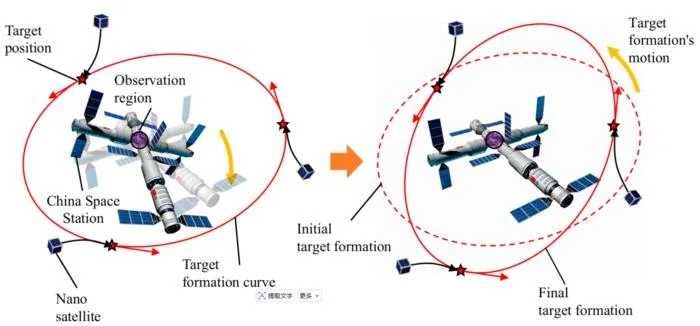
The proposed Tiangong nanosatellite formation would use carefully designed elliptical paths. It would also rely on detailed station models and an automated control system. Together, these features could help the satellites observe external structures while maintaining suitable separation.
However, this is not an announced operational mission. The researchers tested the concept through mathematical analysis and computer simulations. Their work shows how the system might function if engineers develop it further.
The study, titled “Satellite Formation Control for Cooperative Observation around the Rotating China Space Station,” appeared in Space: Science & Technology on April 16, 2026.
Why a Tiangong Nanosatellite Formation Is Difficult
Placing several satellites near Tiangong may sound simple. In reality, the station creates a demanding navigation environment.
Tiangong is a large, multi-module orbital laboratory. Its basic T-shaped structure combines the Tianhe core module with the Wentian and Mengtian laboratory modules. Tianhe manages the station and supports long-duration crewed activities. Wentian and Mengtian expand its scientific and operational capabilities.
Large solar arrays, docking areas, modules, and external equipment give the station an irregular shape. A nearby satellite cannot treat the entire structure as a simple sphere.
China’s Tiangong Station May Be Watched by a Satellite Swarm!
A Rotating and Complex Structure
The station’s orientation may also change. As a result, an open route can appear different from another angle.
Each nanosatellite must know its own position and velocity. It must also track Tiangong’s motion, attitude, and external geometry. Meanwhile, the satellite must remain coordinated with the rest of the cluster.
These demands create several competing goals. The spacecraft must preserve formation, maintain observation coverage, avoid unnecessary corrections, and use fuel carefully.
The paper focuses on Tiangong’s connecting region. Researchers represented that area using 14 observation points. The model counted the region as fully observed only when all 14 points entered the required viewing range.
One fixed camera may struggle to view every point clearly. Several small satellites could reduce blind spots by observing from different positions.
How the Tiangong Nanosatellite Formation Would Work
The researchers propose an elliptical formation that closely follows natural relative orbital motion.
This design matters because constant corrections would consume limited fuel. A near-natural path could reduce propulsion demands and extend the mission’s useful life.
The control system analyzes movement through four reference frames. These include an Earth-centered frame, a station-centered frame, a local orbital frame, and a frame fixed to Tiangong’s body.
Following the Station’s Orientation
The body-fixed frame plays a central role. Within this frame, the station’s modeled components remain in consistent positions.
That makes it easier for the controller to understand where each nanosatellite sits relative to the station. The system can then adjust the formation when Tiangong changes its attitude.
Researchers modeled the station using capsule-shaped bodies and cuboids. This approach offers more detail than one oversized protective boundary.
A single large boundary would block useful observation positions. A more accurate geometric model leaves additional operating space while preserving separation from station components.
Invisible Mathematical Buffers
The proposed controller creates repulsive mathematical fields around the modeled structures. These fields act like invisible buffers.
When a nanosatellite moves too close to one area, the system generates a correction. At the same time, it continues guiding the spacecraft toward its assigned formation position.
The controller also includes an adjustable damping coefficient. This feature limits excessive responses and helps the satellites settle into their target locations.
The researchers say their method provides closed-loop Lyapunov stability under the model’s assumptions. In practical terms, the system should converge toward its desired state instead of producing uncontrolled oscillations.
The Tiangong nanosatellite formation also aims to improve camera coverage. Researchers searched for a formation that balanced viewing performance, distance from the station, and manageable control effort.
What the Simulations Revealed
The researchers tested the system through numerical simulations. They did not conduct an orbital demonstration.
The simulations included two main station conditions. In one case, Tiangong maintained an inertially oriented attitude. In another, it experienced a temporary rotation.
According to the study, the nanosatellites moved toward their assigned elliptical formation. They also remained clear of the modeled station structure.
Control demands stayed within acceptable limits. In addition, the mean full-coverage time closely matched the value selected during the formation design.
Possible Inspection Applications
A future nanosatellite cluster could inspect connection points, module surfaces, solar arrays, and external equipment.
It might also support maintenance planning. Before a crewed or robotic external operation, the satellites could provide fresh images of the relevant area.
Multiple viewpoints could offer another advantage. Operators could compare images from different angles and identify changes more confidently.
The same concept may eventually support other large orbital structures. Possible examples include space telescopes, servicing platforms, assembly sites, and future lunar-orbit stations.
Important Limits of the Research
The study uses several simplifying assumptions.
Each nanosatellite is treated mainly as a mass point. The model does not fully represent the spacecraft’s own rotation and physical dimensions.
It also assumes accurate position and velocity tracking. Real missions would face sensor uncertainty, communication delays, navigation errors, lighting changes, and imperfect propulsion.
Engineers would also need to consider moving solar arrays and unexpected station maneuvers. Operations near a crewed laboratory would require strict testing and control procedures.
Most importantly, the paper does not confirm that China plans to deploy this system. Official sources describe Tiangong as a long-term, multi-module space laboratory with a nominal crew of three and a planned ten-year design life. They do not announce an operational nanosatellite formation based on this research.
Conclusion
The Tiangong nanosatellite formation offers a promising vision for future space-station inspection. Its design combines near-natural orbital motion, detailed geometry, observation planning, and coordinated control.
Simulations suggest that the cluster could maintain formation, adapt to station rotation, and observe selected areas from several viewpoints. Yet the concept remains at the research stage.
A real mission would require extensive testing under more complex conditions. Still, this work provides an important foundation. Future orbital laboratories may eventually operate alongside compact satellite teams that continuously inspect areas beyond the reach of fixed cameras.
Main Sources:
Research paper:
https://spj.science.org/doi/10.34133/space.0348
China Manned Space Agency — Tianhe Core Module:
https://en.cmse.gov.cn/missions/CMTH/
China Manned Space Agency — Wentian Lab Module:
https://en.cmse.gov.cn/missions/wentian/
China Manned Space Agency — Mengtian Lab Module:
https://en.cmse.gov.cn/missions/mengtian/
China Manned Space Agency — Space Station System:
https://www.cmse.gov.cn/col/col933/index.html