
BY:SpaceEyeNews.
Astronomers have identified a stellar arrangement that turns four stars into one remarkably precise natural laboratory. The TIC 433545934 quadruple star system contains two close binaries. Each pair produces its own eclipses, while both pairs travel around a shared center of mass. During one rare alignment, NASA’s TESS telescope recorded three additional dips in brightness. That signal revealed a mutual eclipse between the two binaries—an event never securely confirmed in a system of this exact type before.
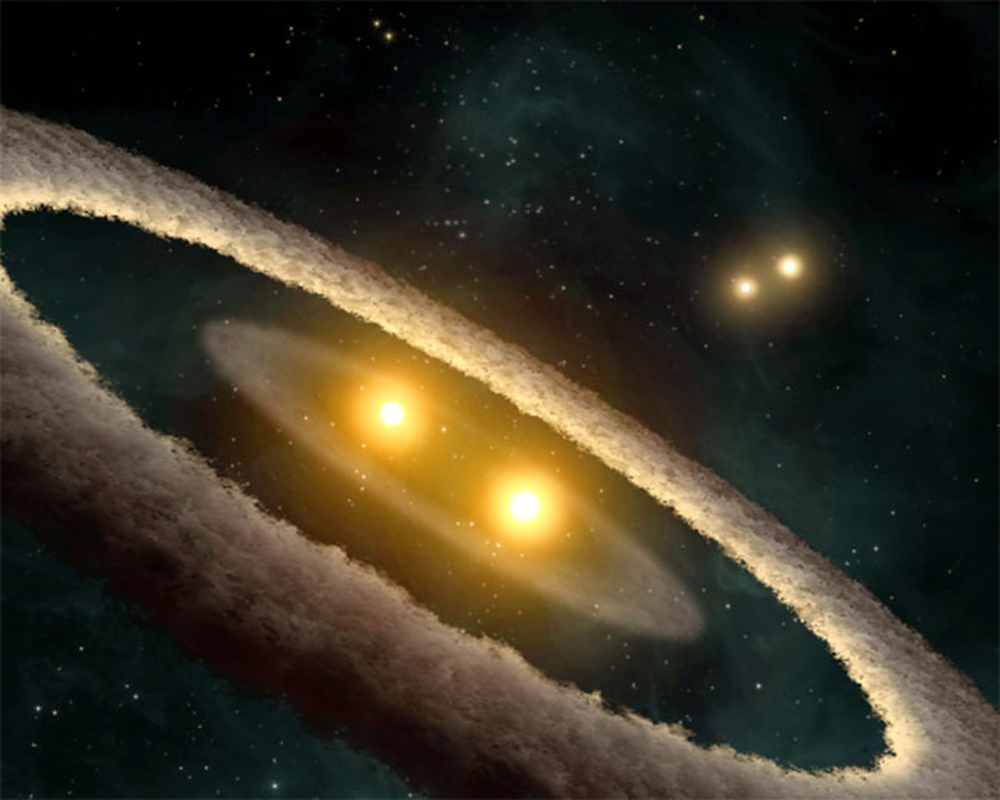
TIC 433545934 Quadruple Star System Has Three Linked Orbits
TIC 433545934 follows a “2+2” structure. Two stars form Binary A, while two others form Binary B. Each binary operates as a close pair. The two pairs then orbit one another.
The stars in Binary A complete an orbit every 2.07 days. Binary B moves even faster, completing each orbit in 1.41 days. Meanwhile, the binaries need about 224.5 days to circle their common center of mass.
That outer period places the system among the most compact confirmed quadruple systems of its type. According to the research team, only four known 2+2 quadruples have shorter outer periods.
The system is also unusually flat. Its three orbital planes differ by less than about two degrees. This near alignment gives observers on Earth an exceptional view as the stars cross one another.
A Triple-Dip Eclipse Revealed Its Rare Geometry
NASA’s Transiting Exoplanet Survey Satellite, better known as TESS, detected the defining event during Sector 38. It first recorded the normal eclipses within both binaries. TESS then detected a much stranger feature lasting more than a day.
Three additional dips appeared as the stars of Binary B moved across the two members of Binary A.
The event is best described as a triple-dipped mutual eclipse. It does not mean that three unrelated eclipses occurred at the same instant. Instead, the four moving stars produced three separate reductions in their combined light during one extended alignment.
This pattern provided immediate evidence that the two binaries occupy the same physical system. A chance alignment between unrelated binaries could produce two eclipse patterns in one image. However, it could not easily create this coordinated crossing between the two pairs.
How Astronomers Confirmed the Four-Star System
TESS observed TIC 433545934 during six sectors. Yet it recorded only one complete mutual eclipse. Researchers therefore combined its observations with data from several ground-based surveys.
They examined about 5,000 measurements from the All-Sky Automated Survey for Supernovae, or ASAS-SN. Those observations covered approximately ten years. The team also analyzed about 2,000 ATLAS measurements spanning 4.4 years.
The astronomers then measured eclipse-timing variations in both binaries. Each pair displayed linked changes matching the 224.5-day outer orbit. That synchronized behavior confirmed that the binaries are gravitationally connected.
Next, the team created a photodynamical model. It combined the light curves, eclipse timings, orbital motion and spectral energy distribution. This approach allowed researchers to reconstruct the four stars and all three orbits simultaneously.
Why the Mutual Eclipse Works in Only One Direction
The outer orbit is far from circular. It has an eccentricity of about 0.62, making it distinctly elongated. The observed mutual eclipses occur near periastron, when the two binaries reach their closest point.
From Earth, Binary B passes in front of Binary A during this favorable alignment. However, researchers found no similarly deep event in which Binary A crosses Binary B.
This one-way pattern comes from the elongated orbit and our viewing angle. Even a small difference in alignment can determine whether distant objects appear to overlap. In this case, the geometry produces a mutual eclipse during only one part of the outer orbit.
What the TIC 433545934 Quadruple Star System Contains
The model suggests that three stars have masses between roughly 2.2 and 2.4 times the Sun’s mass. The fourth contains about 1.35 solar masses. The three larger stars have estimated surface temperatures close to 8,800 kelvin.
Binary A contains two similar, slightly evolved late A-type stars. Binary B is less balanced. Its larger member contributes far more light than its lower-mass companion.
Researchers estimate the system’s age at about 580 million years. This corrects an important detail in some coverage. The system did not form 152 million years ago. Instead, 152 million years is the estimated time remaining before the primary stars in both binaries may overflow their Roche lobes.
The mass estimates also require caution. Researchers lacked radial-velocity measurements, which normally help determine stellar masses. They used stellar-evolution models and the system’s combined light as substitutes. The orbital geometry remains tightly constrained, but the absolute masses may carry larger uncertainties.
A Rare Test of Multiple-Star Evolution
Over time, the larger stars will continue expanding. In about 152 million years, the main star in each binary may begin transferring material to its companion. That process could reshape both pairs and alter the system’s long-term development.
A later stellar merger remains possible, but current observations do not make that outcome certain.
TIC 433545934 offers more than a visually striking eclipse. Its compact structure can test how four-star systems form, maintain nearly aligned orbits and change as their stars age. Future spectroscopy could sharpen the mass estimates. Continued monitoring may also reveal gradual changes in the orbital planes.
TIC 433545934 Quadruple Star System Opens a New Window
The TIC 433545934 quadruple star system stands out because nature has aligned all four stars in an unusually informative way. Its regular inner eclipses, synchronized timing shifts and triple-dipped mutual eclipse expose details that usually remain hidden.
TESS recorded only one complete outer event, but archival observations revealed the larger pattern. With further monitoring, this compact stellar system could become an important benchmark for understanding how quadruple stars form and evolve.
Main Sources:
Primary study: TIC 433545934: The First 2+2-Type Doubly Eclipsing Binary With Extra Mutual Eclipses
NASA: TESS Mission Overview
NASA: For TESS, Stellar Eclipses Shed Light on Possible New Worlds
Original coverage: Four Stars in a Single System Perform a Complex Dance