
BY:SpaceEyeNews.
Rain falls across Titan, but it does not behave like rain on Earth. At nearly minus 180 degrees Celsius, liquid methane drops from a nitrogen-rich sky and lands in hydrocarbon lakes. Now, scientists suggest that Titan methane rain could do something even more surprising. Its splashes might wrap tiny droplets in organic bilayer membranes.
These hollow structures, called vesicles, would resemble the boundaries around living cells. However, researchers have not found vesicles, primitive cells, or life on Titan. A 2025 study presents a physical route through which cell-like compartments might form without liquid water. That distinction is central to the discovery.
Titan Has the Right Setting for Unusual Chemistry
NASA’s Cassini mission showed that Titan has polar lakes and seas filled with methane and ethane. Methane evaporates, forms clouds, falls as rain, and flows through channels. The cycle resembles Earth’s water cycle but uses different materials.
Meanwhile, sunlight and energetic particles split methane and nitrogen molecules in Titan’s thick atmosphere. The fragments recombine into complex organic substances. Some form Titan’s orange haze, while others may settle into the lakes.
This combination lets scientists ask whether early chemical organization can begin in a solvent other than water.
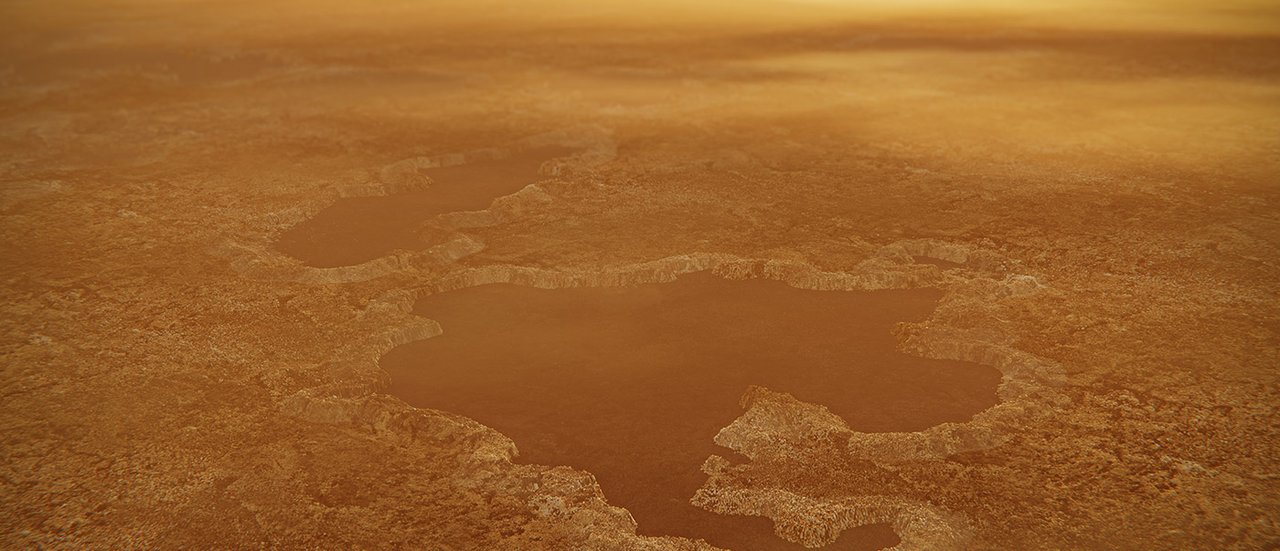
This artist’s concept of a lake at the north pole of Saturn’s moon Titan illustrates raised rims and rampartlike features such as those seen by NASA’s Cassini spacecraft around the moon’s Winnipeg Lacus.Credit: NASA/JPL-Caltech
How Titan Methane Rain Could Build Vesicles
The proposed process comes from physical chemist Christian Mayer and NASA Goddard planetary scientist Conor Nixon. Their study appeared in the International Journal of Astrobiology in July 2025.
An Organic Film Covers the Lake
First, organic molecules called amphiphiles would gather where a hydrocarbon lake meets the atmosphere. Under the right conditions, they could organize into a film only one molecule thick.
No spacecraft has detected such a film on Titan. Its existence remains one of the model’s largest assumptions.
Methane Rain Creates Coated Spray
Next, a large methane raindrop strikes the coated lake. The impact throws smaller droplets of lake liquid above the surface. Each droplet could tear away with part of the organic film wrapped around it.
When the coated droplet falls back, it crosses the film covering the lake again. A second molecular layer could then join the first. Together, the two layers would close around the liquid methane, creating a bilayer vesicle.
In effect, Titan’s weather would perform the assembly. The molecules would not need to form a hollow sphere spontaneously within the lake.
Why a Membrane Matters Before Life Begins
A membrane creates an inside and an outside. That simple division can prevent useful molecules from drifting apart. It can also hold reaction products together and preserve chemical differences between a compartment and its surroundings.
Life on Earth uses membranes made from molecules suited to liquid water. Titan’s lakes contain nonpolar methane and ethane. Any workable membrane would therefore require different chemistry and an effectively reversed molecular arrangement.
Finding such vesicles would expand the possible environments for prebiotic organization. Still, a vesicle is only a container. It has no metabolism, genetic information, controlled growth, or self-reproduction. A membrane alone does not make a cell.
The Titan Membrane Hypothesis Faces Major Tests
Every stage contains uncertainty. Scientists do not know whether enough amphiphiles reach the lakes. Nor have they shown that these compounds form a lasting film in realistic hydrocarbon mixtures.
A splash must produce coated droplets without destroying the film. The droplets must return with both layers intact. Finally, a vesicle must remain stable long enough to influence chemistry.
A Leading Molecule Now Looks Less Promising
Acrylonitrile once appeared to be a strong candidate for building Titan membranes called azotosomes. Yet a 2020 computational study found that acrylonitrile should favor a crystal structure over a freely assembled membrane.
Laboratory results published in 2026 added another challenge. Researchers at NASA’s Jet Propulsion Laboratory tested acrylonitrile in methane and ethane under Titan-like conditions. The compound formed a stable cocrystal with ethane. It also showed little of the behavior needed to produce an acrylonitrile azotosome.
These findings weaken one famous membrane candidate. They do not fully reject the 2025 mechanism. Mayer and Nixon considered mixed membranes and several other nitriles and amines. Moreover, the 2026 experiment did not recreate an organically coated lake or the complete rain-splash sequence.
How Scientists Could Test Titan Methane Rain
A laboratory on Earth could provide the first direct test. Researchers could create a cryogenic lake containing methane, ethane, and nitrogen. They could then add candidate amphiphiles, confirm whether a surface film develops, and simulate repeated methane rainfall.
Light-scattering measurements could reveal particles in the expected size range. Raman spectroscopy could identify their molecules. Further examination would show whether the particles are hollow, whether they contain two layers, and how long they survive.
Even a negative result would help. It could reveal whether the process fails during film formation, splashing, membrane closure, or stabilization.
Dragonfly Will Explore Titan, but Not Its Lakes
NASA plans to launch its Dragonfly rotorcraft no earlier than July 2028, with arrival expected in late 2034. Dragonfly will explore equatorial dunes and the Selk impact region. It will analyze surface materials and investigate Titan’s prebiotic chemistry and habitability.
However, the mission will not visit the northern lakes. NASA also says it will not carry the light-scattering instrument needed for this specific vesicle search. Direct detection may require a later shoreline lander, boat, or submarine designed to sample Titan’s hydrocarbon seas.
Titan Methane Rain Offers a Testable Possibility
The idea that Titan methane rain can create cell-like membranes remains unproven. It does not show that life exists in Titan’s lakes. Instead, it offers a clear mechanism that scientists can reproduce, test, and potentially reject.
If researchers find these vesicles, they would demonstrate that organized compartments can form without liquid water. If the mechanism fails, it would reveal a meaningful chemical limit. Either result would sharpen our understanding of habitability. It would also show how far chemistry can progress toward life under truly unfamiliar conditions.
Main Sources:
- NASA Research Shows Path Toward Protocells on Titan
- A Proposed Mechanism for the Formation of Protocell-Like Structures on Titan
- Experimental Insights Into the Azotosome Hypothesis in Titan’s Lake Fluids
- Can Polarity-Inverted Membranes Self-Assemble on Titan?
- NASA Cassini Science: Titan
- NASA Dragonfly Mission