BY:SpaceEyeNews.
Imagine watching the Sun remain above the horizon for decades. Then, after it finally sets, no sunrise follows for another generation. This extraordinary cycle occurs near the poles of Uranus.
Uranus extreme seasons result from the planet’s unusual orientation. Its rotational axis tilts by about 97.77 degrees. As a result, Uranus appears to orbit the Sun while lying almost completely on its side.
That orientation creates long periods of continuous sunlight and darkness. It also drives atmospheric changes that scientists are only beginning to understand.
Yet the planet does not react to solar heating in a simple way. Its clouds, haze, storms, and internal heat produce a seasonal system unlike any other in the solar system.
Uranus Extreme Seasons Begin With Its Sideways Tilt
Uranus does not literally roll around the Sun. However, that comparison offers a useful picture of its unusual motion.
Earth’s axis tilts by about 23.4 degrees. Uranus, by contrast, has an axial tilt of 97.77 degrees. Its equator therefore sits almost perpendicular to the plane of its orbit.
NASA says this extreme orientation gives Uranus the most unusual seasons among the solar system’s planets. The ice giant still rotates quickly. One Uranian day lasts about 17 hours. However, its polar lighting depends mainly on its long journey around the Sun.
Uranus takes about 84 Earth years to complete one orbit. Each astronomical season lasts roughly 21 years.
Near a solstice, one pole points broadly toward the Sun. The opposite pole faces away. The illuminated pole can experience continuous sunlight, while large areas around the other pole remain in darkness.
At the geographic poles, the interval between sunrise and sunset can approach half a Uranian year. That equals about 42 Earth years.
Therefore, the often-repeated 42-year figure does not mean Uranian summer alone lasts 42 years. Instead, it describes how long the Sun may remain above or below the horizon at a pole as Uranus travels through half its orbit.
How 42 Years of Sunlight Changes Uranus
Decades of sunlight should create strong seasonal effects. Scientists expect the illuminated hemisphere to absorb more solar energy. That energy should influence temperatures, winds, clouds, and atmospheric chemistry.
However, Uranus sits about 19 times farther from the Sun than Earth. Sunlight there is far weaker. The planet also has a mean atmospheric temperature of about minus 195 degrees Celsius.
These conditions slow and complicate the atmospheric response. Solar energy interacts with methane, hydrogen, helium, aerosols, clouds, and deeper atmospheric layers. Heat can also move between latitudes rather than remaining where the sunlight arrives.
Consequently, visible weather does not always follow the changing seasons immediately.
Hubble Tracks a Changing Polar Atmosphere
Long-term observations from the Hubble Space Telescope have revealed clear seasonal changes.
Over two decades, Hubble watched Uranus’s southern polar region fade as it entered winter shadow. Meanwhile, the northern region brightened as it moved toward summer. Researchers also measured changes in atmospheric reflectivity across different latitudes.
These observations show that Uranus extreme seasons affect the planet’s appearance. They also reveal that different parts of the atmosphere respond at different rates.
Some changes may follow rising sunlight levels. Others may depend on atmospheric circulation or chemical reactions that take years to develop.
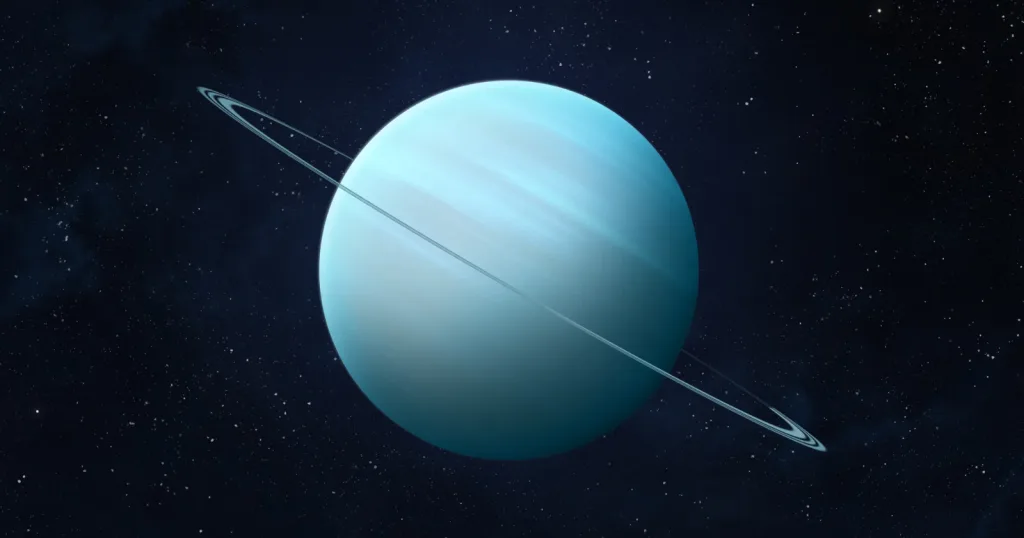
Uranus is tipped so far over it does not spin like other planets so much as.
Webb Reveals Clouds, Haze, and a Polar Cap
The James Webb Space Telescope has provided a sharper infrared view of Uranus.
Webb detected a bright seasonal cap around the north pole. It also revealed a brighter inner cap, a darker boundary, and several cloud features nearby. Some clouds may contain methane ice and could relate to storms below the visible haze.
The north polar cap has become more prominent as the pole receives increasing sunlight. Uranus will reach its next northern summer solstice in 2028.
Astronomers are now watching how the cap, clouds, and surrounding atmospheric bands develop. Webb could help separate long-term seasonal changes from shorter weather events.
Why Uranus Weather Does Not Follow a Simple Pattern
Early models often portrayed Uranus as a planet with a sluggish atmosphere and little internal energy. Voyager 2 strengthened that impression when it photographed a relatively smooth blue-green world in 1986.
New evidence has changed that picture.
In 2025, NASA and University of Oxford researchers reported that Uranus releases about 15 percent more energy than it receives from the Sun. Their analysis suggests the planet has more internal heat than older estimates indicated.
That internal energy could influence atmospheric circulation. It may also affect how quickly different regions respond to sunlight.
Scientists must therefore study two energy sources at once. Seasonal sunlight heats Uranus from above, while residual heat escapes from its interior.
Methane haze adds another challenge. It absorbs red light and gives Uranus its blue-green appearance. It can also hide deeper cloud structures in visible images.
As a result, a bright or dark region does not always provide a direct measurement of temperature. Researchers need infrared and spectroscopic observations to identify cloud heights, chemical changes, and energy movement.
What Put Uranus on Its Side?
Scientists still do not know exactly how Uranus acquired its extreme tilt.
The leading explanation involves a major impact during the early solar system. A large planetary body may have collided with the young Uranus and changed its rotation.
Computer simulations show that a giant impact could create a highly tilted planet. It might also alter Uranus’s interior and produce material linked to its moons. NASA notes that a collision with an Earth-sized object may explain the planet’s orientation.
However, the impact scenario remains a model. Researchers have not recovered direct evidence of one specific collision.
Other ideas propose a slower process. Uranus may once have had a large moon that gradually changed the planet’s axial orientation through gravitational interactions. The moon could later have become unstable and collided with Uranus. NASA has highlighted this possibility as one recent theory.
Each explanation must account for more than the tilt. A successful model must also explain Uranus’s rotation rate, internal structure, rings, magnetic field, and system of moons.
One Uranus Flyby Cannot Explain an 84-Year Cycle
Voyager 2 remains the only spacecraft to visit Uranus.
The spacecraft made its closest approach on January 24, 1986. It passed about 81,500 kilometers from the planet and returned images and measurements of its atmosphere, rings, moons, interior, and magnetic environment.
However, the flyby captured only a brief moment in an 84-year seasonal cycle. At the time, Uranus’s southern region faced the Sun.
Hubble, Webb, and ground-based observatories now provide longer monitoring. Still, remote telescopes cannot fully probe the deep atmosphere or directly measure the planet’s interior.
A dedicated orbiter and atmospheric probe could observe Uranus through changing seasons. Such a mission could also explain how sunlight, chemistry, circulation, and internal heat interact.
Uranus Extreme Seasons Remain a Planetary Mystery
Uranus extreme seasons create one of the solar system’s most remarkable natural cycles. Near each pole, decades of daylight eventually give way to decades without sunrise.
Yet the lighting pattern is only part of the story.
Hubble has recorded shifting brightness across the planet. Webb has revealed a growing polar cap, haze, clouds, and storms. New research also suggests Uranus releases more internal heat than scientists once believed.
Researchers still cannot fully explain how the planet responds to each season. They also do not know whether one giant impact or a slower gravitational process placed Uranus on its side.
A season on Uranus can last a human generation. After only one close spacecraft visit, understanding those seasons may take even longer.
Main Sources:
NASA — Uranus Facts
https://science.nasa.gov/uranus/facts/
NASA — Webb Rings in Holidays With Ringed Planet Uranus
https://science.nasa.gov/missions/webb/nasas-webb-rings-in-holidays-with-ringed-planet-uranus/
NASA — 20-Year Hubble Study of Uranus Yields New Atmospheric Insights
https://science.nasa.gov/missions/hubble/20-year-hubble-study-of-uranus-yields-new-atmospheric-insights/
NASA — NASA and Oxford Discover Warmer Uranus Than Once Thought
https://science.nasa.gov/missions/hubble/nasa-oxford-discover-warmer-uranus-than-once-thought/
NASA — Voyager 2 Mission
https://science.nasa.gov/mission/voyager/voyager-2/
NASA — Uranus Viewed in 2014 and 2022
https://science.nasa.gov/asset/hubble/uranus-nov-2014-and-nov-2022/