BY:SpaceEyeNews.
Introduction — Vela Supercluster Finally Comes Into View
The Vela Supercluster is no longer a mystery. Astronomers have now mapped this vast structure for the first time, revealing one of the largest formations in the known universe. For years, it remained hidden behind the dense disk of the Milky Way, buried within a region that blocked our view of the deeper cosmos.
What has emerged is staggering in scale. The Vela Supercluster stretches across hundreds of millions of light-years and contains enormous clusters of galaxies bound together by gravity. Its true size stayed uncertain for nearly a decade. Now, with new data, that uncertainty has been replaced by clarity.
This is not just a story about discovery. It is a reminder that even in our cosmic neighborhood, entire structures can remain concealed, waiting for the right tools to bring them into focus.
Vela Supercluster and the Zone of Avoidance Problem
Why the Vela Supercluster Stayed Hidden
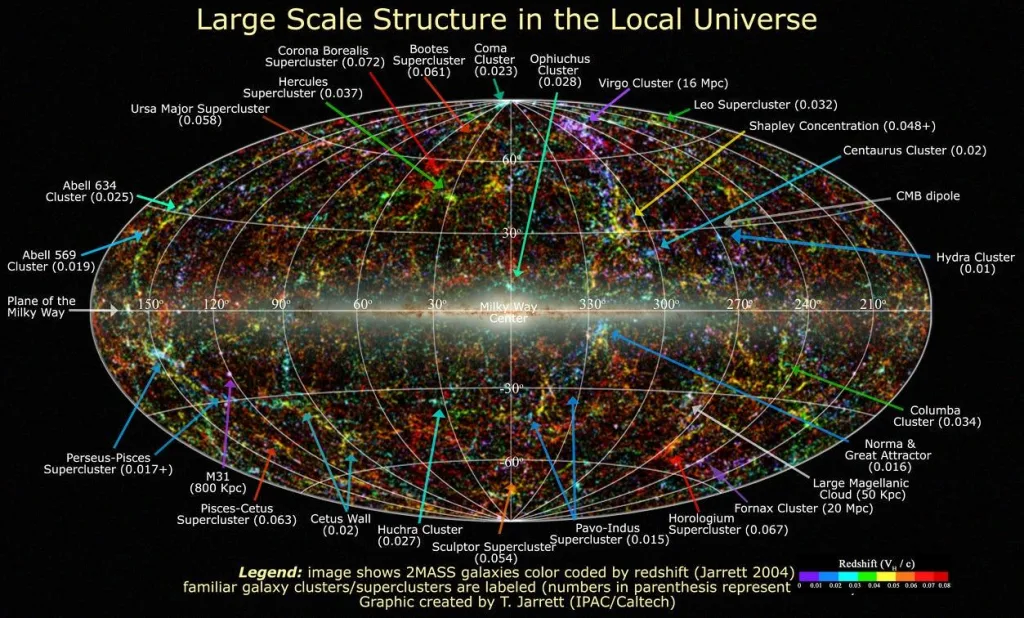
The Vela Supercluster lies behind one of astronomy’s most challenging regions: the Zone of Avoidance. This is where the Milky Way dominates the sky. Dense concentrations of stars and interstellar dust obscure anything beyond it.
Roughly one-fifth of the night sky falls into this blind spot. Optical telescopes struggle here because light from distant galaxies gets scattered and absorbed. Even large cosmic structures can vanish behind this veil.
That is exactly what happened with the Vela Supercluster. Early observations hinted at its presence, but they revealed only fragments. Its true extent remained unknown.
From Unknown Territory to Defined Structure
When astronomers first identified the Vela Supercluster in 2016, they treated it as largely uncharted territory. The structure earned a reputation as a cosmic unknown, with unclear boundaries and uncertain mass.
Recent observations changed that. Instead of relying only on visible light, researchers tracked how galaxies move through space. By combining thousands of measurements, they built a coherent picture of the region.
The result is the first reliable map of the Vela Supercluster. It confirms a massive, connected structure that had been hidden in plain sight.
Inside the Vela Supercluster: Scale, Mass, and Structure
A Structure on a Cosmic Scale
The Vela Supercluster spans roughly 300 million light-years. That makes it about 3,000 times wider than the Milky Way. It includes at least 20 galaxy clusters, each filled with hundreds or thousands of galaxies.
Its total mass reaches an estimated 30 quadrillion suns. That level of mass places it among the most significant structures in the nearby universe.
A Dynamic Internal Structure
The new map reveals more than size. It shows motion. Two major cores dominate the structure, and they appear to be moving toward each other.
This interaction reflects the gravitational forces shaping the cosmic web. Observing these movements helps astronomers understand how massive structures grow and evolve over time.
Position Among the Universe’s Giants
The Vela Supercluster rivals the Laniakea Supercluster, which contains our galaxy. It also approaches the scale of the Shapley Supercluster, one of the most massive known superclusters.
While even larger formations exist beyond this category, Vela stands out as a key structure in our local cosmic environment.
How Scientists Mapped the Vela Supercluster
Seeing Through the Cosmic Dust
To uncover the Vela Supercluster, astronomers turned to radio astronomy. Unlike visible light, radio waves can pass through dust clouds. This allows scientists to detect galaxies hidden behind the Milky Way.
Hydrogen gas within galaxies emits radio signals. By observing this emission, astronomers can trace galaxies that remain invisible in optical surveys.
The Power of MeerKAT
A crucial role in this discovery came from the MeerKAT telescope. This array of radio dishes operates in South Africa and captures faint signals from deep space.
Researchers gathered thousands of new measurements using MeerKAT. They combined these with tens of thousands of existing data points. This combination provided the clarity needed to map the structure.
Tracking Motion with Redshift
Scientists relied on Redshift to understand galaxy motion. Redshift reveals how fast galaxies move away due to cosmic expansion. By analyzing these motions, researchers defined the boundaries of the Vela Supercluster.
This approach reveals more than location. It shows how galaxies behave within a larger gravitational system.
What Remains Hidden
Even now, some regions remain difficult to observe. Not all galaxies emit strong radio signals. As a result, parts of the Vela Supercluster may stay partially obscured.
Future instruments will improve this picture, but complete visibility may never be possible.
Why the Vela Supercluster Matters for Cosmology
Refining Our Models of the Universe
The Vela Supercluster adds critical data to cosmology. Scientists need precise measurements of large structures to test their models. Size and motion both play key roles.
With improved observations, researchers can better compare theory with reality. This leads to more accurate simulations of the universe’s evolution.
The Influence of Hidden Mass
Massive structures shape how galaxies move. The Vela Supercluster contributes a significant amount of mass to our region of space. This affects large-scale motion patterns across the cosmos.
Understanding these influences helps explain how galaxies cluster and drift over time.
A Reminder of What We Cannot See
The discovery of the Vela Supercluster highlights a major limitation. Our map of the universe is incomplete. If such a large structure remained hidden for so long, others may exist as well.
Astronomers now recognize that the Zone of Avoidance still holds unanswered questions. Each new observation could reveal another hidden structure.
Looking Toward the Future
New radio telescopes will continue to expand our view. They will detect weaker signals and map more distant regions. However, some observational limits will remain.
Even with advanced tools, the universe will always retain some of its mystery.
Conclusion — Vela Supercluster and the Hidden Universe
The Vela Supercluster stands as a powerful example of how much remains unseen. Its discovery and mapping mark a turning point in our understanding of the cosmos.
This structure is more than a distant curiosity. It represents a missing piece of the cosmic puzzle. It shows that even nearby regions can conceal vast formations.
As astronomy advances, more hidden structures may come into view. Until then, the Vela Supercluster reminds us that the universe is still unfolding, revealing its scale one discovery at a time.
Main Sources:
- https://www.livescience.com/space/astronomy/astronomers-just-mapped-one-of-the-largest-structures-in-the-universe-long-hidden-behind-the-milky-ways-zone-of-avoidance
- https://arxiv.org/ (Preprint study on Vela Supercluster mapping)