BY:SpaceEyeNews.
Voyager 2 Neptune navigation achieved something that still sounds almost impossible. After twelve years and more than 7.1 billion kilometres, the spacecraft reached its planned encounter point within only 100 kilometres. NASA compares that accuracy to sinking a golf putt from 3,630 kilometres away.
This was not simply an impressive number. The spacecraft needed to follow a narrow route past Neptune and then continue toward Triton. Its precision determined which discoveries the mission could make during humanity’s only close visit to the distant planet.
How Voyager 2 Neptune Navigation Achieved Its Precision
NASA launched Voyager 2 on August 20, 1977. Jupiter and Saturn formed its primary destinations. However, mission planners selected a route that kept Uranus and Neptune within reach.
A rare alignment of the outer planets made the extended journey possible. Such a useful arrangement occurs roughly once every 175 years. Voyager 2 used gravity assists at each major encounter to change its direction and speed.
These assists created the broad path through the outer Solar System. Yet they could not provide all the fine adjustments needed near Neptune. Navigation teams had to refine the route throughout the journey.
Small Adjustments Made a Major Difference
After the Uranus encounter, Voyager 2 completed its largest midcourse correction. On February 14, 1986, it operated its hydrazine thrusters for two hours and 33 minutes.
That adjustment gave mission planners more flexibility when selecting the final Neptune route. Engineers continued tracking the spacecraft as it crossed billions of kilometres.
Radio signals helped them measure distance and motion. Doppler measurements revealed small changes in velocity. Optical images also helped navigation teams refine the positions of Neptune and its moons.
Later updates improved the spacecraft’s instrument and antenna pointing. These corrections mattered because the encounter would pass quickly. Voyager could not pause or repeat an observation.
The final numbers reveal the scale of the achievement. NASA records a traveled distance of 7,128,603,456 kilometres before Neptune. The delivery accuracy came within 100 kilometres of the intended encounter point.
That equals an error margin of about 14 parts per billion. On NASA’s imaginary 3,630-kilometre golf green, the comparable deviation would measure only about five centimetres.
Why the Neptune Encounter Point Mattered
The 100-kilometre figure does not describe Voyager 2’s altitude above Neptune. It measures the difference between the planned encounter point and the spacecraft’s delivered position.
Voyager 2 passed about 4,950 kilometres above Neptune’s north pole on August 25, 1989. This became its closest approach to any planet during the entire mission.
Engineers designed that route to accomplish more than a close look at Neptune. The planet’s gravity redirected the spacecraft toward Triton, Neptune’s largest moon.
Around five hours later, Voyager 2 passed approximately 40,000 kilometres from Triton. A larger navigation error near Neptune could have changed that second encounter. It might also have affected camera angles, instrument timing and the quality of the resulting data.
Working With an Eight-Hour Communication Delay
Distance created another challenge for Voyager 2 Neptune navigation. Radio signals required more than four hours to travel between Earth and Neptune. A complete round trip took over eight hours.
Therefore, controllers could not guide the encounter in real time. They had to prepare commands and observation sequences before each event occurred.
Neptune’s distance from the Sun also made photography difficult. Sunlight near the planet reaches only about one-thousandth of its intensity at Earth. Voyager’s cameras needed longer exposures to collect enough light.
Meanwhile, the spacecraft’s motion could blur those exposures. Engineers adjusted camera movements to compensate and preserve image clarity.
Receiving Voyager’s faint radio signal presented another challenge. NASA expanded its largest Deep Space Network antennas from 64 to 70 metres. The Parkes radio telescope in Australia and the Very Large Array in New Mexico also supported the encounter.
Together, these facilities increased receiving power and helped return the valuable data to Earth.
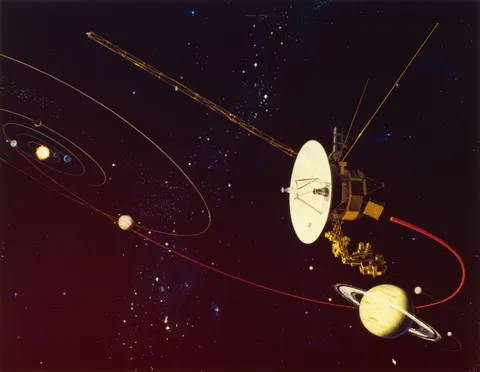
What Voyager 2’s Neptune Precision Delivered
The carefully planned route produced discoveries that continue to shape Neptune research. Voyager 2 observed the Great Dark Spot, a vast atmospheric feature that resembled Jupiter’s Great Red Spot.
It also recorded fast-moving clouds, powerful winds and Neptune’s faint rings. NASA’s historical summaries credit the encounter with finding six new moons and four rings. Some newer NASA pages list five newly discovered moons because they apply different classifications to an earlier observation.
Triton Revealed an Active Frozen World
Triton provided some of the mission’s greatest surprises. Voyager measured a surface temperature near minus 235 degrees Celsius. It was the coldest natural surface the spacecraft encountered.
Images revealed dark plumes rising above Triton’s icy landscape. Scientists linked these features to nitrogen gas carrying material into the moon’s thin atmosphere.
The terrain also showed signs of relatively recent geological activity. Triton was not simply a frozen and unchanged object. It appeared far more dynamic than researchers had expected.
Voyager 2 returned more than 9,000 images during its wider Neptune observation period. Those pictures documented the planet, its atmosphere, rings and moons from perspectives unavailable to Earth-based observatories.
Why Neptune Still Has No Second Visitor
Voyager 2 remains the only spacecraft to explore Neptune and Triton at close range. No approved mission has yet repeated the 1989 encounter.
Interest in the ice giants has grown since then. Astronomers have discovered thousands of planets around other stars, including many worlds similar in size to Uranus and Neptune. Studying our own ice giants could therefore improve our understanding of planetary systems across the galaxy.
However, the latest planetary science decadal survey gives its highest new flagship priority to a Uranus Orbiter and Probe. A dedicated Neptune mission remains a scientific proposal rather than an approved journey.
Voyager 2 Neptune Navigation Still Inspires
Voyager 2 Neptune navigation succeeded through precise tracking, planned corrections and careful coordination. It was not the result of one perfect calculation made before launch.
Reaching the intended point within 100 kilometres allowed Voyager to study Neptune and continue toward Triton. That single route produced discoveries scientists still examine decades later.
The golf-putt comparison makes the scale easier to imagine. Yet the deeper achievement lies in guiding a 1970s spacecraft across 7.1 billion kilometres and delivering it exactly where science needed it to be.
Main Sources:
NASA Voyager mission facts: https://science.nasa.gov/mission/voyager/did-you-know/
NASA Voyager planetary journey: https://science.nasa.gov/mission/voyager/planetary-voyage/
NASA Neptune flyby history: https://www.nasa.gov/solar-system/30-years-ago-voyager-2s-historic-neptune-flyby/
JPL Neptune flyby preparation: https://www.jpl.nasa.gov/news/voyager-2-prepares-for-1989-neptune-flyby/
National Academies planetary science priorities: https://www.nationalacademies.org/news/report-identifies-priority-planetary-science-missions-planetary-defense-efforts-and-strategic-investments-for-the-next-decade