
BY:SpaceEyeNews.
The Vulcan launch failure that cost Amazon 40 internet satellites began to unfold shortly after liftoff on November 15. United Launch Alliance (ULA) lost contact with the rocket about ten minutes into the flight. By then, the best chance of understanding what went wrong lay in data from the opening minutes. In a November 18 update, ULA said Vulcan appeared to have supplied too little fuel to its two Blue Origin BE-4 engines. Investigators still have to establish why.
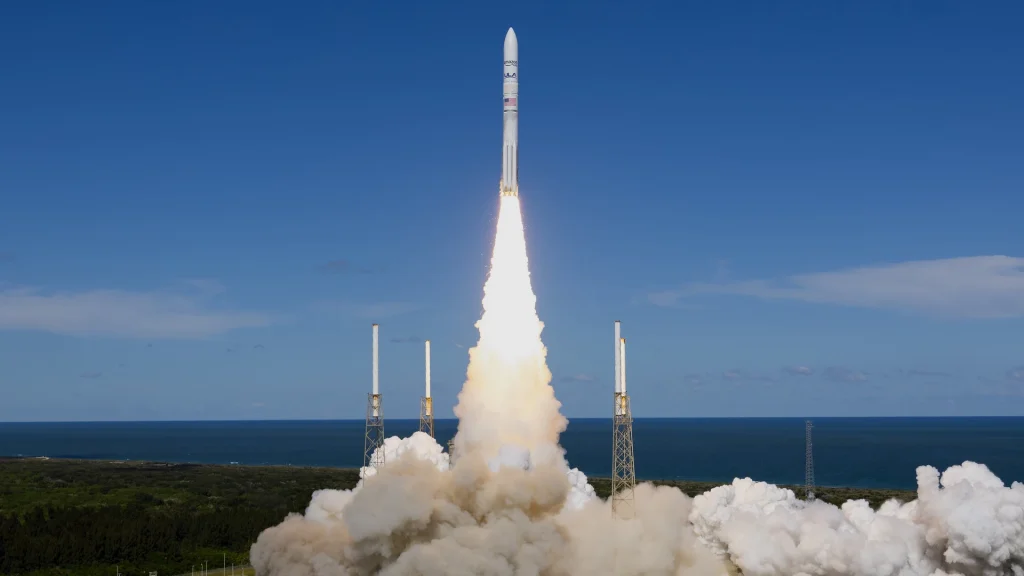
Vulcan lifts off from Cape Canaveral on November 15, 2026, carrying 40 Amazon Leo satellites. Photo credit: United Launch Alliance.
Where the Vulcan launch failure began
Vulcan lifted off from Cape Canaveral carrying the largest batch of satellites Amazon had yet assigned to a Leo mission. The rocket flew with six solid boosters alongside its liquid-fueled first stage. Above them sat Centaur V, the upper stage responsible for taking the satellites the rest of the way to orbit.
The critical moment came when the two stages separated. By ULA’s initial assessment, the first stage had delivered less thrust than expected almost from the start. Centaur took over at a lower altitude than planned, with too little speed to complete the climb. Its RL10 engines started and appear to have run as engineers expected. Even so, the upper stage could only add so much speed with the propellant it carried.
That sequence explains a detail in ULA’s first public statement. On launch day, the company placed the anomaly about ten minutes into flight. Two days later, engineers identified a much earlier loss of performance. The later time marked the apparent loss of telemetry and the mission. The earlier one gave investigators a place to start looking for the cause.
What changed when ULA reviewed the fuel data
On November 17, ULA could say which stage had fallen short. Its next update narrowed the question further. After reviewing data from across the vehicle, engineers identified inadequate fuel delivery to the BE-4 engines as the likely explanation for low thrust. That finding shifted attention to what reached the engines during ascent.
The distinction matters because a thrust reading alone tells engineers little about the source of a problem. An engine needs a steady supply of fuel to deliver the thrust the flight plan calls for. If the vehicle supplies too little, thrust can fall even when the engine hardware responds as designed. ULA’s public update leaves open which part of the delivery process fell short. It also leaves open what engineers might need to change before another flight.
How the solid boosters performed
The six side-mounted boosters presented a separate question. A nozzle problem on an earlier mission had prompted improvements ahead of the Amazon launch. Investigators therefore had a specific reason to examine how those components behaved this time. ULA said the flight data indicated normal performance from the solid boosters. Its preliminary explanation centers on the liquid-fueled stage that flew between them.
Why Blue Origin has a stake in the findings
Blue Origin builds both of Vulcan’s BE-4 engines. It also uses seven engines of the same design on the first stage of its own New Glenn rocket. For Amazon, that shared hardware connects two launch contracts. The company booked 38 Vulcan missions and converted options with Blue Origin into a firm commitment for 24 New Glenn flights.
An internal BE-4 fault would raise a question for engineers working on both vehicles. The early evidence instead points to fuel delivery aboard Vulcan, a narrower finding. Blue Origin chief executive Dave Limp acknowledged his team’s work supporting ULA’s investigation after the update. For New Glenn customers, the relevant detail will be whether the final review identifies anything that also applies to their rocket.
What the loss means for Amazon Leo
Amazon had planned to put more than 1,500 first-generation Leo satellites into orbit across its 38 Vulcan missions. The November flight was the first in that series. Its 40 satellites represented a step up from earlier deliveries. For comparison, an Atlas V carried 29 Leo satellites in July, while an Ariane 6 carried 36 in June.
Amazon had also changed how crews prepare each flight. Amazon invested more than $200 million in upgrades at ULA’s Cape Canaveral facilities. A dedicated assembly building and another mobile launch platform allow crews to prepare two Vulcan missions at once. Before the November flight, work on the second rocket was already underway in a separate building. Amazon had expected the launches to follow within weeks if the first mission went to plan.
Before launch, Amazon said it had completed its thousandth satellite in September and had hundreds ready to fly. That inventory gives the company spacecraft for upcoming missions. It also shows why launch frequency matters so much to Leo. Satellites waiting at the factory can add capacity to the network only once a rocket delivers them to their intended orbit.
The next Leo flight uses Ariane 6
Amazon’s next scheduled launch follows a different route. As of November 19, Arianespace was targeting November 23 to launch 36 Leo satellites from Kourou, French Guiana. That mission was already on the schedule before Vulcan lifted off. Amazon lists the flight as Leo Europe 4, its fourth mission in the European series. It gives Amazon another opportunity to add satellites while ULA investigates. An Ariane 6 flight would advance the constellation, though Amazon’s larger deployment plan still depends heavily on Vulcan.
What ULA still needs to establish
The Vulcan launch failure investigation now turns on a practical question. What prevented the first stage from supplying enough fuel just after liftoff? The answer matters to the team preparing the next rocket in Florida. Knowing when thrust first fell can direct engineers toward the fault. Identifying what caused it will help them decide what to inspect, test or change.
ULA leads the investigation under Federal Aviation Administration oversight. The FAA will review and approve the final findings, including any corrective actions. For now, the flight data explain how an early shortfall left 40 satellites out of reach of orbit. The next milestone is an explanation precise enough for engineers to act on before Vulcan flies again.
Main sources:
United Launch Alliance — Vulcan Leo 1 investigation updates
https://blog.ulalaunch.com/blog/vulcan-leo-1-updates
Amazon — First Vulcan mission and launch preparations
https://www.aboutamazon.com/news/amazon-leo/amazon-leo-vulcan-satellites-launch
Amazon — Leo mission dates and payloads
Blue Origin — New Glenn and its BE-4 engines
https://www.blueorigin.com/new-glenn
Amazon — Launch contracts and Cape Canaveral investment
https://www.aboutamazon.com/news/amazon-leo/amazon-leo-plans-double-launch-rate-20-missions
GeekWire — Todd Bishop’s November 18 coverage
You Might Also Like:
Vulcan rocket failure: Amazon Loses 40 Satellites—What Next?
Recent Liquid Water on Mars: Zhurong’s New Evidence