
BY:SpaceEyeNews.
A wandering black hole has revealed itself about 30,000 light-years from the center of a massive galaxy. Astronomers found it after a nearby star produced a bright and unusual flare.
The object may hold around one million times the Sun’s mass. Yet deep images show no obvious dwarf galaxy or star cluster around it. Its isolated position raises a major question. How did such a large black hole reach the galaxy’s outskirts?
Known as TDE 2025abcr, the event offers a rare look at a hidden population. These displaced black holes may preserve evidence of mergers that shaped galaxies billions of years ago.
A Stellar Flare Exposed the Wandering Black Hole
The Zwicky Transient Facility, or ZTF, first detected the flare on November 4, 2025. ZTF photographs the northern sky every two days from Palomar Observatory in California.
Its cameras record hundreds of thousands of changing objects each night. Most are variable stars, supernovae or other temporary events. Checking each object manually would be impossible.
Robert David Stein and his colleagues developed a machine-learning system to manage that flood of data. Their classifier searched for light patterns linked to tidal disruption events, or TDEs.
Previous searches focused mainly on galaxy centers. That approach made sense because massive black holes usually occupy galactic nuclei. However, it also created a large observational blind spot.
The team modified the program to examine flares anywhere in each image. It began operating in August 2025. Only three months later, it identified TDE 2025abcr far from its apparent galaxy’s center.
Normally, this wandering black hole would produce no visible light. The passing star briefly changed that.
Why the Flare Was Not a Supernova
At first, an off-center flare might appear to come from an exploding star. However, TDE 2025abcr behaved differently.
Its temperature exceeded about 9,900 degrees Celsius. More importantly, it became hotter by roughly 89 degrees Celsius each day. A typical supernova generally cools as its material expands.
Spectroscopic observations provided stronger evidence. The flare displayed broad hydrogen and helium features at the same distance as the nearby galaxy. Its brightness and changing temperature also matched a tidal disruption event.
In this process, a star travels close enough to a black hole for intense gravity to pull its material into long streams. Some of that material heats up and produces a bright flare lasting for months.
Astronomers did not photograph the black hole itself. Instead, they detected its influence on the star and the resulting light. The event therefore acted like a temporary beacon at the black hole’s location.
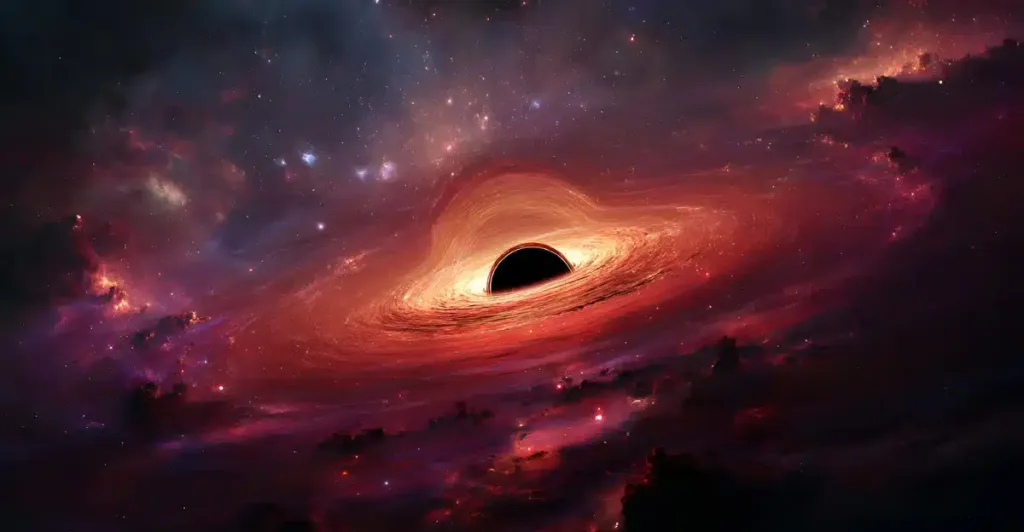
The most distant black hole ever confirmed has just been found — and it’s baffling astronomers.
A Million-Solar-Mass Object With No Visible Home
The wandering black hole may contain about 1.2 million solar masses. That estimate comes from the flare’s peak luminosity, not from tracking stars around the object.
As a result, the mass remains uncertain. The study allows a range from roughly 360,000 to four million solar masses.
Meanwhile, the main galaxy contains about 150 billion solar masses in stars. Its central black hole may reach approximately 660 million solar masses. TDE 2025abcr therefore points to a separate and much lighter object.
The measured separation is 9.3 kiloparsecs, or around 30,000 light-years. This is only the projected distance visible from Earth. The true three-dimensional separation could be greater.
Deep observations found no clear dwarf galaxy or dense star cluster at the flare’s position. Four faint objects appear nearby, but none aligns with the event. The black hole consequently appears to have no visible home.
How Did the Wandering Black Hole Get There?
Researchers propose two main explanations. Both begin with galaxies merging, but they produce the black hole’s unusual position in different ways.
A stripped galaxy may remain hidden
A large galaxy may have absorbed a smaller companion. During that process, gravitational forces could have gradually removed most of the smaller galaxy’s stars.
Its dense nucleus may have survived with the original central black hole still inside. Any remaining stars could now be too faint for current images to reveal.
If this explanation is correct, the object is not completely alone. It occupies the almost invisible remains of a smaller galaxy.
Three black holes may have interacted
Another possibility involves three massive black holes. Two may already have formed a binary near the galaxy’s center. A later merger could then have introduced a third.
Their complex gravitational interaction may have displaced the lightest member toward the galaxy’s outskirts. Computer models have long predicted this type of outcome.
However, astronomers have not observed TDE 2025abcr moving across space. The term “wandering” describes its displaced location and possible history. It does not represent a direct measurement of its motion.
Later observations may separate the two scenarios. As the flare fades, sensitive telescopes could uncover a faint stellar remnant around the black hole.
Why This Discovery Matters
TDE 2025abcr is not the first evidence of an off-center massive black hole. The earlier event AT2024tvd appeared about 2,600 light-years from its galaxy’s nucleus.
However, the new object sits much farther away. Researchers describe it as the first optical tidal disruption event discovered clearly in a massive galaxy’s far outskirts.
That difference matters because traditional surveys rarely searched such locations for black-hole activity. Other wandering objects may already exist in archived observations but remain classified as different types of flares.
The study estimates that highly displaced TDEs occur at less than 10% of the rate seen in galaxy centers. One detection cannot establish their true abundance, though.
A larger sample could reveal how often mergers leave black holes behind. It could also show whether most remain inside faint galactic remnants or become genuinely isolated.
Rubin Observatory Could Discover Many More
The Vera C. Rubin Observatory will repeatedly survey the southern sky with exceptional depth and detail. Its data could transform the search for displaced black holes.
Researchers expect Rubin to identify many dozens of off-center tidal disruption events each year. Its precision should also resolve smaller separations that older surveys struggle to measure.
Each new detection will add another piece to the history of galaxy mergers. Together, these events may show how black holes move, interact and settle as galaxies grow.
Wandering Black Hole Opens a New Search
TDE 2025abcr remained hidden until a passing star illuminated its location. That brief flare exposed a massive black hole far beyond the region where astronomers usually search.
Its exact origin remains uncertain. It may occupy a stripped galactic core, or gravitational interactions may have displaced it.
Either way, this wandering black hole suggests that galactic outskirts contain overlooked objects. Future surveys could turn one remarkable discovery into an entirely new population.
Main Sources:
TDE 2025abcr study:
https://arxiv.org/abs/2602.10180
University of Maryland:
https://cmns.umd.edu/news-events/news/first-ever-wandering-black-hole-tde-stein-gezari-veilleux
Zwicky Transient Facility:
https://www.ztf.caltech.edu/new/ztf-spots-tde2025abcr.html
Earlier AT2024tvd study:
https://arxiv.org/abs/2502.17661