BY:SpaceEyeNews.
Astronomers have identified a wandering black hole in one of the most unexpected places yet observed. The object revealed itself through a brilliant flare located more than 30,000 light-years from the center of a massive galaxy.
The flare, known as TDE 2025abcr, appeared when a passing star moved dangerously close to the hidden black hole. The star’s material heated rapidly and produced radiation that telescopes could detect across several wavelengths.
That type of event is rare. Its location makes this case even more important. Most known tidal disruption events appear near galactic centers, where astronomers expect massive black holes to reside. TDE 2025abcr instead exposed a massive object far into its galaxy’s outskirts.
A Wandering Black Hole Revealed by a Distant Flare
TDE 2025abcr occurred in the outskirts of the galaxy WISEA J014656.04-152214.7. Observations place the event roughly 9 to 10 kiloparsecs from the galaxy’s visible nucleus. That equals a projected separation of about 30,000 light-years.
Researchers describe it as the first optical tidal disruption event found through a dedicated search of a galaxy’s outer regions. However, later studies note that another optically selected off-center event had already been identified. The safest description is that TDE 2025abcr ranks among the clearest and most distant optical examples of its kind.
The event released an enormous amount of energy. NASA reported that the ultraviolet flare briefly became brighter than the entire host galaxy. Its peak output approached the brightness of roughly 10 billion Suns.
Astronomers did not rely on brightness alone. Optical spectra showed broad hydrogen and helium features commonly associated with tidal disruption events. NASA’s Swift Observatory also detected ultraviolet and X-ray radiation. Together, the event’s temperature, spectrum and fading pattern helped researchers confirm its nature.
The Black Hole Was Hiding Outside the Galactic Nucleus
The wandering black hole behind TDE 2025abcr likely contains around one million times the Sun’s mass. The original study estimated a mass close to 1.2 million solar masses, although the uncertainty remains significant.
That value makes the object far smaller than the black hole believed to occupy the host galaxy’s center. Researchers estimate that the central object could contain several hundred million solar masses.
This difference supports the idea that astronomers detected a secondary black hole rather than the galaxy’s main central object. It may represent the surviving core of a smaller galaxy that merged with the larger system long ago.
Importantly, astronomers did not directly photograph the black hole. Black holes produce no visible light on their own. Instead, researchers inferred its presence from the radiation released by the disrupted star.
The term “wandering” also requires care. Scientists have not yet measured the object moving across the galaxy. The label describes a massive black hole located far from the main galactic nucleus. Its full orbit and three-dimensional position remain unknown.
How Did the Wandering Black Hole Get There?
A past galaxy merger offers the leading explanation.
Large galaxies grow partly by absorbing smaller systems. During such a merger, tidal forces can strip away most of the smaller galaxy’s stars. However, its central black hole may survive. It can remain far from the new galaxy’s center for a long period.
In this scenario, the wandering black hole may still sit inside a faint star cluster or the compact remains of a disrupted dwarf galaxy.
Later observations from the James Webb Space Telescope and the Keck Observatory found infrared emission at the event’s location. One possible interpretation involves an unresolved stellar cluster with tens of millions of solar masses. Such a cluster could represent the remaining nucleus of a smaller merged galaxy.
Yet the evidence remains uncertain. Gas surrounding the disrupted star could also produce the infrared excess. Researchers therefore cannot confirm that a hidden stellar cluster surrounds the black hole.
Another scenario involves gravitational interactions near the host galaxy’s center. When several massive black holes gather after repeated mergers, their interactions can push the lightest object outward. The displaced black hole may then travel through the galaxy’s outer regions.
Future observations could distinguish between these possibilities. Once the flare fades, telescopes may reveal whether a compact galaxy remnant remains at the same location.
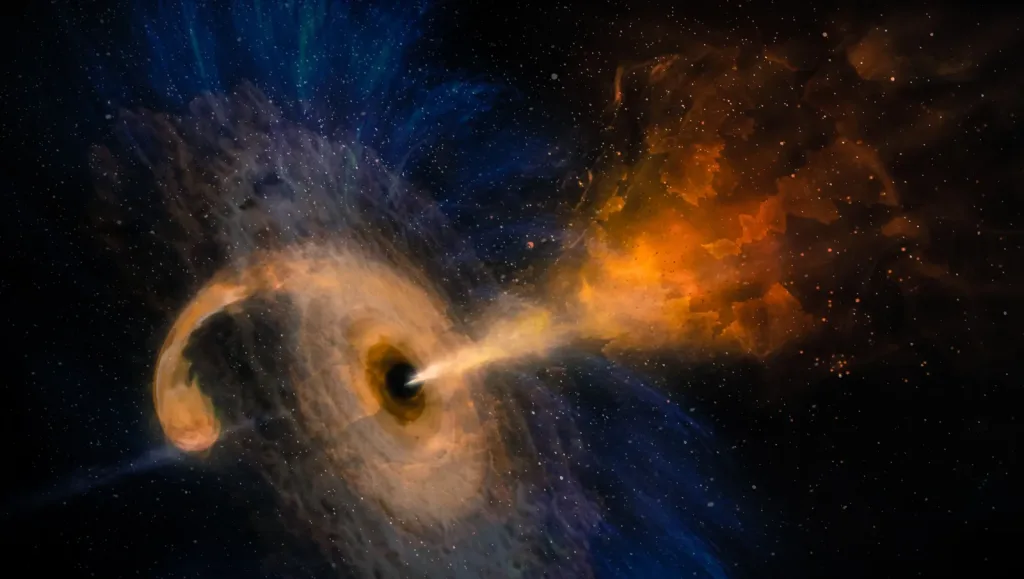
Astronomers identify one of the universe’s rarest black hole events.
AI Found an Event Traditional Searches Could Miss
Artificial intelligence played a central role in the discovery.
Modern surveys detect enormous numbers of changing objects each night. The Zwicky Transient Facility alone records hundreds of thousands of temporary or variable sources. Astronomers must quickly decide which ones deserve further observation.
Researchers used a machine-learning classifier called tdescore to identify possible tidal disruption events. They modified the system so it would also search far from galaxy centers.
That adjustment proved crucial. Traditional searches often prioritize nuclear flares because most known tidal disruption events occur there. An automated system built around that expectation could easily ignore an unusual off-center source.
The AI tool did not prove that TDE 2025abcr was a tidal disruption event. It selected the source as a strong candidate. Astronomers then confirmed it with observations from the SOAR Telescope, Swift and other instruments.
The discovery shows how search assumptions can shape astronomical results. Once researchers removed the galactic-center restriction, they uncovered a black hole that might otherwise have remained invisible.
A New Way to Find Hidden Black Holes
Astronomers expect displaced black holes to exist after galaxy mergers. Finding them has remained difficult because inactive black holes emit almost no detectable radiation.
Tidal disruption events provide a temporary solution. When a star passes close enough, the resulting flare acts like a cosmic marker. It reveals the black hole’s location and allows scientists to estimate its mass.
The original study suggests that highly offset events occur at less than 10% of the rate seen near galactic nuclei. That still leaves a potentially large hidden population.
The Vera C. Rubin Observatory could transform the search. Its wide survey of the changing sky may detect dozens of clearly offset tidal disruption events each year. Other facilities can then provide rapid follow-up observations.
Conclusion: One Wandering Black Hole May Reveal Many More
TDE 2025abcr matters because it exposed a massive black hole where astronomers rarely look. The star’s flare revealed an object more than 30,000 light-years from its galaxy’s center.
This wandering black hole may be the remnant of a smaller galaxy or an object pushed outward by complex gravitational interactions. Astronomers still need more evidence to determine its history.
Even so, the discovery proves that visible-light surveys, AI classifiers and rapid telescope observations can uncover hidden black holes across galaxies. As new observatories begin scanning the sky, TDE 2025abcr may become the first clear sign of a much larger wandering population.
Main Sources:
University of North Carolina at Chapel Hill:
https://college.unc.edu/2026/07/black-hole/
NASA Science:
https://science.nasa.gov/missions/swift/nasas-swift-sees-wandering-mega-black-hole-shredding-star/
Original study in The Astrophysical Journal Letters:
https://arxiv.org/abs/2602.10180
JWST and Keck follow-up study:
https://arxiv.org/abs/2604.16093
Phys.org article:
https://phys.org/news/2026-07-astronomers-universe-rarest-black-hole.html