
BY:SpaceEyeNews.
WASP-17b’s uneven atmosphere has given astronomers a clearer view of how heat shapes a distant giant planet. Using the James Webb Space Telescope, researchers found that its evening atmosphere extends farther outward than its morning atmosphere. The result creates an uneven outline around this intensely heated world.
The discovery goes beyond an unusual shape. It reveals differences that conventional atmospheric averages can hide. Scientists can now investigate conditions around different parts of the planet’s edge, bringing detailed studies of alien climates closer.
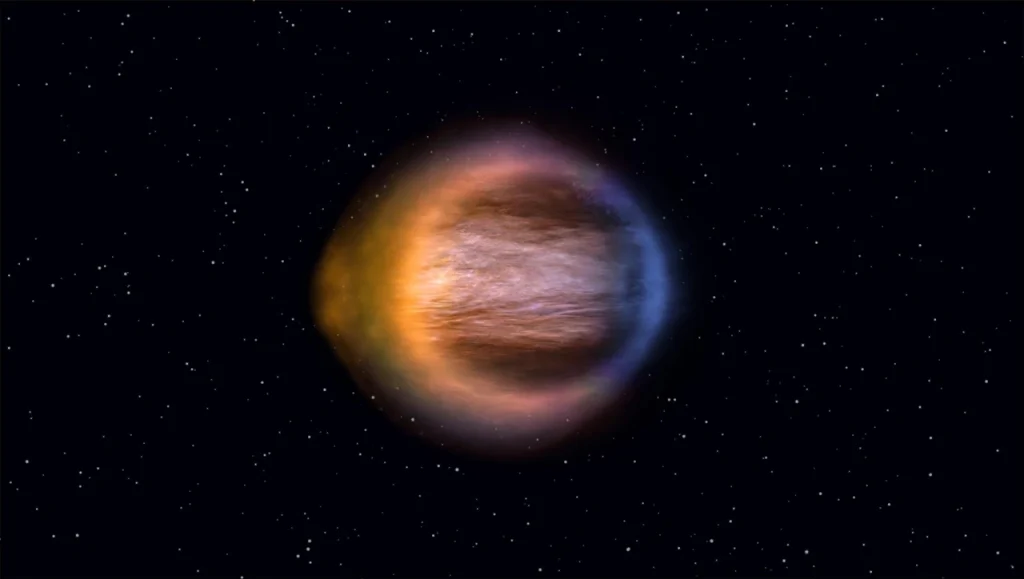
WASP-17b’s Uneven Atmosphere Revealed by James Webb.
What Webb Revealed About WASP-17b’s Uneven Atmosphere
WASP-17b orbits a star roughly 1,300 light-years from Earth. Its atmosphere experiences intense heating, while powerful circulation redistributes energy around the planet.
Researchers led by Lili Alderson investigated these conditions through a collaboration involving Cornell University and the University of Bristol. Their study appeared in Nature Astronomy on October 14, 2026.
The team found a more extended atmosphere near the evening equator. The morning equator showed a comparatively compact atmospheric edge.
However, Webb did not photograph a visibly distorted planet. Researchers reconstructed these differences from changes in starlight during planetary transits. The colorful images accompanying the announcement illustrate that interpretation. www.bristol.ac.uk
Why the Evening Atmosphere Extends Farther
The explanation begins with the planet’s permanent dayside and nightside. One hemisphere receives continuous stellar heating, while the opposite hemisphere faces away from the star.
This arrangement creates strong contrasts in atmospheric conditions. Equatorial winds transport heated gas away from the dayside and toward the nightside.
Hot Gas Crosses the Evening Edge
At the evening boundary, gas arrives from the strongly heated dayside. Higher temperatures allow the atmosphere to expand, increasing its vertical extent.
That expansion gives the evening edge a larger apparent atmospheric radius. The result matches the pattern researchers expected from atmospheric circulation models.
Here, “evening” describes a location where circulating gas moves toward darkness. It does not mean the planet experiences an ordinary sunset cycle like Earth.
Cooler Gas Returns Across the Morning Edge
Gas loses heat as it travels across the nightside. When it reaches the morning boundary, its lower temperature produces a less extended atmosphere.
Together, these differences explain the unequal contours. The observations support the predicted circulation pattern, although they do not directly film winds moving around the planet.
How Transmission Strings Reveal Hidden Differences
The researchers used a method called “transmission strings,” developed by Bristol astrophysicists David Grant and Hannah Wakeford.
During a transit, the planet crosses in front of its star. Some starlight passes through the atmosphere before reaching Webb. Different gases absorb different wavelengths, leaving clues about atmospheric conditions.
Traditional analysis often combines those clues into one spectrum representing the entire atmospheric edge. That approach provides valuable information, but it can conceal regional differences.
Moving Beyond a Single Average
Transmission strings allow the apparent atmospheric radius to change around the planet’s outline. Researchers can then reconstruct spectra for different angles along that boundary.
This approach separates conditions that an average would blend together. Instead of assigning one atmospheric profile to the whole edge, scientists explore how those properties vary.
The study combined observations from Webb’s NIRISS, NIRSpec and MIRI instruments. Together, their measurements covered wavelengths from 0.6 to 12 micrometers.
Crucially, the method also explores variations between equatorial and polar regions. That adds detail beyond a simple comparison between two atmospheric halves.
A Temperature Difference of Around 650 Degrees
The analysis indicates an approximately 650-kelvin temperature difference between the morning and evening edges. A temperature difference of 650 kelvin equals a difference of 650 degrees Celsius.
These values come from atmospheric modeling, rather than direct thermometer readings. They carry uncertainties, so the estimated contrast should not become an exact, fixed number.
Nevertheless, the overall pattern fits theoretical expectations. The hotter evening atmosphere has a greater vertical extent than the cooler morning atmosphere. www.nature.com
Chemistry Adds Another Piece
The researchers also examined water vapor and carbon dioxide around the atmospheric edge. Their results were consistent with constant abundances of these molecules across the sampled regions.
This distinction matters. Different-looking spectra do not automatically mean that each region contains dramatically different amounts of gas. Temperature and atmospheric extent also influence the signals.
Other observations of the planet’s dayside and nightside support the broader interpretation. Together, these measurements provide complementary ways to test atmospheric models.
What WASP-17b’s Uneven Atmosphere Cannot Show Yet
The findings represent progress toward atmospheric mapping, but they do not provide a complete weather forecast.
Scientists have not tracked individual storms across WASP-17b or watched clouds evolve through successive days. The study maps inferred atmospheric properties around the transmitting edge.
The analysis also assumes symmetry between the northern and southern hemispheres. That choice simplifies the reconstruction and reflects expectations from circulation models.
Additionally, transmission strings require especially strong observational data. Greater spatial detail comes with trade-offs, including larger uncertainties and lower spectral resolution than some alternative approaches.
Those limits help define what the results can support. The map reveals meaningful structure without resolving every atmospheric feature. www.nature.com
A New Direction for Alien Weather Studies
WASP-17b’s uneven atmosphere shows why a single average cannot capture everything happening around a distant world.
The next step involves applying this technique to other suitable planets. Comparisons could help researchers test how atmospheric structure changes under different conditions.
For now, the strongest result is clear: Webb observations reveal regional differences consistent with heat circulating through an intensely irradiated atmosphere. The evening edge expands, while the cooler morning edge remains less extended.
That brings exoplanet research closer to explaining atmospheric behavior, alongside identifying atmospheric ingredients. A distant point of light can now reveal a more structured and dynamic world.
Main sources:
- University of Bristol: Trailblazing technique uncovers real shape of scorching-hot exoplanet atmospheres
- Nature Astronomy: A spatial map of the atmospheric limb of a hot Jupiter
- SciTechDaily: NASA’s James Webb Telescope Reveals a Giant Alien Planet That’s Not Quite Round
You Might Also Like:
Venus Tectonic Activity May Still Be Reshaping the Planet
Interstellar Comet 3I/ATLAS Lights Up Mars in a Historic NASA Flyby.
Jupiter Lightning Stronger Than Earth: New Study Reveals Extreme Storm Physics