
BY:SpaceEyeNews.
The new Webb Lion Nebula image captures a dying star transforming its surroundings from the inside. At the center sits an intensely hot white dwarf. Around it, glowing gas forms a lion-like face. Dusty structures create what appears to be a wide mane. Yet this remarkable scene is temporary. NASA says the expanding nebula could disperse within about 10,000 years, making Webb’s observation a rare snapshot of an ongoing stellar transformation.
What the Webb Lion Nebula Image Actually Shows
NASA released Webb’s new images of NGC 2392 on August 10, 2026. The object lies about 5,000 light-years from Earth in the constellation Gemini.
NGC 2392 is a planetary nebula. Despite its name, it has no connection to planets. Instead, it formed when a lower-mass star became unstable and released its outer layers. Those layers now surround the star’s remaining core.
Astronomers call the object the Lion Nebula because its circular structure resembles a lion’s head. A bright central point looks like a nose. Cavernous bubbles and curved shells create the face. A broad ring of dust forms the mane.
Webb observed the nebula with its NIRCam and MIRI instruments. NIRCam records near-infrared light, while MIRI detects mid-infrared wavelengths. Combining their observations highlights both the glowing gas and the nebula’s varied dust structures.
This is not a newly discovered stellar nursery. Another object, Sharpless 132, also carries the Lion Nebula nickname. However, Sharpless 132 is a separate star-forming region. Webb’s new observation focuses on NGC 2392 and the final stages of a dying star.
A White Dwarf Shapes the Lion Nebula
The tiny bright object at the center controls the entire scene. It is a white dwarf, the exposed stellar core left behind after the original star released much of its material.
This remnant remains extremely hot. Its radiation energizes nearby hydrogen and produces a growing bubble of ionized gas. That bubble forms the lion’s apparent face in Webb’s image.
The gas does not expand as one smooth sphere. Instead, Webb shows an intricate collection of rings, shells, cavities and thin tendrils. These features have developed over several thousand years. They continue changing as radiation and expanding gas move through the surrounding material.
Scientists still want to understand why planetary nebulae often develop such complicated shapes. A star may release material unevenly or lose it during separate episodes. Interactions within the surrounding environment could also influence the final structure.
The Webb Lion Nebula image gives researchers a much clearer view of those patterns. Each ring or shell may preserve evidence from a different stage of the star’s transformation.
Why the Lion Appears to Have a Mane
The nebula’s mane is more than an unusual visual feature. It represents the illuminated interior of a large dust shell around the central star.
Along its outer regions, Webb reveals compact clumps with material extending behind them. These formations resemble cometary tails pointing away from the center.
The clumps survive because they are denser than the material around them. They absorb or block part of the white dwarf’s radiation. As a result, they protect dust located directly behind them. That shielding creates the elongated shapes visible around the mane.
Other dust does not receive the same protection. The expanding bubble of ionized gas moves outward and removes dust in its path. Webb therefore captures two processes at once. Some material is disappearing, while stronger clumps continue to survive.
MIRI provides an especially valuable view of this dusty environment. Its mid-infrared observations highlight differences across the dust shell. They show that the nebula is not a uniform cloud. It contains distinct layers, clumps and filaments responding differently to the central star.
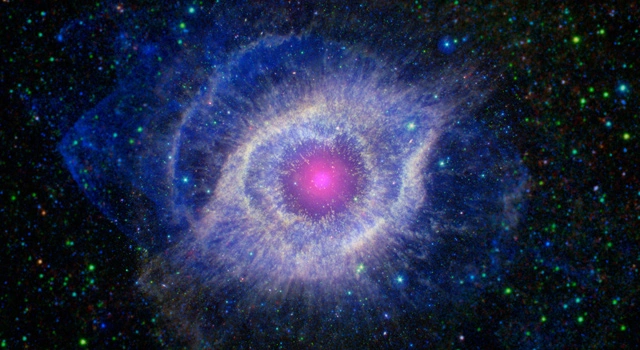
the Helix Nebula Bigger in Death Than Life | NASA Jet Propulsion Laboratory (JPL)
Webb Reveals Details Hubble Could Not See
NASA’s Hubble Space Telescope photographed NGC 2392 in visible light in 2000. That observation already revealed the lion-like shape and its hazy, comet-shaped features.
At first glance, Webb’s infrared view may appear similar. However, the newer image resolves compact dust clumps and the haze of ionized gas with greater clarity. It also separates structures that overlap in visible light.
This does not make Hubble’s image outdated. Instead, the two observatories provide complementary perspectives. Hubble traces features visible at optical wavelengths. Webb examines infrared light that carries different information about gas and dust.
Together, the observations help astronomers connect the nebula’s large-scale appearance with the smaller structures inside it. Webb’s view also shows where dust remains concentrated and where radiation has already altered it.
The image is therefore more than a colorful portrait. It acts as a map of the physical processes reshaping the nebula.
A Cosmic Lion That Will Eventually Fade
The Lion Nebula has taken several thousand years to reach its present form. However, its recognizable shape will not last forever.
Gas and dust continue moving away from the white dwarf. The central radiation keeps ionizing gas and altering the surrounding dust. As the material spreads across a larger area, the nebula will grow fainter.
Astronomers estimate that NGC 2392 could disperse in approximately 10,000 years. That sounds distant on a human scale, but it represents a brief interval in the life of the universe.
The released material will eventually mix with interstellar space. In that sense, the nebula marks both an ending and a transition. The original star has reached its final compact state, while its former outer layers return material to the galaxy.
The Webb Lion Nebula Image Captures a Temporary Wonder
The Webb Lion Nebula image reveals a structure that remains active, complex and temporary. A small white dwarf powers the glowing face. Its radiation illuminates the dusty mane, reshapes expanding gas and removes less-protected material.
Meanwhile, dense clumps continue shielding the delicate tails behind them. Webb’s infrared instruments make these competing processes easier to examine than ever before.
NGC 2392 is not a region where new stars are forming. It is the fading signature of a star that has already completed most of its journey. Webb has captured that signature before the cosmic lion gradually disappears into the Milky Way.
Main Sources:
NASA — Lion Nebula Roars to Life With NASA’s Webb
https://science.nasa.gov/missions/webb/lion-nebula-roars-to-life-with-nasas-webb/
ESA/Webb — Lion Nebula Roars to Life for Webb
https://esawebb.org/news/weic2616/
NASA — Hubble Observation of NGC 2392
https://science.nasa.gov/asset/hubble/ngc-2392/