
BY:SpaceEyeNews.
Webb planet collisions research is revealing what distant worlds leave behind after major impacts. Around other stars, warm dust carries mineral clues to encounters between developing planets. Those clues could help explain the processes that shaped Earth and the Moon.
Astronomers examined 21 unusual debris disks using James Webb Space Telescope observations and archival Spitzer data. Their findings suggest that different dust compositions trace different collision energies. Webb did not watch planets collide. Instead, researchers studied the material remaining afterward, opening another route to understanding planetary history.
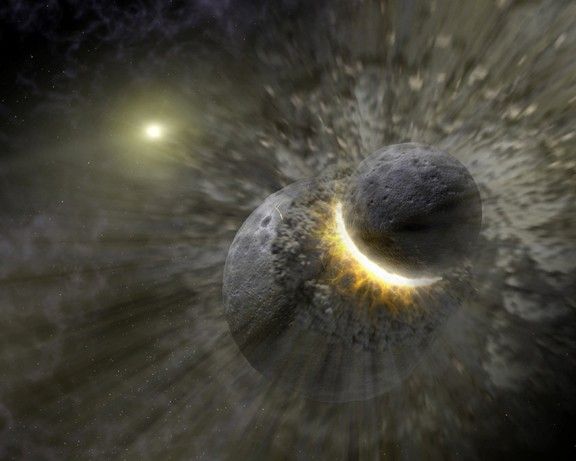
Webb Planet Collisions Research Examines 21 Dusty Systems
Kate Su of the Space Science Institute led the investigation into environments called extreme debris disks. These systems contain unusually abundant warm dust close to their stars, near regions where rocky planets can develop.
The sample combines 16 systems observed with Webb and five represented by Spitzer archival data. Webb’s contribution includes 12 newly observed disks and follow-up observations of four previously studied systems.
Across the sample, researchers identified three shared features. The disks contain particularly small dust grains, concentrated warm material, and irregular brightness changes.
Together, these characteristics distinguish them from more typical debris disks. Comparing their mineral compositions then gave the team a way to investigate the events supplying that dust. The findings appear in The Astrophysical Journal. science.nasa.gov
Mineral Clues Reveal Different Collision Scales
The clearest division involves silica, a compound familiar from many rocks on Earth. Researchers separated the sample into silica-rich and silica-poor disks. Each group suggests a different history of encounters between planetary bodies.
Silica-Rich Dust Points to Larger Encounters
About one-third of the sample contains silica-rich material. The team links these disks to high-energy impacts involving Mars-sized bodies. Such events could vaporize a substantial portion of the participating rock.
Obsidian provides a familiar terrestrial example of silica-rich material. However, that comparison does not mean Webb identified ordinary volcanic glass floating around these stars.
The important finding concerns the dust’s composition and its possible origins. Its mineral signature supports a scenario involving large planetary embryos and considerable energy.
Silica-Poor Dust Suggests Smaller Events
The remaining two-thirds contain silica-poor dust. Forsterite, a mineral found in green sand on some Hawaiian beaches, illustrates this category.
Researchers associate these disks with less energetic events, including grazing encounters between Moon-sized objects. Such encounters offer a different explanation for the material surrounding their stars.
These size comparisons remain interpretations of the mineral evidence. The observations do not directly measure the original bodies or reconstruct every detail of their encounters.
Stellar Ages Help Explain the Pattern
Age adds another dimension to the findings. Within this sample, silica-rich disks occur only around stars younger than 300 million years.
That pattern fits expectations that rocky planets assemble during the early history of planetary systems. Large encounters during this period could generate the silica-rich debris that Webb detects.
By contrast, silica-poor disks occur across a wider range of ages. Their presence suggests that smaller encounters can accompany different stages of a system’s development.
Still, the age boundary requires careful interpretation. It describes the systems studied so far. It does not establish a universal deadline after which substantial planetary impacts become impossible.
Why Does the Infrared Brightness Change?
These dusty environments also vary over time. Silica-poor disks often show greater brightness changes than their silica-rich counterparts.
The researchers propose that fresh debris evolves rapidly. Orbital changes and further encounters could alter the material responsible for the infrared signal.
This explanation connects two parts of the investigation: what the dust contains and how its emission changes. Composition offers clues to the original event, while variability helps researchers explore what follows.
However, the team presents this mechanism as a proposal. Changing brightness alone does not reveal the exact sequence of events within a distant disk.
What the Findings Mean for Earth and the Moon
The study offers a useful comparison with our own beginnings. Scientists think a Mars-sized object called Theia encountered the young Earth in a major impact. Material from that event subsequently gathered to form the Moon.
Webb’s findings allow researchers to investigate debris associated with potentially comparable processes elsewhere. Rather than observing planetary embryos directly, they examine the mineral traces those bodies leave behind.
Our solar system may also have experienced more than one extreme debris disk phase. That possibility broadens the relevance beyond a single Moon-forming event.
Nevertheless, these distant systems do not provide a recording of Earth’s past. They offer examples that researchers can compare with explanations of our solar system’s development.
Why Are Extreme Debris Disks So Rare?
One question remains especially intriguing. Current observations suggest that only roughly 1% of young stars show detectable signs of this dusty phase.
Theoretical expectations suggest that astronomers should observe more such systems. The difference leaves researchers with a puzzle about how these environments develop and become visible.
Crucially, the figure does not mean that only 1% of young stars experience planetary collisions. It describes the observable signatures of an extreme debris disk.
The older systems deserve particular attention. Only three disks in the sample meet the older-age criterion discussed by the researchers. They therefore want more observations to test their expectation that older extreme debris disks lack silica-rich material. The current sample cannot establish that expectation as a universal rule. science.nasa.gov
A larger sample would help test the proposed connections between composition, age, and collision scale. For now, the patterns offer promising evidence without resolving every question about their origins.
Webb Planet Collisions Findings Connect Dust With Planetary History
Webb planet collisions research shows how much information tiny mineral grains can preserve. Their composition, surrounding stellar ages, and changing infrared emission offer complementary clues to planetary development. The emerging picture connects distant debris with processes that may have shaped our own world. Further observations can test those connections and reveal how widely these patterns apply.
Main sources:
NASA — NASA’s Webb Provides Crash Course on Planet-Shattering Collisions
ESA/Webb — Webb Provides Crash Course on Planet-Shattering Collisions
Phys.org — Webb provides crash course on planet-shattering collisions