
BY:SpaceEyeNews.
For decades, astronomers have struggled to answer one of the biggest mysteries in stellar physics: why some stars explode in spectacular supernovas while others quietly collapse into black holes. Now, a new study suggests the answer may depend on one of the universe’s strangest particles — neutrinos.
Researchers from Waseda University have discovered that tiny changes in neutrino behavior during the first moments of a collapsing star can completely alter its fate. Their findings could reshape how scientists model supernovas, black holes, and even the cosmic origin of heavy elements.
The study, published in Physical Review Letters, focuses on rapid neutrino flavor conversion. This process happens at extreme speeds and on microscopic scales inside dying stars. According to the researchers, these tiny particle transformations may determine why some stars explode while others quietly disappear.
Why Some Stars Explode Has Confused Scientists For Years
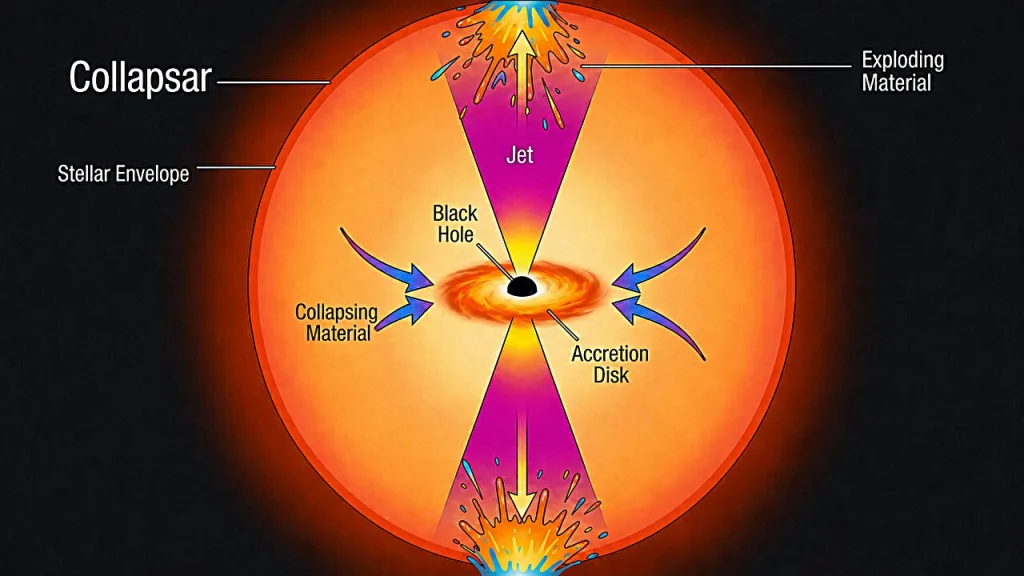
Massive stars spend millions of years producing energy through nuclear fusion. Eventually, they run out of fuel. Once that happens, gravity overwhelms the star’s core and causes a rapid collapse.
Scientists expected this collapse to naturally trigger a huge explosion. In theory, the collapsing core creates a shock wave powerful enough to blast the outer layers into space. That event becomes a supernova.
However, computer simulations repeatedly produced inconsistent results.
Some virtual stars exploded correctly. Others failed completely. In many cases, the shock wave stalled and faded instead of growing stronger. The star then collapsed inward and formed a black hole without a bright explosion.
This mismatch created what astronomers call the “failed supernova problem.”
Researchers suspected something important was missing from the physics inside their simulations. Over time, attention shifted toward neutrinos because these particles carry enormous amounts of energy during core collapse.
Neutrinos Play A Bigger Role Than Expected
Neutrinos are among the smallest known particles in the universe. Trillions pass through Earth every second without interacting with matter.
Yet inside collapsing stars, neutrinos become extremely important.
There are three known neutrino types, or “flavors”:
- Electron neutrinos
- Muon neutrinos
- Tau neutrinos
What makes neutrinos unusual is their ability to switch between these flavors. Scientists call this phenomenon neutrino oscillation.
Inside a dying star, only certain neutrino flavors efficiently transfer energy into surrounding matter. That heating process helps revive the collapsing shock wave.
If enough heating occurs, the star explodes.
If heating weakens, the explosion can fail entirely.
This connection is central to understanding why some stars explode under certain conditions while others collapse quietly.
Rapid Flavor Conversion Changes Everything
The new research focused on a special process called rapid flavor conversion.
In this process, dense streams of neutrinos suddenly switch flavors together in an extremely short time. The transformation occurs within nanoseconds and across distances smaller than a few centimeters.
That scale created a major challenge for astronomers.
Current supernova simulations do not have enough resolution to directly reproduce this behavior. Traditional models simplify neutrino interactions because accurately tracking them requires enormous computing power.
The research team led by Ryuichiro Akaho developed new theoretical models to solve this limitation. Their simulations tracked neutrino movement in multiple directions while also including detailed rapid flavor conversion physics.
The results revealed a surprising connection between neutrino behavior and stellar explosions.
Why Some Stars Explode Depends On Accretion Rate
The study found that a star’s fate strongly depends on something called the accretion rate.
Accretion rate describes how quickly matter falls onto the newly forming protoneutron star after collapse begins.
When the accretion rate stays relatively low, rapid neutrino flavor conversion strengthens the heating behind the shock wave. That additional energy increases the chance of a successful explosion.
Under those conditions, the star is more likely to become a visible supernova.
The situation changes dramatically at higher accretion rates.
When too much matter falls inward too quickly, rapid flavor conversion reduces the overall neutrino energy flow. That weakens the heating process and suppresses the explosion.
As a result, the star may collapse directly into a black hole without producing a bright supernova.
This discovery shows that the same neutrino physics can either help or prevent an explosion depending on the conditions inside the star.
The Smallest Particles Control Giant Cosmic Events
One reason this discovery matters is the enormous influence supernovas have on the universe.
Supernovas produce and distribute many heavy elements essential for planets and life. Elements such as iron, gold, oxygen, uranium, and carbon spread across galaxies through stellar explosions.
Without supernovas, the universe would look completely different.
Understanding why some stars explode also improves scientific models involving:
- Black hole formation
- Neutron star evolution
- Galaxy chemistry
- Cosmic element production
- Neutrino astronomy
The findings may also help scientists better interpret future observations from neutrino detectors and gravitational wave observatories.
Modern observatories continue searching for nearby stellar explosions. Improved models could allow astronomers to predict what happens inside collapsing stars with much greater accuracy.
Current Supernova Simulations May Be Incomplete
The study also uncovered another major issue.
Simplified neutrino oscillation models can produce misleading results in both directions. Some simulations fail to detect real flavor transformations. Others predict oscillations that may never happen.
That means many existing supernova models may oversimplify crucial particle interactions.
According to the researchers, future simulations will require:
- Higher spatial resolution
- More detailed neutrino transport calculations
- Stronger computational resources
- Multidirectional particle tracking
This will significantly increase the complexity of stellar explosion modeling.
Even today’s advanced supercomputers struggle with these calculations because the processes happen at incredibly tiny scales and extreme speeds.
Still, scientists believe these improvements are necessary if they want to fully solve the mystery of why some stars explode.
Why This Discovery Could Shape Future Astronomy
The new findings arrive during an important period for astrophysics.
Modern telescopes and observatories are gathering more detailed information about stellar explosions than ever before. Instruments now track neutrinos, gravitational waves, and electromagnetic signals simultaneously.
That creates new opportunities to test supernova theories directly.
If future observations confirm these neutrino effects, scientists could gain a much clearer understanding of how massive stars die.
The discovery may also improve models involving:
- Black hole birth rates
- Supernova brightness
- Neutron star populations
- Heavy element formation
- Galaxy evolution
Researchers may eventually combine neutrino physics with next-generation supercomputer simulations to create the most realistic supernova models ever developed.
Why Some Stars Explode May Finally Have An Answer
For years, astronomers believed the answer to stellar explosions depended mostly on gravity, pressure, and shock-wave physics. This new study suggests the solution may actually lie in microscopic neutrino transformations happening within billionths of a second.
Tiny particles inside a collapsing star may decide whether that star lights up an entire galaxy or disappears silently into darkness.
That contrast makes the discovery especially fascinating.
The universe’s largest explosions may ultimately depend on some of its smallest particles.
As scientists continue improving supernova simulations, neutrinos could become the key to finally understanding why some stars explode while others quietly collapse into black holes.
Main Sources:
- https://universemagazine.com/en/why-do-some-stars-explode-while-others-dont-the-answer-lies-in-neutrinos/
- https://journals.aps.org/prl/
- https://phys.org
- https://science.nasa.gov/universe/stars/supernovae/
- https://www.esa.int/Science_Exploration/Space_Science