
BY:SpaceEyeNews.
WISE 0855 water clouds are revealing a surprising kind of weather: changing skies on a world without sunrise. Using the James Webb Space Telescope, astronomers tracked atmospheric variations on this cold neighbor for 11 hours. Their observations help separate cloud changes from chemical activity deeper below.
The discovery goes beyond finding water in a distant atmosphere. Scientists can now examine how different atmospheric layers contribute to its changing light. That distinction offers a clearer view of a world whose own warmth helps power its weather.
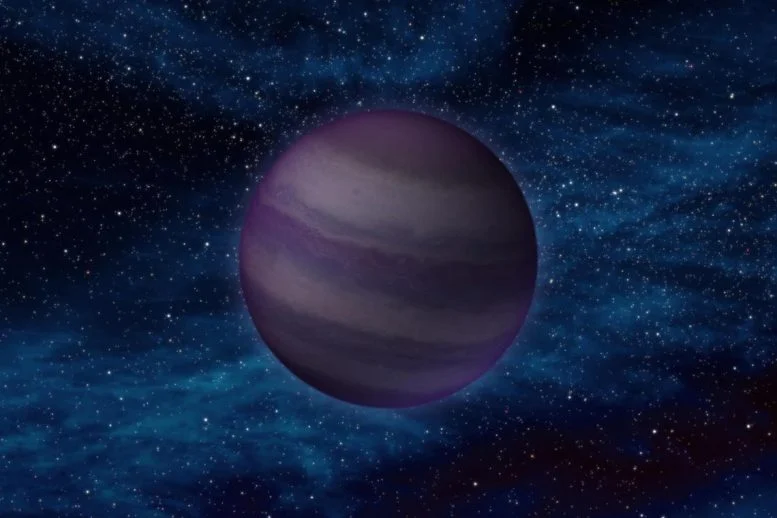
Artist’s concept of a brown dwarf. Brown dwarfs begin their lives like stars, but they never accumulate enough mass to fuse atoms steadily at their cores and ignite with starlight. Credit: NASA/JPL-Caltech.
A Frozen Neighbor With Active Skies
WISE 0855 lies about 7.5 light-years from Earth. It has roughly Jupiter’s size and a temperature near 265 Kelvin, equivalent to about minus eight degrees Celsius. Researchers describe it as the coldest known brown dwarf, although its low estimated mass complicates that classification.
Unlike planets warmed by a nearby star, this isolated object releases heat left over from its formation. That internal energy helps move material through its atmosphere.
Its unusual conditions make WISE 0855 especially valuable. Astronomers can investigate cold atmospheric processes without a nearby host star dominating the observations. The result provides a useful comparison for giant planets elsewhere.
How Webb Separated the Atmospheric Signals
Brittany Miles of the University of Arizona led the observing team. Webb’s Near-Infrared Spectrograph, or NIRSpec, collected a spectrum every 15 minutes throughout the observing period.
Each spectrum divides incoming light into wavelengths. Different gases absorb particular wavelengths, while clouds and temperature also influence the emerging signal. Following those patterns over time helps researchers identify which atmospheric ingredients contribute to brightness changes.
Beyond a Simple Brightness Measurement
A brighter patch does not automatically mean thinner clouds. Temperature differences and changes in chemistry can also affect the light reaching a telescope. Ordinary brightness measurements combine those influences, making the cause difficult to untangle.
Webb supplied the additional detail needed to compare individual molecular features. Instead of treating every fluctuation as one weather signal, the team could investigate distinct patterns. This separation forms the central advance of the study.
The timing matters as much as the spectral detail. Repeated measurements let the team compare how different features vary together. A shared pattern can suggest a common atmospheric process, while contrasting patterns demand a different explanation.
What WISE 0855 Water Clouds Reveal
The researchers compared Webb’s measurements with atmospheric models. Their analysis supports patchy water clouds, with variations in cloud thickness contributing to the observed changes.
As WISE 0855 rotates, different atmospheric regions enter view. Some regions have different cloud cover or temperatures. Together, those differences alter the light that escapes into space.
Reading Clouds Through Infrared Light
Webb did not produce close-up photographs of individual clouds. Scientists inferred their properties from changing spectra and comparisons with models. That distinction matters because the observations reveal atmospheric behavior without resolving a familiar cloud-filled sky.
The University of Arizona describes the findings as the first detection of variable water clouds beyond our solar system. The research paper frames the cloud interpretation more cautiously, presenting evidence from the measured signals and atmospheric models. news.arizona.edu
The milestone concerns changing cloud properties. It does not mean astronomers have discovered distant water for the first time.
Deep Gases Expose an Atmosphere in Motion
Clouds explain only part of the picture. Webb also recorded related variations in spectral features associated with carbon monoxide and phosphine. Those changes point toward processes operating deeper in the atmosphere.
Heat from the interior drives circulation, carrying gases upward from warmer layers. Once those gases reach cooler regions, their abundances can differ from what local temperatures alone would predict.
Scientists call this disequilibrium chemistry. Put simply, atmospheric transport leaves a chemical signature that reflects conditions elsewhere, rather than only the immediate surroundings.
Two Processes, Different Atmospheric Layers
The study links the chemical variations to deeper pressure levels than the changing water clouds. This helps explain why a single cause cannot account for every fluctuation. arxiv.org
Think of the atmosphere as several connected layers, each contributing something different to the escaping light. Cloud cover changes the view through higher regions. Meanwhile, deeper circulation supplies chemical clues about conditions that remain hidden below.
Separating those contributions makes the observations far more informative.
Why This Discovery Matters Beyond WISE 0855
Jupiter offers a useful comparison. Its atmosphere also contains gases transported from deep, warmer regions through convective mixing. Similar physical processes can therefore operate on worlds with very different surroundings.
That connection helps researchers test the models they use to interpret giant exoplanets. Clouds can obscure deeper layers, while chemistry can reveal circulation that temperatures alone do not explain.
Better models should help astronomers distinguish these effects when studying other cold worlds. However, similar atmospheric processes do not make WISE 0855 another Earth.
Water clouds alone establish neither oceans nor a habitable surface. Here, the scientific value lies in understanding weather and heat transport. The observations show how much researchers can learn by watching an atmosphere repeatedly, rather than relying on one snapshot.
What Longer Observations Could Reveal
Eleven hours provided a detailed observing window, but it cannot answer every question. Miles wants longer Webb observations to refine the understanding of WISE 0855’s rotation and atmospheric movement. news.arizona.edu
Additional measurements could help distinguish patterns that repeat with rotation from changes that develop over time. They could also improve models of how different atmospheric layers interact.
For now, scientists have evidence of a complex atmosphere with multiple sources of variability. Building a fuller picture will require more observing time and continued comparisons between data and models.
WISE 0855 Water Clouds Open a New Window
WISE 0855 water clouds show that a sunless world can still have active, changing skies. Webb’s contribution is the ability to separate cloud behavior from deeper chemical signals. By following those differences, astronomers are turning faint infrared light into a richer account of distant weather. This cold neighbor offers a valuable testing ground for understanding giant worlds across the galaxy.
Main sources:
- University of Arizona: Discovery marks the first detection of variable water clouds outside of our solar system
- Original research: Water Cloud and Chemical Modulations in the Coldest Brown Dwarf
- SciTechDaily: Webb Discovers Something Extraordinary in the Clouds of a World With No Sun