BY:SpaceEyeNews.
WISPIT 2 planet formation has come into sharper focus as astronomers connect a growing giant planet with nearby gas movements. New ALMA observations reveal how two young worlds reshape the disk surrounding their central stars. The most revealing details appear around WISPIT 2b, where gas behaves as simulations predicted.
The discovery brings several pieces together: a visible planet, evidence of growth, its surrounding disk, and gas responding to its presence. That combination gives researchers an unusually detailed view of a planetary system still taking shape.
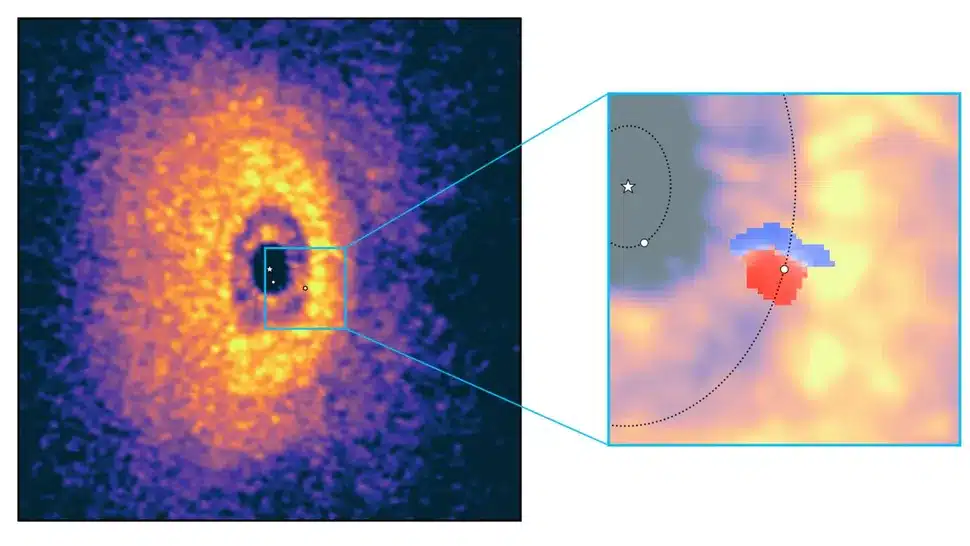
The WISPIT 2 disk appears in false color, with ALMA data revealing its gas rings and forming planetary system. Credit: M. Benisty, MPIA / ALMA)
Two Growing Planets Around Two Stars
Roughly 430 light-years away, WISPIT 2 contains two known giant planets inside an extended disk of gas and dust. WISPIT 2b has approximately five times Jupiter’s mass. It lies about 57 times the Earth–Sun distance from the center, almost twice Neptune’s distance from our Sun.
Its companion, WISPIT 2c, occupies a much closer orbit. ESO announced its confirmation in March 2026, following observations with the Very Large Telescope and its interferometer. Researchers estimated that this second planet has roughly twice WISPIT 2b’s mass and sits about four times closer to the center. www.mpg.de
A Closely Orbiting Stellar Pair
Later research added another surprise: two stars occupy the system’s center. Their orbit takes approximately 4.8 days. The finding makes WISPIT 2 a rare opportunity to study directly imaged young planets around a close stellar pair. arxiv.org
ALMA Maps the Planets’ Changing Birthplace
The new observations show distinct structures around the two planets. WISPIT 2b has opened a gap in the gas disk. Farther inward, a cavity lies inside WISPIT 2c’s orbit. Between the planets, researchers also identified a ring containing gas and dust.
These structures show that the planets influence material beyond their immediate surroundings. As they develop, they alter the environment that supplies their growth. Their positions help researchers connect individual worlds with specific features in the disk.
The observations therefore capture more than an arrangement of bright rings. They give astronomers a way to connect the disk’s appearance with the activity of known planets. Comparing the gas and dust also helps them examine different components of the same evolving environment. arxiv.org
What the Colors Actually Show
ALMA tracks radiation from cold material at millimeter and submillimeter wavelengths. Carbon monoxide emission reveals the gas structure and helps trace the hydrogen associated with it.
The published images use false colors to display measurements clearly. Some maps highlight emission, while others distinguish gas moving toward or away from us. Earlier optical and infrared observations supplied the planet detections.
Together, these measurements explain the “ultrasound” comparison. The image reveals activity inside a planetary birthplace, although the telescope uses electromagnetic radiation rather than sound. www.mpg.de
WISPIT 2 Planet Formation Reveals a Gas Signature
The strongest result concerns the gas near WISPIT 2b. Researchers identified a distinctive change in its motion at the planet’s location. This feature matches predictions from simulations of interactions between planets and disks.
The team describes it as the first confirmed gas-motion signature associated with a directly imaged planet. That distinction matters. Astronomers had previously detected unusual gas movements in other disks, but linking them securely to a visible planet remained difficult. arxiv.org
Connecting Growth With Nearby Gas
Earlier observations detected hydrogen emission indicating that WISPIT 2b continues to gather material. ALMA now adds detailed information about the gas surrounding this growing world.
For researchers, the strength comes from combining independent evidence. They know where the planet sits, have signs of continuing growth, and can examine nearby gas behavior. This provides a firmer test of simulations than an unexplained disturbance alone.
The result also changes the questions astronomers can ask. Instead of simply searching for a possible planet, they can investigate how a confirmed planet affects its surroundings. arxiv.org
What the Observations Still Cannot Separate
Despite the detail, researchers cannot yet assign every part of the nearby emission to one physical process. The signal extends across a region larger than the expected size of a compact disk immediately surrounding the planet.
Several effects could contribute. The planet may generate spiral disturbances, warm nearby gas, and host a smaller disk of its own. These contributions can overlap in the observations.
Finer measurements of gas velocities should help separate them. Until then, describing the entire feature as a clearly resolved disk around WISPIT 2b would overstate the evidence. arxiv.org
Likewise, the cavity around WISPIT 2c does not establish that it is less developed than its companion. Different disk structures alone cannot provide a simple ranking of planetary maturity.
Why These Young Worlds Matter
The broader value of WISPIT 2 planet formation extends beyond this particular system. Astronomers often use disk gaps and gas disturbances to search for planets that remain difficult to detect directly.
However, turbulence and other disk processes can complicate those interpretations. A system containing an independently observed planet offers a useful comparison. Researchers can test which signatures reliably accompany a planet and which require greater caution. www.mpg.de
PDS 70 already provides another valuable example of planets growing within their natal disk. WISPIT 2 expands that picture through its multiple rings, central stellar pair, and detailed gas observations. ESO
The Next Observational Step
Improved ALMA capabilities and ESO’s Extremely Large Telescope could deepen these investigations. Greater sensitivity and sharper measurements may reveal smaller structures or planets closer to their stars.
Those advances would help researchers compare distant giants with worlds occupying more familiar orbital distances. Meanwhile, continued observations of WISPIT 2 can refine the interpretation of the gas already in view. www.mpg.de
A Clearer View of Planetary Growth
WISPIT 2 planet formation now offers a stronger connection between a young giant and the changing material around it. The achievement combines several observations into a useful test of how planets grow and shape their surroundings.
Questions remain about the precise mixture of gas motion, heating, and material close to WISPIT 2b. Answering them could turn this striking view into an increasingly detailed explanation of a planetary system under construction.
Main sources:
- Max Planck Society, September 24, 2026: Astronomers produce the first complete picture of gas planet formation in action.
- Benisty and colleagues: Mapping the WISPIT2 Planet-Hosting Cavity at Sub-Hill-Radius scales.
- European Southern Observatory, March 24, 2026: Two planets spotted forming in a disk around a young star.
- Bürgy and colleagues: A closer look at the WISPIT 2 host star: Evidence for a spectroscopic binary.