BY:SpaceEyeNews.
Astronomers may have found one of the clearest real-life snapshots yet of how a planetary system like our own begins. The system is called WISPIT 2, and it lies about 437 light-years from Earth. It is also extremely young, with an estimated age of around 5.4 million years. That makes it a newborn compared with our 4.6-billion-year-old sun.
What makes WISPIT 2 so important is not just its age. Scientists have now confirmed that two giant planets are still forming inside its disk of gas and dust. That instantly turns this system into something far more valuable than a routine exoplanet discovery. It becomes a rare natural laboratory for studying how planetary systems take shape.
We will never be able to watch the early solar system that produced Earth, Jupiter, Saturn, and the rest of our planetary neighborhood. That chapter is long gone. But systems like WISPIT 2 can offer something close. They allow astronomers to study the same physical processes that likely shaped our own cosmic home billions of years ago.
Why WISPIT 2 Matters
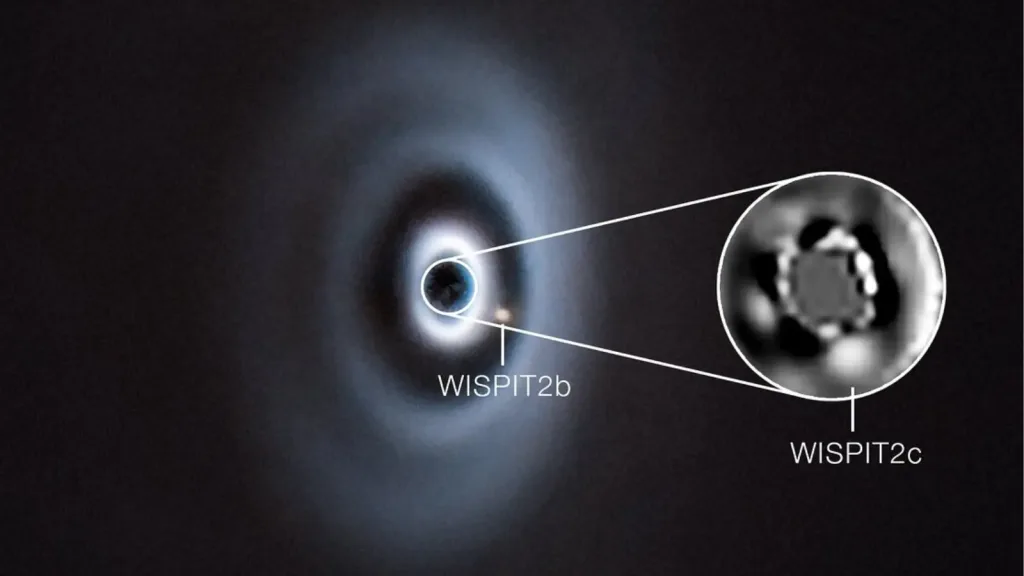
At the center of the system is a young star surrounded by a broad protoplanetary disk. This is the flattened disk of gas and dust from which planets grow. Inside that disk, astronomers have identified two forming gas giants, named WISPIT 2b and WISPIT 2c.
That alone is enough to make the system remarkable. But the real significance lies in what those planets are doing. They appear to be shaping the disk around them, carving out visible gaps as they orbit and gather material. This gives researchers a chance to study not just the planets themselves, but the full process of system-building in action.
WISPIT 2 stands out because astronomers are not simply seeing finished planets circling a mature star. They are seeing a young system while it is still under construction. That is exactly the stage researchers want to catch, because it helps bridge the gap between a raw disk of dust and a stable planetary system.
A Rare Multi-Planet Discovery
Planet formation is difficult to observe directly. Astronomers have discovered thousands of exoplanets, but catching planets while they are still forming remains rare. Seeing two planets forming around the same star is even rarer.
That is why WISPIT 2 has attracted so much attention. It is only the second known system where astronomers have directly observed two planets in the process of formation around the same star. That makes it one of the most valuable young planetary systems under study today.
This also changes the scale of the story. Instead of focusing on one isolated protoplanet, scientists are now looking at a broader planetary architecture. WISPIT 2 is beginning to look less like a single interesting object and more like a full system taking shape in real time.
The First Planet: WISPIT 2b
The first major breakthrough came with the discovery of WISPIT 2b. This young planet is estimated to have a mass of about 4.9 times that of Jupiter. It orbits far from its star, at a distance of roughly 57 to 60 astronomical units. In simple terms, that places it about 57 to 60 times farther from its star than Earth is from the sun.
That distance matters. A massive young planet sitting inside a large gap in a dusty disk is exactly the kind of clue astronomers look for when trying to understand how planets influence their surroundings. WISPIT 2b was already a compelling discovery on its own because it showed clear signs of interaction with the surrounding material.
But the story became even more interesting when follow-up observations suggested that WISPIT 2 might hold more than one forming world.
The Second Planet: WISPIT 2c
The real leap came with the confirmation of WISPIT 2c, the second giant planet in the system. This object was detected much closer to the star, at around 15 astronomical units. That is roughly four times closer to the star than WISPIT 2b, which made it much harder to detect.
Astronomers confirmed WISPIT 2c using some of ESO’s most advanced observing tools, including the Very Large Telescope, the VLT Interferometer, and upgraded instruments designed for extreme precision. These observations showed that WISPIT 2c is not a background object or a false signal. It is a real forming planet embedded in the disk.
Researchers also gathered spectroscopic data, which allowed them to study the planet’s atmosphere and physical properties in more detail. Their analysis suggests that WISPIT 2c may have a mass of about 8 to 12 times Jupiter’s mass, making it roughly twice as massive as WISPIT 2b.
That makes the system even more striking. WISPIT 2 does not just contain one giant forming world. It contains at least two, and they sit at very different distances from the star.
Why This System Looks Like a Young Solar System Analogue
The phrase “young solar system analogue” is one of the most interesting parts of this story. It does not mean WISPIT 2 is a perfect twin of our early solar system. It is not. But it does mean the system may reflect some of the same broad processes that shaped our own planetary neighborhood long ago.
The disk around WISPIT 2 shows multiple rings and gaps. These features matter because growing planets can disturb the gas and dust around them. As they gather mass, they can carve paths through the disk, leaving behind visible structures that astronomers can study.
Both confirmed planets seem to be linked to these gaps. That gives scientists a direct window into how planets and disks interact during the early stages of development. Instead of seeing a finished outcome, they are watching the building process itself.
This is exactly what makes WISPIT 2 so exciting. The system offers a rare look at the mechanics of planetary assembly. It is one of the clearest examples yet of how giant planets may form and reshape their surroundings while a system is still young.
A Possible Third Planet
The story may not end with two planets. Astronomers have identified at least one additional smaller gap farther out in the disk. That feature has not yet been tied to a confirmed planet, but it strongly suggests that another world may be forming there.
Based on the structure of the gap, researchers suspect this possible third object could be around Saturn mass. That remains unconfirmed for now, but the idea is scientifically important. If future observations prove that another planet is present, WISPIT 2 would become an even richer system for studying how multiple planets emerge together inside a single disk.
That possibility gives the discovery an added sense of momentum. WISPIT 2 is not just a finished headline. It is an active research target that may reveal much more in the coming years.
Why Astronomers Care So Much
There are thousands of known exoplanets, but most are mature worlds observed long after their formation. What astronomers really want is a clear view of the transition from dusty birth disk to fully developed planetary system. That transition is one of the hardest stages to observe directly.
WISPIT 2 sits right inside that missing chapter. It shows a young star, a structured disk, and planets still embedded in the material from which they formed. That combination is rare, and it gives scientists a chance to test ideas about how giant planets grow, migrate, and influence the architecture of a system.
For general readers, the significance is easy to grasp. We all wonder how Earth formed, how Jupiter became so massive, and what the solar system looked like before the planets settled into their modern arrangement. WISPIT 2 does not answer every question, but it gives astronomers a far better chance to study the process than ever before.
A Window Into Our Cosmic Past
What makes WISPIT 2 so compelling is the sense of perspective it provides. It reminds us that the solar system did not begin as a calm set of planets orbiting in neat paths. It began in a dense, dusty disk around a young star, with giant worlds taking shape and reshaping their surroundings.
That is what astronomers may now be seeing in WISPIT 2. With two confirmed forming giant planets, a strongly structured disk, and hints of a possible third world, this system has quickly become one of the most important young planetary systems known.
In the end, WISPIT 2 matters because it offers something rare in astronomy: a chance to look back, not by observing our own past directly, but by finding another system that may be living through a similar beginning. That is what makes this discovery so powerful. It may be the closest view yet of how a solar system like ours first came to life.