
BY:SpaceEyeNews.
Venus surface photos offer something radar maps cannot: a view of another planet from ground level. On October 22, 1975, the Soviet Venera 9 lander transmitted the first photograph from Venus’s surface. Fifty-one years later, that rocky scene remains a landmark in planetary exploration.
Yet the anniversary highlights an extraordinary gap. The latest photographs taken from the ground date to 1982. Scientists have continued studying Venus from space, but fresh close-up images could answer questions those early panoramas could barely address.
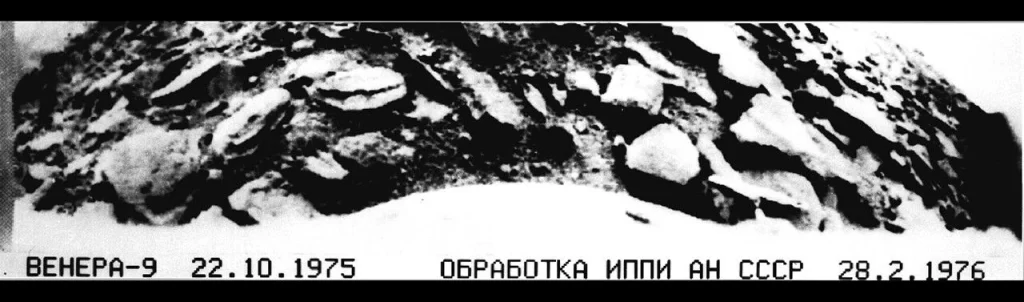
Venus Surface Photos: Venera 9’s Historic First View.
What the First Venus Surface Photos Revealed
Rocks beneath the clouds
Venera 9 revealed a landscape of angular rocks and patches of soil. Many stones measured roughly 30–40 centimeters across, with some partly buried in the ground.
The photograph gave researchers direct evidence of local surface conditions. Instead of an indistinct scene beneath thick clouds, recognizable rocks filled the frame. Venus finally had a landscape scientists could examine at ground level.
NASA’s image description also helps readers interpret the unusual view. The white structure along the bottom belongs to the lander. Meanwhile, the horizon appears in the upper corners. science.nasa.gov
Why the image looks distorted
The panorama’s curved appearance comes from the imaging system, rather than the shape of the terrain. This matters when viewing restored versions online.
Processing can improve clarity and make an old panorama easier to understand. However, a reconstructed landscape should never carry the same label as an original photograph. Rearranged features can create a convincing scene without preserving their actual positions.
A Camera Working Against Extreme Conditions
Venera 9 transmitted from the surface for 53 minutes. That short window produced a lasting scientific record under exceptionally difficult conditions.
Near the ground, temperatures exceed 450°C. Atmospheric pressure reaches roughly 90 times Earth’s sea-level pressure. Together, these conditions make protecting instruments and electronics a major engineering challenge. science.nasa.gov
The achievement involved more than delivering a working camera. The mission also had to return useful observations before communication ended.
That distinction matters. A 53-minute transmission period does not, by itself, prove that heat disabled the lander at exactly that moment. Reporting the confirmed communication duration avoids turning an operational detail into an unsupported explanation.
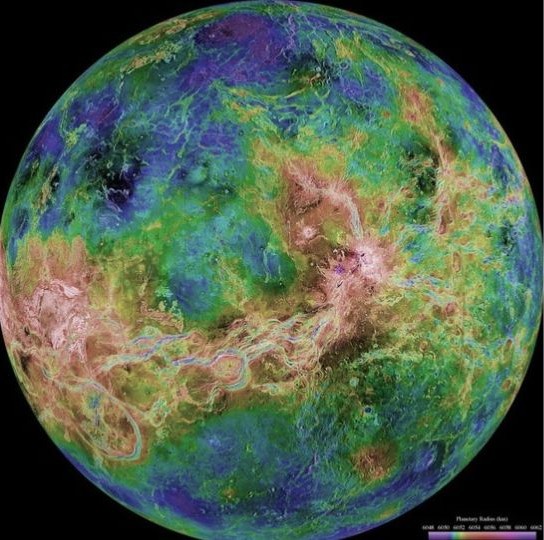
Large faults on Venus’s surface indicate that the planet remains geologically active. Credit: NASA/JPL/USGS.
From Monochrome Scenes to Color Panoramas
Venera 10 expands the view
Three days later, Venera 10 reached the surface on October 25, 1975. It returned black-and-white imagery during 65 minutes of communication.
Together, the two missions provided separate ground-level glimpses of Venus. Their photographs helped scientists move beyond distant observations and examine individual rocks, soil, and local terrain. www.esa.int
Color arrives in 1982
Venera 13 landed on March 1, 1982, followed by Venera 14 on March 5. These missions returned color panoramas that remain central to our visual record of the surface. heasarc.gsfc.nasa.gov
The images brought texture and surroundings into sharper focus. However, each landing site represented only a tiny part of the planet.
That limitation still matters. A handful of panoramas cannot reveal the full variety of Venusian landscapes, especially highland regions that earlier cameras never explored closely.
How Scientists Kept Studying Venus
Radar reveals changes in volcanic terrain
The lack of new ground-level photographs did not end exploration. During the early 1990s, NASA’s Magellan spacecraft mapped Venus using radar, which penetrates its opaque clouds.
Decades later, researchers found evidence of change within those archived observations. A 2023 study identified a volcanic vent associated with Maat Mons that enlarged and changed shape.
The relevant radar images came from February and October 1991. Therefore, 2023 marks the discovery’s publication, rather than the timing of the volcanic activity. www.jpl.nasa.gov
This finding showed why old mission data remain valuable. New analysis can uncover events that researchers missed when spacecraft first returned the observations.
Parker captures the surface glow
NASA’s Parker Solar Probe added another unexpected perspective during Venus flybys in 2020 and 2021. Its camera detected light from the planet’s hot nightside surface.
Those observations revealed broad terrain features from space. They did not replace the detailed views that a camera near the ground could provide. svs.gsfc.nasa.gov
Consequently, saying that nobody has imaged Venus since 1982 would be incorrect. The missing observations are new photographs taken from the surface itself.
DAVINCI Could Deliver a Closer Look
Investigating the ancient highlands
NASA’s DAVINCI mission aims to photograph Alpha Regio while its probe descends through the atmosphere. This rugged highland contains complex terrain known as tesserae.
Scientists consider these regions important records of Venus’s geological history. Detailed images could reveal structures that radar observations cannot resolve as clearly.
Atmospheric measurements would add another dimension. By examining gases and isotopes, researchers hope to investigate the planet’s water history and long-term evolution.
The goal extends beyond obtaining dramatic pictures. Combining terrain and atmospheric evidence could help test ideas about how Venus developed its present conditions. science.nasa.gov
Hardware faces Venus-like heat
In September 2026, NASA reported a successful series of thermal tests involving a DAVINCI engineering model. Engineers heated the vessel to approximately 465°C during six furnace cycles.
These tests assessed protection against the rapid heating expected during descent. They represent concrete preparation, although successful testing does not guarantee a particular launch date. science.nasa.gov
DAVINCI’s planned imaging will occur during descent. Readers should therefore expect a different perspective from the stationary panoramas returned by earlier landers.
The Next Chapter for Venus Surface Photos
NASA’s VERITAS and ESA’s EnVision would complement close-up observations with orbital investigations of terrain and geological activity. Mission schedules remain subject to change. science.nasa.gov
For now, Venus surface photos connect a remarkable past with unfinished science. The next close views could help explain how this neighboring world evolved so differently from Earth.
Main sources:
- NASA — First Look: Venus
- ESA — The First Images of the Surface of Venus
- NASA — The Venera 13 and 14 Probes to Venus
- NASA/JPL — Magellan Data Reveals Volcanic Activity on Venus
- NASA — New Views of Venus’ Surface From Space
- NASA — DAVINCI’s Many Firsts at Venus
- NASA — DAVINCI Beats Heat in Preparation for Venus Descent
You Might Also Like:
NASA Venus Missions: A New Chance to Decode Earth’s Twin
Venus Tectonic Activity May Still Be Reshaping the Planet
China Venus Atmosphere System Could Change Venus Exploration.