
BY:SpaceEyeNews.
Small galaxies hold clues to events that unfolded long before the first stars appeared. Now, a precise primordial helium measurement has brought those clues into sharper focus. An international team measured this ancient element with approximately 0.5% uncertainty, strengthening a key test of early-universe physics.
The result agrees with predictions for the universe’s first few minutes. It also gives researchers a more sensitive way to examine the particles that influenced those conditions. The breakthrough combines carefully selected galaxies, extensive telescope observations, and improvements in how scientists interpret their light.
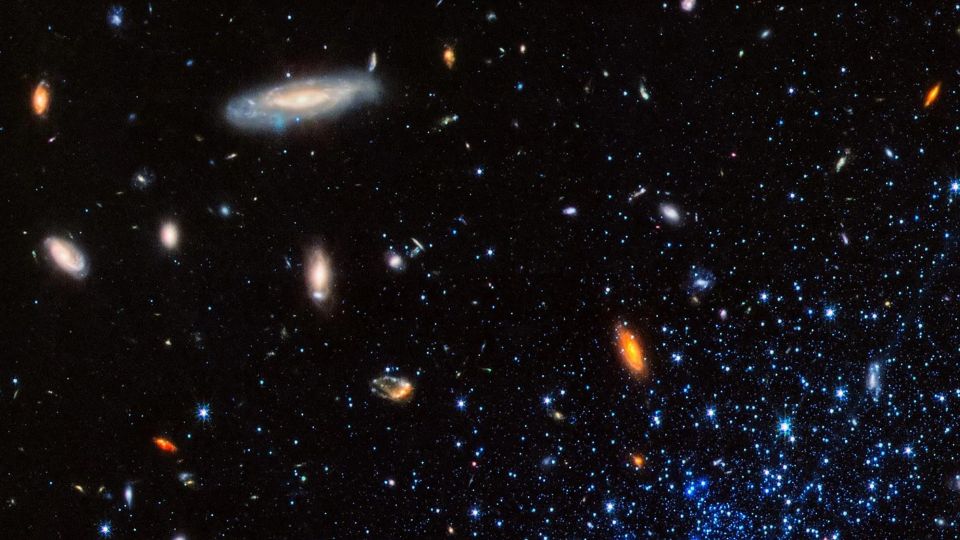
Primordial Helium Reveals the Universe’s First Minutes
Why Small Galaxies Preserve Ancient Evidence
Measuring the universe’s original helium supply requires separating its ancient chemical signature from later changes. Stars produce additional helium throughout their lives. They also enrich surrounding gas with heavier elements, complicating attempts to reconstruct the original mixture.
To reduce that problem, researchers focused on galaxies with very low concentrations of heavier elements. Their gas has experienced relatively little chemical enrichment, preserving a composition closer to the early universe’s.
These galaxies function as chemical time capsules. However, they are not completely untouched remnants of the Big Bang. Their value comes from the limited changes in their gas, which make the primordial contribution easier to estimate.
Choosing the Cleanest Targets
The broader study examined 54 ionized gas regions using high-quality observations from the Large Binocular Telescope. Researchers checked the measurements for reliability and potential systematic errors.
After screening the sample, they identified 15 particularly metal-poor targets that supported a robust weighted-average estimate. This selection reduced their dependence on extending an observed chemical trend back to the universe’s original composition.
The distinction matters. The project did not simply observe 15 galaxies and assume their helium was entirely primordial. Instead, the team assessed a larger dataset and selected targets that best supported the measurement. arxiv.org
How Telescope Observations Sharpened the Result
The observatory reports approximately 130 hours of telescope observations for the project. Its MODS optical spectrographs and LUCI near-infrared instruments supplied complementary measurements.
Researchers analyzed hydrogen and helium emission lines to determine the elements’ relative abundance. These lines carry information about the glowing gas, including conditions that can affect the inferred helium amount.
Combining Many Chemical Signatures
The team examined more than 10 helium lines and 15 hydrogen lines together. That approach helped expose subtle effects that become significant when uncertainties fall below one percent.
Accurate instrument calibration and consistent analysis were essential. Improved calculations of helium emission also strengthened the methodology.
Better data alone would not have delivered the same result. Researchers needed to understand how instrumental effects and gas conditions could influence their measurements. Five related papers describe the project, its observations, and its implications for cosmology. www.lbto.org
What the Primordial Helium Measurement Revealed
The final result places the primordial helium mass fraction at 0.2458, with an uncertainty of 0.0013. In everyday terms, helium accounted for approximately 24.58% of the original ordinary matter’s mass.
The uncertainty equals 0.13 percentage points. This distinction prevents a common misunderstanding: the reported 0.5% precision describes relative uncertainty, not helium’s share of matter.
These percentages concern ordinary matter. They do not include dark matter or dark energy. cse.umn.edu
Comparing Observation With Prediction
The study compares its measurement with a standard Big Bang nucleosynthesis prediction of approximately 24.67%. The two values agree within their uncertainties.
That agreement supports the physical framework describing light-element formation during the early universe. More importantly, the smaller uncertainty makes the comparison more demanding.
A theory can match a broad measurement range relatively easily. A tighter range gives scientists less room to accommodate predictions that differ from the observations. arxiv.org
Why Helium Helps Scientists Test Neutrinos
Helium production depends partly on how quickly the early universe expanded. Light particles, including neutrinos, contributed to the energy density that influenced this expansion.
Additional light species could have changed the expansion rate and the resulting helium abundance. Consequently, a precise primordial helium measurement helps researchers constrain the particles present during that period.
This is an indirect test. Astronomers are not detecting ancient neutrinos inside those galaxies. They are measuring a chemical outcome that depends on early physical conditions.
Results Support the Standard Picture
The researchers combined their helium result with deuterium measurements and cosmic microwave background information. Their analysis found consistency with the standard picture of three light neutrino species.
The findings strengthen the connection between particle physics and astronomical observations. They also restrict some possible departures from established theory.
However, agreement does not eliminate every alternative explanation. Different proposals require different tests, and some effects could remain too small for current measurements to distinguish. arxiv.org
Connecting Two Chapters of Cosmic History
The helium evidence concerns nuclear reactions during the universe’s opening minutes. Cosmic microwave background measurements probe a much later stage, roughly 380,000 years after the Big Bang.
Comparing these records allows scientists to test whether one framework explains both periods. Their consistency supports the standard account of how the early universe evolved.
This connection gives the result significance beyond a single abundance measurement. Independent observations can reinforce each other while testing different assumptions and physical processes.
What Remains Open
Researchers must continue checking instrument calibration, atomic calculations, and models of the emitting gas. Smaller statistical uncertainties make these systematic effects increasingly important.
The study does not explain what preceded the Big Bang. Nor does it directly identify dark matter. Its contribution is more specific: a sharper observational test of early-universe conditions.
Small Galaxies Strengthen a Major Cosmic Test
The new primordial helium measurement turns relatively unprocessed galactic gas into a precise record of cosmic history. Its agreement with predictions strengthens confidence in the standard early-universe picture.
Future refinements could make this test even more demanding. For now, small galaxies have helped researchers examine the universe’s first minutes with substantially greater precision.
Main sources:
- Large Binocular Telescope Observatory — New LBT Measurements Yield Precision Insights into the Early Universe and Particle Physics
- University of Minnesota — Primordial Helium Measured to Most Precise Fraction to Date
- Research paper — The LBT Yp Project I: Observations and Methodology
- Research paper — The LBT Yp Project IV: A New Value of the Primordial Helium Abundance
- Research paper — The LBT Yp Project V: Cosmological Implications
You Might Also Like:
Black Hole Formed Before Galaxy? Webb Discovers Something Impossible
JWST First Stars Discovery: Strongest Evidence Yet of the Universe’s Earliest Stars
CERN Primordial Plasma Reveals Nuclear Shapes