
BY:SpaceEyeNews.
Mega-Earths seem to stretch the limits of what a rocky planet can become. These unusual worlds apparently contain more than ten times Earth’s mass, yet their densities suggest surprisingly little gas. Now, researchers question whether some deserve that extraordinary reputation.
The problem may lie with their stars. Magnetic activity can interfere with the signals astronomers use to estimate planetary masses. As a result, an ordinary planet could appear much heavier and denser than it actually is.
The new study raises an intriguing possibility: some exceptional rocky worlds may reflect misleading measurements rather than exceptional planetary formation.
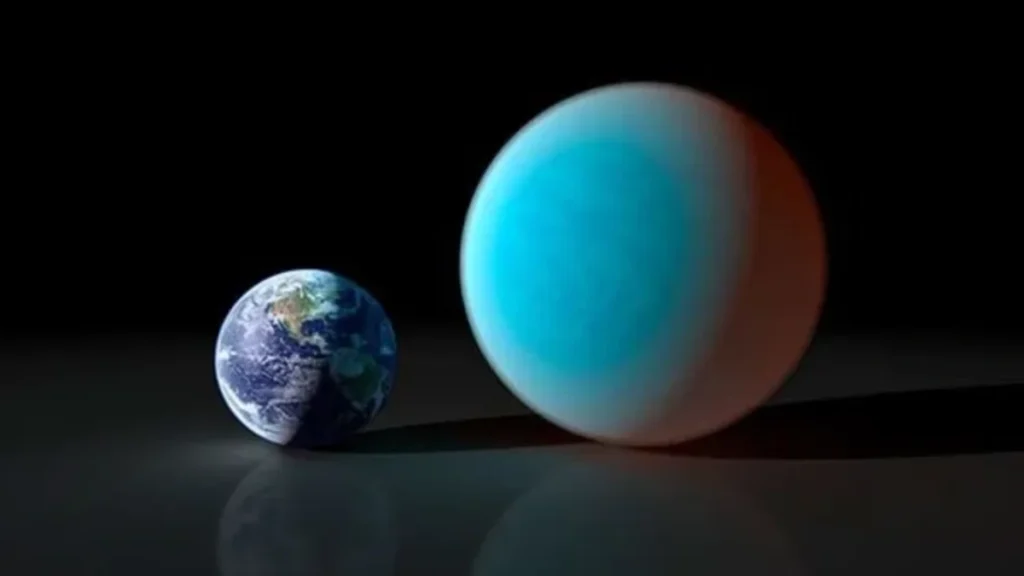
Mega-Earths: Giant Worlds Under Scientific Scrutiny.
Why Mega-Earths Puzzle Astronomers
A rocky planet with an enormous mass presents a formation puzzle. While gas remains in a young planetary system, a growing core can attract a substantial atmosphere. That process makes extremely massive, mostly rocky worlds difficult to explain.
However, planet formation offers more than one possible route. Some dense worlds might represent the remaining cores of larger planets that lost their outer envelopes. Others could have assembled under unusual conditions.
The often-cited boundary of roughly ten Earth masses therefore needs context. It describes an approximate theoretical threshold, rather than an absolute rule that nature cannot cross.
Researchers must first establish whether the apparently exceptional planets actually exceed that threshold. Otherwise, an inaccurate measurement could send explanations in the wrong direction.
A Closer Look at 333 Planets
Casey L. Brinkman and Nicolas Cowan examined published planetary measurements in their study, posted on arXiv on October 8, 2026. Their sample included 333 planets with measured radii and radial-velocity masses.
They identified four rocky mega-Earth candidates: WASP-84 c, TOI-1347 b, TOI-2322 c, and HD 63433 b. The researchers also considered four additional dense planets: GJ 523 b, TOI-815 c, HD 18599 b, and GJ 143 b.
Eight Worlds, Two Different Groups
That distinction matters. The additional four planets do not all fit a predominantly rocky composition. Some could contain substantial water or other volatile materials, despite having relatively little hydrogen and helium.
Consequently, describing the sample as eight confirmed giant rocky planets would overstate the evidence. The study instead examines eight unusual combinations of mass and radius.
Their apparent densities make them interesting. Their host stars make those measurements harder to trust. arxiv.org
How Stars Can Make Planets Look Heavier
Astronomers estimate planetary mass by measuring the gravitational influence a planet exerts on its star. The resulting stellar motion produces shifts in spectral lines. Researchers use those shifts to estimate the planet’s mass. science.nasa.gov
A star, however, does more than respond to orbiting planets. Its surface changes, and magnetic activity affects the light reaching our telescopes.
Starspots and brighter regions move across the visible surface as the star rotates. These features can alter spectral measurements, adding variations that resemble or complicate a planetary signal.
When Stellar Activity Overlaps an Orbit
The challenge grows when a planet’s orbital period approaches its star’s rotation period. Two different processes can then generate variations on similar schedules.
Separating them requires careful analysis. If researchers assign too much of the measured signal to the planet, they may overestimate its mass.
That error also changes the inferred density. The measured radius can remain similar while an inflated mass makes the planet appear more compact and rocky.
The concern therefore goes beyond brightness changes alone. It involves how stellar activity affects the spectral information behind the mass estimate. arxiv.org
TOI-2322 c Illustrates the Challenge
TOI-2322 c provides a useful example. Its original study reported approximately 18 Earth masses and a radius around 1.87 times Earth’s.
The planet completes an orbit in roughly 20.23 days. Its host star rotates in about 21.28 days. Those similar timescales illustrate why separating stellar and planetary contributions can prove difficult.
Yet the original researchers did not ignore stellar activity. They combined observations and used a statistical framework to model its effects. Their analysis supported an unusually massive planet with an Earth-like bulk composition. arxiv.org
The newer study challenges confidence in such interpretations. Readers should therefore understand this as a scientific disagreement about measurement reliability, rather than a simple case of overlooked starspots.
Better evidence must distinguish between competing explanations.
What the Mega-Earths Study Actually Establishes
The researchers argue that stellar activity likely inflates the masses of these unusual worlds. Their findings question whether the strongest-looking candidates provide convincing evidence for extremely massive rocky planets.
However, a suspicious measurement does not automatically mean that the planet itself is imaginary.
Three Questions Need Separate Answers
A planet’s existence, mass, and composition represent different scientific questions. Evidence supporting one does not settle the others.
A world can remain a real planet even if its estimated mass changes. Likewise, density can suggest possible compositions without revealing every layer inside it.
The study also remains a preprint, with its arXiv record listing submission to a journal. Readers should treat its interpretation as a research claim undergoing evaluation. arxiv.org
It challenges the evidence for mega-Earths without establishing that no such world could exist anywhere.
What Could Resolve the Uncertainty?
The next step is to test whether these mass estimates remain stable under closer scrutiny.
Repeated spectral observations can help researchers track stellar changes alongside orbital signals. Comparing independent observations and different modeling approaches can also reveal whether a result depends heavily on particular assumptions.
The goal is consistency. A convincing mass estimate should withstand reasonable changes in how researchers account for stellar activity.
For readers, the distinction is straightforward: an extraordinary interpretation becomes stronger when several approaches support the same result.
Mega-Earths Remain an Open Question
Mega-Earths could reveal unusual pathways in planetary evolution. But their scientific importance depends on measurements that can withstand careful testing.
This study shifts attention toward the stars behind the signals. Some apparently exceptional worlds may eventually receive more modest mass estimates. Others may survive further scrutiny.
Either outcome would improve our understanding of how planets form and how reliably astronomers can characterize them.
Main sources:
- Universe Magazine: Do “mega-Earths” really exist?
- Research preprint, Brinkman and Cowan: “Mega-Earths” are likely an artifact of stellar activity
- Original TOI-2322 research, published in Astronomy & Astrophysics: Two transiting rocky planets close to the stellar rotation period and its first harmonic
- NASA: Radial Velocity
You Might Also Like:
70 Ophiuchi Habitable Zone: Could It Host Another Earth?
HOEE Starshade Could Reveal Earth-Like Worlds