
BY:SpaceEyeNews.
Supermassive black holes may not always remain at the centers of their galaxies. After merging, some could move away from their original positions, leaving clues in the light around them.
Now, researchers have identified a pattern across approximately 100,000 quasars that supports this possibility. Objects with larger apparent velocity offsets tend to show greater dust reddening.
The relationship matches a prediction published a decade earlier. However, it does not prove that individual black holes have escaped their galaxies. Instead, it offers statistical evidence that deserves closer investigation.
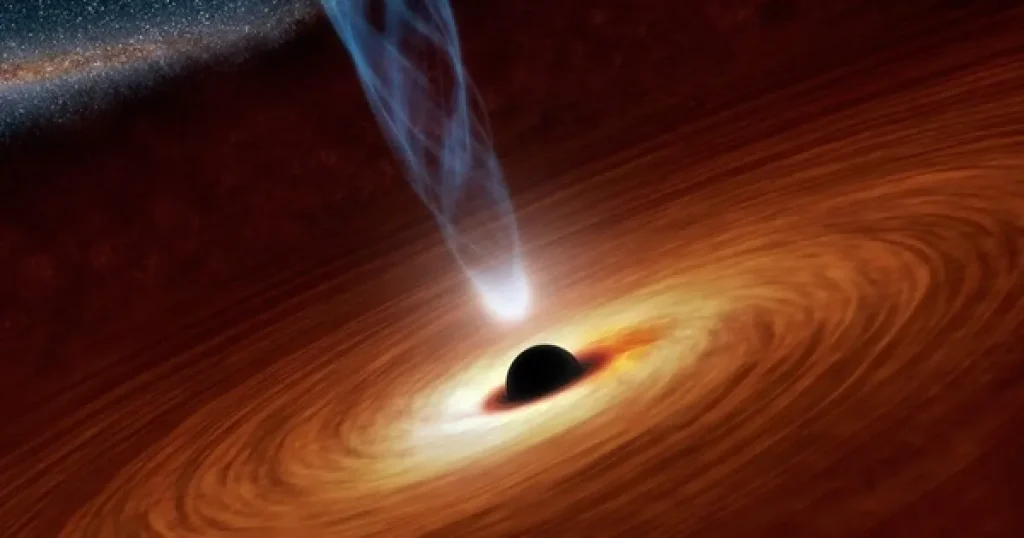
What the Quasar Survey Reveals
Bence Bécsy, an ELTE graduate now at the University of Birmingham, led the research. The team analyzed observations from the Sloan Digital Sky Survey’s DR16 quasar catalogue.
Their study appeared in Monthly Notices of the Royal Astronomical Society. Rather than searching for one unusual object, the researchers examined a possible signature across a large population.
Two Measurements, One Pattern
First, they compared spectral features from gas close to each black hole with features associated with its host galaxy. Differences between these features can indicate motion along our line of sight.
Next, they measured how much redder each quasar appeared than comparable objects at similar redshifts. This excess redness served as an indicator of dust obscuration.
Together, these measurements revealed a modest correlation with high statistical significance. That distinction matters: the pattern is measurable across the sample, but individual quasars vary considerably. academic.oup.com
How Supermassive Black Holes Move After Mergers
When two black holes merge, gravitational waves carry energy and momentum away from the system. Uneven emission gives the remaining black hole a recoil, shifting its motion.
Depending on the circumstances, this recoil can displace the black hole from the galactic center. A sufficiently large velocity could allow it to escape the galaxy entirely.
Leaving the Center Is Not Leaving the Galaxy
A smaller recoil produces a different outcome. The galaxy’s gravity keeps the black hole bound, drawing it back toward the central region.
It can then pass through the center, slow down farther away, and reverse direction. This repeated motion resembles a pendulum, although the surrounding stars and gas complicate its path.
Why Faster Motion Could Mean More Dust
In 2016, Péter Raffai, Zoltán Haiman, and Zsolt Frei explored how this motion might affect quasar observations.
Their simulations predicted a connection between a displaced black hole’s velocity and the dust obscuring its light. The explanation depends on where the black hole sits during its journey.
Near the galactic center, an oscillating black hole reaches its greatest speed. In the model, these central passages also increase the likelihood of observing it through larger dust columns.
Consequently, quasars with larger velocity offsets should appear redder on average.
The phrase “on average” is essential. Different viewing angles, environments, and observation times can produce very different results for individual objects. A large sample helps reveal the underlying tendency.
The Dustiest Quasars Provide a Striking Clue
ELTE’s announcement highlights one particularly clear comparison. Heavily obscured quasars were approximately three times more common in the fastest group than in the slowest.
This describes the proportion of heavily obscured objects. It does not mean every fast-moving black hole has three times more dust around it.
The finding strengthens the connection between the observed pattern and the earlier prediction. Nevertheless, matching a prediction does not automatically establish its explanation. www.elte.hu
Checks Strengthen the Result
The researchers tested different selection criteria and measurement procedures. The relationship remained consistent across those checks.
They also compared narrow spectral lines associated with gas that should not follow the black hole’s motion. In that comparison, the positive correlation largely disappeared.
This control test supports the proposed interpretation. It also helps distinguish the main result from a pattern affecting all spectral measurements equally.
What the Evidence Still Cannot Prove
The team did not directly film black holes moving or measure their complete trajectories. Spectral offsets provide indirect clues, and other processes can influence them.
Gas flowing inward or outward could shift spectral features. Viewing angles and uneven structures near the black hole could also affect the measurements.
Therefore, the observations establish a correlation more securely than they establish its cause. research.birmingham.ac.uk
An Uncertain Merger Estimate
If recoil explains the signal, the researchers suggest that roughly half the sampled quasars may have experienced relatively recent black hole mergers.
That estimate depends heavily on the models and the assumed duration of the observable recoil phase. It should not become a claim that half of all galaxies contain displaced black holes.
Further observations and improved simulations must test both the recoil interpretation and competing explanations.
Why These Findings Matter for LISA
If confirmed, this approach could help researchers estimate how frequently massive black holes merge. It could also reveal more about their motion and the dusty environments surrounding active galactic nuclei.
These questions connect directly with the European Space Agency’s planned LISA observatory.
ESA currently plans a 2035 launch. Three spacecraft will form a triangle in space, with approximately 2.5 million kilometers between them.
LISA will measure gravitational waves from sources including merging massive black holes. Quasar surveys, meanwhile, can investigate possible traces that remain after such events. www.esa.int
Together, these approaches could improve our understanding of merger populations. However, LISA will not necessarily verify the history of each quasar in this survey.
Supermassive Black Holes Leave Questions Behind
The study offers a promising way to investigate supermassive black holes displaced by earlier mergers. Its strength lies in a predicted relationship emerging across a large observational sample.
The remaining challenge is identifying exactly what produces that relationship. Better models and independent observations will help separate recoil from other effects.
For now, the evidence suggests that galactic centers may preserve a more complicated merger history than their bright appearance reveals.
Main sources:
- Eötvös Loránd University: Predicted a Decade Ago, Now Discovered
- Research paper: Statistical evidence for massive black hole recoils in active galactic nuclei
- University of Birmingham: Research record and study abstract
- European Space Agency: LISA mission
- European Space Agency: LISA factsheet
You Might Also Like:
Supermassive Black Holes Could Be Creating Billions of Planets
Black Hole Jets May Follow a Surprising 2% Rule
Markarian 501 Black Holes: A Merger Within 100 Years?