
BY:SpaceEyeNews.
Three planets orbit aging stars in places where current models suggest they should not have survived. This planetary survival paradox raises a compelling question: how did these worlds reach their present locations?
A Chinese research team has identified an unexpected pattern across three planetary systems. Their host stars have already passed through a major expansion stage. Yet planets remain on close orbits, inside the regions those stars should once have occupied.
The findings challenge scientists to reconstruct these systems more carefully. They also offer fresh context for discussing Earth’s distant future, without changing current predictions about our planet.
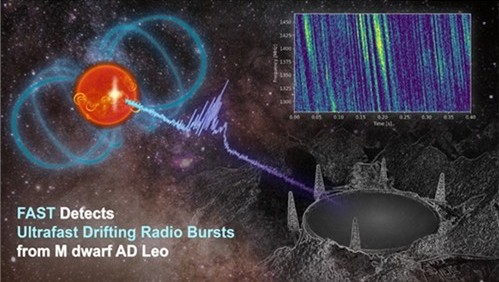
Diagrammatic drawing of ultrafast drifting radio bursts from M dwarf AD Leo received by FAST. Inset: The dynamic spectrum of the ultrafast drifting radio bursts. Photos: Courtesy of the research team led by Tian Hui
What the Researchers Actually Discovered
The investigation concerns 24 Boo b, HD 12648 b, and TYC 4282-605-1 b. Qian Shengbang, a professor at Yunnan University, leads the research team.
Its central discovery concerns the stars’ histories. The researchers identified all three hosts as red-clump giants, which burn helium in their cores.
That classification matters because these stars have already experienced extensive expansion during their earlier red-giant evolution. They subsequently contracted, leaving scientists with a puzzle about the planets nearby.
New Evidence About Known Worlds
Calling all three planets newly discovered would misrepresent the breakthrough. NASA’s Exoplanet Archive lists 24 Boo b as a planet discovered in 2018.
The new work instead connects planetary orbits with a clearer understanding of stellar development. It asks how the systems could have reached their current arrangements.
PNAS published the study online on October 22, 2026. Its title is “The survival paradox of close-in planets orbiting red-clump giants.”
How Stellar Vibrations Reveal the Survival Paradox
A star’s appearance does not tell scientists everything about its interior. Two giant stars can look similar while occupying different evolutionary stages.
To investigate, the team analyzed subtle brightness variations in satellite observations. These variations contain signatures of stellar oscillations, which provide clues about internal structure.
This approach, called asteroseismology, helped establish that the three stars currently burn helium in their cores. The study’s public research information identifies NASA’s TESS observations among its data sources.
Comparing Past Expansion With Present Orbits
Next, researchers used stellar models to estimate how far the hosts had previously expanded. They compared those estimates with the planets’ current orbital distances.
All three planets occupy locations within the reconstructed expansion regions. Under the expected evolutionary picture, those locations should not contain surviving close companions.
However, this comparison does not show the planets’ complete histories. Scientists observe the systems today and reconstruct earlier conditions through models.
The distinction also keeps the claim testable. Future analyses can check the stellar classifications, refine orbital measurements, and revisit the expansion estimates. Agreement across those checks would strengthen the puzzle. Differences could reveal which part of the reconstructed history needs adjustment.
Nobody watched these planets pass through their stars’ expansion. Their existence therefore establishes a discrepancy that needs explanation, rather than proving a particular route to survival.
Why 24 Boo b Stands Out
Among the three worlds, 24 Boo b provides the most striking example. It completes an orbit in approximately 30 days.
The new study places it about 0.183 astronomical units from its host. That equals roughly 18 percent of the average Earth–Sun distance.
The researchers describe it as the closest known planet orbiting a red-clump giant. This distinction applies to that specific stellar category, rather than all stars.
Such a compact orbit sharpens the central question. How could a planet remain so close after its host’s earlier expansion?
Older NASA archive entries give slightly different orbital estimates, around 0.19 astronomical units. For this discovery, the new analysis supplies the relevant value.
Importantly, proximity alone cannot reveal the answer. Researchers must also understand the star’s earlier development and the planet’s orbital history.
Possible Explanations Remain Open
The planetary survival paradox does not yet have a confirmed solution. Several kinds of evolutionary history could complicate the straightforward picture of a star expanding around nearby planets.
An earlier example shows why scientists consider alternatives. The planet Halla, also known as 8 Ursae Minoris b, orbits another helium-burning giant.
NASA described its unexpected presence in 2023. Researchers used stellar oscillations to investigate its host and found a similar conflict with expected expansion.
Lessons From Halla
One proposed explanation involves a host that originally consisted of two stars. A merger could have altered its development, preventing the expansion expected for an isolated star.
Another proposal suggests that material from a stellar merger could form a new planet afterward. In that case, the planet would not need to survive the earlier expansion.
These ideas concern Halla. They do not establish what happened around 24 Boo, HD 12648, or TYC 4282-605-1.
Their value lies in showing why present planetary locations can have different explanations. Survival, later formation, and changes in orbital arrangements represent distinct possibilities to investigate.
Finding three additional systems strengthens the case for examining such questions systematically. However, multiple examples do not prove that every system shares the same history.
What This Means for Earth’s Future
The connection to Earth is understandable. Our Sun will also undergo major changes as it ages, including substantial expansion.
Nevertheless, these distant planets do not provide a revised forecast for Earth. Qian explicitly noted that the findings do not directly change current predictions about our planet’s fate. www.globaltimes.cn
Their broader importance concerns the models scientists use to explore stellar and planetary evolution. Unexpected systems help researchers identify assumptions that need closer examination.
Survival Does Not Mean Habitability
A planet remaining physically present is different from retaining conditions suitable for life. These observations offer no evidence that Earth could remain habitable throughout the Sun’s later evolution.
Nor should scientists treat these systems as exact copies of our solar system. Their individual histories matter when interpreting the comparison.
For readers, the distinction is essential: the discovery expands a research question, rather than establishing that Earth’s future has changed.
Planetary Survival Paradox: What Comes Next?
Further progress will require more examples and tighter constraints on stellar histories. Better measurements can help researchers test whether different evolutionary pathways explain the observed arrangements.
Comparing systems will also help distinguish recurring patterns from unusual individual circumstances. A useful explanation must account for both the stars’ internal states and their nearby planets.
The planetary survival paradox therefore offers a concrete challenge for astronomy. Three worlds occupy surprising orbits, and their histories remain unresolved. Understanding how they arrived there could improve our picture of planetary evolution long after stars leave their familiar earlier stages.
Main sources:
- PNAS — The survival paradox of close-in planets orbiting red-clump giants
- Global Times — Chinese team finds 3 new planets, prompting new questions about Earth’s future
- NASA Exoplanet Archive — 24 Boo
- NASA — Discovery Alert: The Planet That Shouldn’t Be There
- University of Hawaiʻi — Astronomers Discover Death-Defying Planet
You Might Also Like:
millisecond pulsars FAST telescope discovery in globular clusters
China’s Shijian satellites fast-track space tech: Inside Beijing’s New Orbital Upgrade-Video
Fast radio bursts reveal dark universe clues