
BY:SpaceEyeNews.
The 3I/ATLAS ice signature presents an intriguing puzzle: familiar water ice appears to leave an unfamiliar pattern in the comet’s light. The explanation may involve tiny, dusty grains rather than unusual chemistry.
Universe Magazine describes Webb observations that link this interstellar visitor with icy objects beyond Neptune. The reported resemblance raises a compelling possibility. Different star systems may produce some surprisingly similar planetary building blocks.
However, the distinction between observation and interpretation matters. A matching spectral feature offers a valuable clue, but it cannot establish an identical origin or history.
What Makes the 3I/ATLAS Ice Signature Unusual?
Water ice absorbs infrared light at characteristic wavelengths. The supplied account highlights features near 1.5, 2.0, and 3 microns. Yet the shorter two features appeared unusually weak in the comet’s spectrum.
That imbalance matters because the strength of an absorption feature depends on more than the presence of a particular substance. Particle size and surrounding material also influence the pattern.
Consequently, faint absorption does not necessarily mean that little ice exists. Instead, it may reveal something about the ice grains themselves.
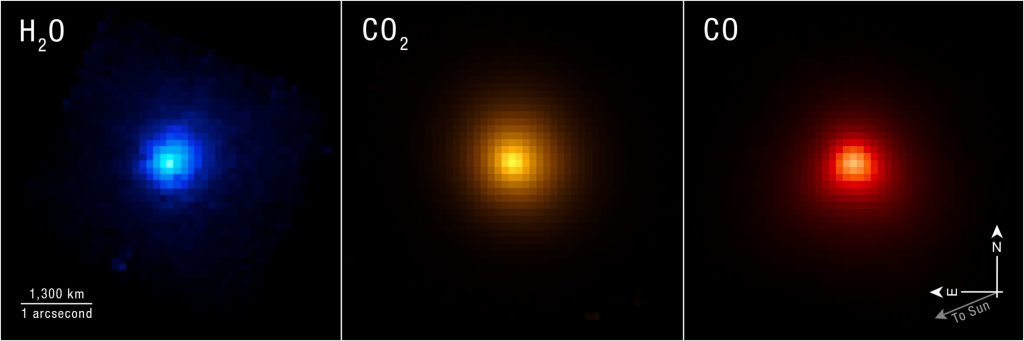
The account identifies Webb’s NIRSpec instrument as the source of the observations. Its measurements concern material released around the comet as sunlight warms its surface.
This distinction prevents a misleading conclusion. Astronomers can investigate escaping particles without directly measuring every layer inside the nucleus.
The observed grains therefore provide a sample of the comet’s activity. They do not automatically describe its entire structure or original composition.
Tiny, Dusty Grains Offer an Explanation
The proposed interpretation involves ice grains approximately one micron across or smaller, mixed with dust. This size estimate comes from modeling, rather than resolved photographs of individual particles.
Within a small grain, light travels only a short distance through ice. That limited path can weaken absorption, particularly at wavelengths where ice absorbs less strongly.
The stronger feature near three microns can therefore remain noticeable while weaker features become difficult to detect. This offers a physical explanation for the apparent mismatch.
Dust adds another influence. Its contribution can alter the overall spectrum and complicate attempts to isolate the ice signal.
An Unusual Spectrum, Not an Unknown Substance
The central question concerns the arrangement and dimensions of familiar material. It does not require an exotic chemical explanation.
Nevertheless, models involve assumptions. Researchers must consider how different combinations of grain size, dust content, and other properties affect the resulting spectrum.
The most useful interpretation explains multiple features together. Matching one feature alone provides a weaker basis for identifying the particles’ physical characteristics.
Changing Grains Could Reveal Different Material
A Coma That Evolves
The supplied account describes later observations that favored larger icy particles. If confirmed, this change would add another dimension to the spectral puzzle.
A comet’s surrounding cloud does not remain fixed. Heating, particle release, and ice loss continually influence the material that contributes to its light.
As a result, observations at different times can sample different particle populations. An evolving spectrum need not indicate a fundamental change in the nucleus’s bulk composition.
Heating or Newly Exposed Layers?
Uneven heating offers one possible explanation. Different regions may release different mixtures as their exposure to sunlight changes.
Another possibility involves deeper material becoming accessible after surface ice disappears. However, the reported change alone cannot distinguish these explanations conclusively.
Comparisons across observing sessions could help researchers test which processes best explain the changing signal.
They also need to distinguish a real change in particle properties from differences in observing conditions. A brighter or fainter feature can reflect several influences at once. Tracking the full spectrum helps narrow those possibilities.
A Surprising Resemblance Beyond Neptune
Similar Features Across Different Environments
Perhaps the most interesting claim concerns similarities between the comet’s spectrum and those of some trans-Neptunian objects.
These distant bodies offer a comparison with icy material inside our own planetary system. A shared pattern could indicate comparable physical properties despite very different journeys.
For 3I/ATLAS, the comparison concerns material escaping into space. For a distant icy body, observations generally probe its visible surface.
Those environments differ. Researchers must account for that difference before treating their spectral resemblance as evidence of shared formation conditions.
Similarity Does Not Mean an Identical History
Two objects can display related absorption features without sharing every chemical ingredient. Their temperatures, surface histories, and particle structures may also differ.
The comparison therefore supports a focused question: can related ice properties arise in more than one planetary system?
It does not establish that the objects formed together or experienced identical conditions. Calling them exact twins would overstate the evidence.
Still, the resemblance provides a useful starting point for testing how widely certain properties of icy material occur across different stellar environments.
What the Findings Could Mean for Planet Formation
Testing Shared Building Blocks
The 3I/ATLAS ice signature could help researchers compare material from different stellar environments. Such comparisons offer a way to test ideas about the solids that contribute to planetary growth.
If the interpretation holds, microscopic ice mixed with dust may help explain similarities across otherwise distinct objects.
However, one visitor cannot establish a universal recipe. A broader sample would help separate common properties from unusual cases.
An important question is whether the observed grains preserve their original characteristics or reflect later processing. Their passage near the Sun adds another influence. Understanding that alteration would help scientists connect the present observations with the material’s earlier history, without assuming complete preservation through time.
What the Evidence Cannot Establish
The reported spectrum does not independently determine the comet’s age. Describing it as a relic from the dawn of the Universe therefore goes beyond the evidence discussed here.
Nor does the observation prove how Earth acquired its water. Connections to that question require additional evidence about composition, transport, and planetary history.
Further comparisons could test whether the same explanation works across multiple objects. Better constraints on particle size and dust content would also strengthen the interpretation.
Why the 3I/ATLAS Ice Signature Matters
The significance lies in a precise connection: familiar ice may behave similarly in material from different star systems.
Tiny grains offer a plausible explanation for the reported weak absorption features. Their resemblance to distant Solar System material makes the finding especially interesting.
Yet the strongest conclusion remains measured. The 3I/ATLAS ice signature offers a testable clue about shared physical properties, rather than proof of identical planetary beginnings.
The next challenge is to determine how common those properties are. Each well-characterized interstellar visitor could make that comparison more informative.
Sources :
Universe Magazine — An anomalous chemical signature detected in the interstellar comet 3I/ATLAS — based on the text you supplied.
Official background resource: NASA — 3I/ATLAS. Retrieval was unavailable; this link does not constitute verification of the specific ice-grain findings.
You Might Also Like:
3I/ATLAS Methanol Discovery Reveals Unusual Origins
Interstellar Comet 3I/ATLAS May Reveal Its Hidden Origins
Interstellar Comet 3I/ATLAS Nears Jupiter Flyby — And Jupiter Could Nudge Its Exit Route.