
BY:SpaceEyeNews.
Earth without life could still have oceans, mild temperatures, and billions of years of habitable conditions. A new computer model suggests that geology alone could sustain those features. For astronomers seeking inhabited worlds, that creates a crucial challenge: a welcoming planet might remain completely lifeless.
Researchers have built a virtual Earth that excludes biology while tracking the planet’s evolving physical systems. Their results offer a comparison for future observations. Before interpreting an atmosphere as evidence of life, scientists need to understand how closely nature can reproduce it without organisms.
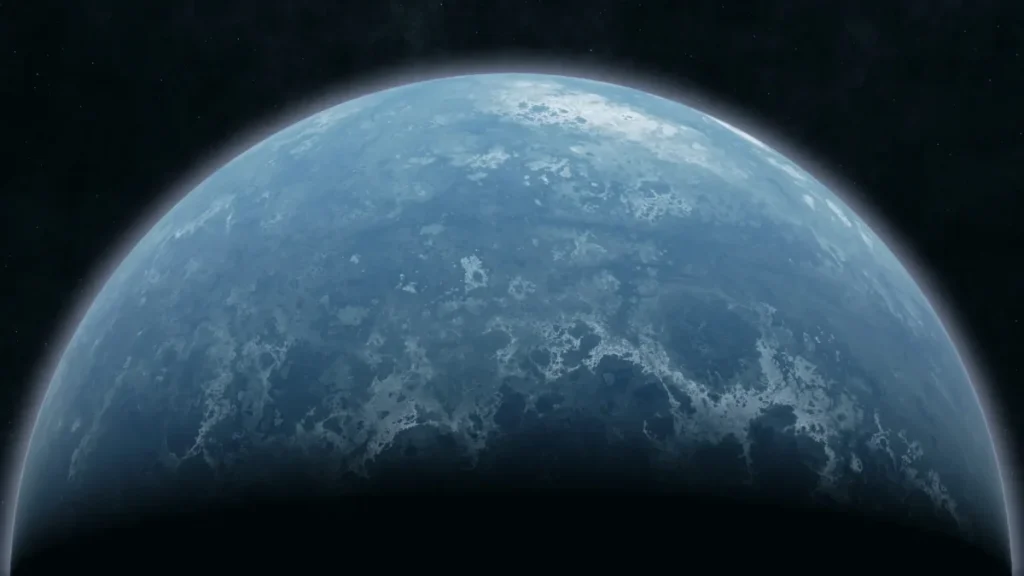
Earth Without Life: A New Perspective on Alien Worlds.
Building an Earth without life
The University of Washington team expanded VPLanet, software that simulates planetary evolution. Their work connects the interior, surface, and atmosphere, following exchanges that shape conditions over billions of years.
The simulation runs from 50 million to five billion years after formation. At 4.5 billion years, researchers compared its properties with preindustrial Earth. That reference avoids the recent atmospheric changes caused by human activity.
Testing the virtual planet
The comparison covered 19 properties, including atmospheric carbon dioxide and magnetic field strength. Seventeen matched within the quoted uncertainty ranges. Ocean acidity and dissolved carbon dioxide showed modest discrepancies, which the authors discuss as limitations.
These comparisons make the model useful, but they do not establish a perfect reconstruction. Its purpose is to provide a physically connected example of a habitable world without biology. Researchers can then investigate how different assumptions change the outcome.
An Earth without life therefore serves as a reference case, rather than a forecast of our planet’s future. Researchers deliberately remove biological influences to examine what the remaining processes can accomplish. This separates a planet’s ability to support organisms from evidence that organisms have actually appeared.
How a lifeless planet keeps its oceans
The striking result concerns climate stability. Across its modeled evolution, the virtual planet maintained average surface temperatures near 12–24°C. Meanwhile, the Sun’s brightness increased substantially.
The carbonate–silicate cycle helped maintain that balance. Volcanoes supplied atmospheric carbon dioxide, strengthening the greenhouse effect. Rainwater and rock weathering helped remove it, while carbon moved through the oceans, crust, and interior.
A geological climate regulator
Warmer conditions accelerated weathering, drawing down more atmospheric CO₂. That reduced warming. Cooler conditions slowed removal, allowing volcanic emissions to replenish the atmosphere and increase heat retention.
This feedback links the planet’s deep interior to its surface environment. In the simulation, it operated without organisms managing the climate.
The finding challenges the strongest claim that life must maintain habitable conditions. However, it does not imply that organisms have little influence on real Earth. Biology changes atmospheric composition and carbon cycling. The narrower conclusion is that this modeled planet retained suitable surface conditions without those contributions.
A familiar planet with a different history
Although the simulation reached broadly familiar conditions, its early history looked different. Initially, carbon dioxide reached a partial pressure near one bar. That represents roughly 3,500 times the preindustrial terrestrial value.
The young ocean also became more acidic, reaching a pH near 6.6. Compared with seawater around pH 8.1, that means roughly 30 times the hydrogen ion concentration. It does not mean the ocean contained 30 times more dissolved CO₂.
The missing methane contribution
The simulated early planet was cooler than some geological reconstructions suggest for actual Earth. Methane offers one possible explanation for that difference.
Early microorganisms may have supplied additional methane, helping offset the young Sun’s lower brightness. The model focuses instead on carbon dioxide and water vapor as its main greenhouse gases.
That choice needs careful interpretation. Nonbiological processes can also produce methane. Excluding it from this simulation does not establish that every lifeless atmosphere must lack it. arxiv.org
What future telescopes could see
The researchers also calculated reflected-light spectra for the modeled atmosphere and a realistic Earth comparison. These spectra show how atmospheric gases alter the light a distant observer receives.
The inhabited Earth comparison contains absorption features associated with oxygen, ozone, and methane. Water vapor and carbon dioxide dominate the corresponding features in the lifeless model. Nitrogen also belongs to the modeled atmosphere, even though it lacks similarly prominent features in this comparison.
This comparison turns an abstract evolutionary model into something astronomers could test against measurements. A telescope would not directly reveal a planet’s entire history. Instead, scientists would compare its light with predictions from several plausible histories. The challenge is to identify which explanations survive the available evidence, while allowing for uncertainty in the measurements.
Looking beyond oceans and mild temperatures
NASA’s planned Habitable Worlds Observatory aims to examine potentially habitable planets and search their atmospheres for possible signs of biology. Models like this could help scientists interpret those observations and refine observing priorities.
The useful question extends beyond whether a planet contains a particular gas. Researchers must assess whether its environment can sustain the observed chemistry without organisms.
Oxygen and methane together can offer a stronger clue because chemical reactions consume them, requiring replenishment. However, their detection would still demand careful environmental interpretation.
A mismatch with one model would justify further investigation, rather than immediately establish life. Several independent clues would build a stronger case than any isolated atmospheric feature.
Where the model still falls short
Clouds remain a major uncertainty. They affect both the energy a planet absorbs and the light it reflects into space. Simplified cloud treatment therefore influences the climate calculation and the predicted appearance.
The model achieved its temperature calibration with approximately 8% cloud cover, compared with roughly 67% on real Earth. That difference highlights a modeling limitation. It should not become a prediction that lifeless planets generally have fewer clouds.
Ocean chemistry introduces another uncertainty. Small discrepancies in acidity and dissolved carbon dioxide reveal where simplifying assumptions need further attention.
Future work must also address atmospheric escape more fully. Losing gases to space can change atmospheric chemistry and water inventories over long periods.
Researchers therefore need to test broader conditions before applying this comparison confidently to unfamiliar worlds. A successful Earth calibration provides a starting point, not a universal answer.
Earth without life sets a higher standard
Earth without life offers an important lesson for the search beyond our solar system: habitability can emerge without biology. Oceans and a stable climate identify promising targets, but they cannot reveal whether anything lives there.
The model’s value lies in making that distinction more rigorous. By improving explanations for lifeless worlds, scientists can better recognize observations that challenge those explanations. Finding another living planet will require understanding its lifeless alternatives first.
Main sources:
- University of Washington — Official research announcement: UW scientists build whole-Earth simulation to help find life on other planets
- The Planetary Science Journal — A Whole-planet Model of the Earth without Life for Terrestrial Exoplanet Studies
- Research manuscript — Full methods, results, and limitations
- NASA — Habitable Worlds Observatory
You Might Also Like:
Milky Way Habitability: Why Our Galaxy Looks Good for Life
70 Ophiuchi Habitable Zone: Could It Host Another Earth?
GJ 523b Mega-Earth Challenges Planet Formation
Enceladus Ocean Plume Sampling Could Reveal Life Clues