
BY:SpaceEyeNews.
NASA has samples waiting on Mars. China has a target for bringing its own collection home. That contrast now shapes the Mars sample return debate, as NASA reportedly reassesses its options and Tianwen-3 advances toward launch.
The stakes extend beyond which country arrives first. NASA must find an affordable route for retrieving Perseverance’s carefully selected samples. Meanwhile, China must turn an ambitious schedule into a successful interplanetary mission.
Both efforts could transform our understanding of Mars. However, neither political urgency nor confident predictions can replace tested hardware, stable funding, and reliable execution.
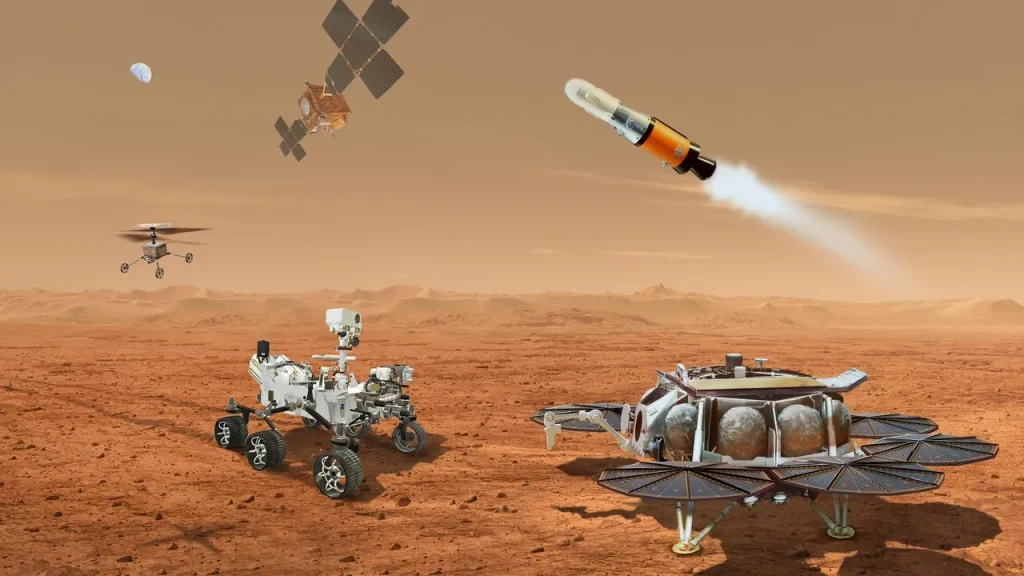
An illustration of different Mars Sample Return mission concepts.
(Image credit: NASA/ESA/JPL-Caltech)
NASA’s Mars Sample Return Reset
A new review, rather than a confirmed launch
Space.com reported in November that NASA is developing a fresh retrieval strategy through the Perseverance Sample Retrieval Architecture initiative. Its coverage attributed the announcement to NASA Mars Exploration Program director Tiffany Morgan during a November 9 scientific meeting.
The reported effort will examine requirements, previous lessons, available capabilities, and acquisition options. This signals renewed attention to returning the samples. It does not, by itself, establish a fully funded mission or a confirmed return date.
That distinction matters because the earlier program faced more than ordinary scheduling delays.
The US Government Accountability Office’s July 2026 assessment documented closeout activities. NASA had narrowed the program’s work, while remaining staff focused on selected lander technologies that could support future missions.
Therefore, the latest reassessment should not imply that NASA has simply resumed its previous design. The agency still needs a practical route from scientific ambition to mission delivery.
Why the older figures need context
In April 2024, NASA described an approach costing roughly $8 billion to $11 billion, with samples returning in 2040.
NASA subsequently announced two landing approaches for further study in January 2025. One drew on established landing technology; the other considered commercial capabilities. That earlier comparison illustrates how the agency explored alternatives before the later closeout activities changed the program’s direction.
Those figures explained why NASA sought alternatives. They are historical estimates, not the approved budget and timetable for the newly reported initiative.
Tianwen-3 Targets a 2031 Return
China’s published schedule offers a clearer target. CNSA states that Tianwen-3 will launch around 2028, with a planned sample return around 2031.
The mission will use two Long March 5 rockets from Wenchang. Its architecture includes a lander, an ascender, a service capsule, an orbiter, and a reentry module.
Consequently, describing Tianwen-3 as “one mission” requires care. It combines sampling and return within one coordinated campaign, but involves multiple spacecraft components and two launches.
The mission’s scientific ambition includes investigating whether life once existed on Mars. Yet a successful return would not automatically establish that life existed. Researchers would still need to test possible biological explanations against geological and chemical alternatives.
China has also selected cooperative scientific payloads involving institutions beyond the mainland. These partnerships show that the mission includes international research alongside national exploration goals.
For now, 2028 and 2031 remain targets. They describe the intended sequence, rather than a guaranteed outcome.
Different Samples, Different Scientific Strengths
Perseverance’s collection carries valuable context
Perseverance offers NASA an important scientific asset: samples selected during detailed exploration of the Martian landscape.
The rover’s observations help researchers connect each sample with its surroundings. That context matters when interpreting how rocks formed, how water altered them, and which processes shaped their chemistry.
Returning those samples could allow scientists to examine questions that the rover’s onboard instruments cannot fully resolve.
Furthermore, a collection from several geological settings can reveal relationships that an isolated sample might miss. Its value depends partly on the history researchers can reconstruct around it.
Tianwen-3 could provide another perspective
Tianwen-3 will gather its own material through a separate exploration campaign. Its eventual scientific contribution will depend on the sampling location, collection methods, preservation, and laboratory analysis.
A faster return would represent a major achievement. Nevertheless, arrival order alone cannot establish which collection offers greater scientific value.
Different samples could reveal different chapters of Martian history. Even if China returns material first, Perseverance’s collection could remain highly valuable.
Why Competitive Pressure Cannot Fix Engineering
The Global Times coverage places considerable emphasis on warnings from Chinese space experts. They argue that rivalry narratives could encourage unrealistic deadlines and distract from NASA’s underlying difficulties.
Those statements represent the interviewees’ assessments. They do not independently establish why NASA made particular budget or management decisions.
Still, NASA’s own earlier announcements acknowledged serious affordability and mission complexity challenges. These problems require concrete solutions.
The difficult steps remain
Any surface sample-return campaign must complete a demanding sequence. Spacecraft must reach Mars, manage surface operations, lift samples into orbit, and deliver them toward Earth.
Each transition introduces technical requirements. Teams must also protect sample integrity and prevent contamination from undermining later analysis.
A shorter schedule cannot remove those requirements. Cutting development time without sufficient evidence of readiness could increase the chance of expensive redesigns.
Competition may draw public attention and strengthen political interest. However, sustained progress depends on engineering decisions, realistic budgets, and clear responsibilities.
The useful question is whether urgency produces better support for the mission. Urgency becomes less helpful when expectations move faster than demonstrated capability.
The Milestones That Will Show Real Progress
For NASA, the next meaningful developments concern decisions and resources. A selected retrieval approach would clarify which spacecraft and technologies the agency intends to use.
Committed funding, defined partner responsibilities, and credible milestones would provide stronger evidence than another aspirational return date.
China faces a different test: demonstrating readiness against its published timetable. Hardware integration, testing, and launch preparations will show whether Tianwen-3 can maintain its planned sequence.
For both efforts, sample handling deserves attention alongside flight hardware. Containment, preservation, and analysis preparations affect the quality and reliability of the eventual science.
These practical milestones offer readers a better measure of progress than predictions about an inevitable winner.
Mars Sample Return Matters Beyond First Place
NASA’s existing collection and China’s planned return campaign create a compelling contrast. One has valuable samples awaiting retrieval. The other has an announced timetable for collecting and returning its own material.
China could complete that journey first, but major challenges remain. NASA’s renewed strategic work also requires concrete decisions before it becomes a dependable flight plan.
Ultimately, Mars sample return will succeed through careful execution and meaningful scientific results. The first delivery would mark a historic achievement. Later collections could still answer equally important questions about the planet’s past—and whether life ever emerged there.
Main sources:
NASA — Mars sample-return redesign and historical cost estimates:
https://www.nasa.gov/news-release/nasa-sets-path-to-return-mars-samples-seeks-innovative-designs/
NASA — Two landing approaches announced in January 2025:
https://www.nasa.gov/news-release/nasa-to-explore-two-landing-options-for-returning-samples-from-mars/
US Government Accountability Office — July 2026 program assessment:
https://files.gao.gov/reports/GAO-26-108556/index.html
China National Space Administration — Tianwen-3 mission plan and cooperative payloads:
https://www.cnsa.gov.cn/english/n6465652/n6465653/c10743241/content.html
NASA — Perseverance’s sample collection:
https://science.nasa.gov/mission/mars-sample-return/perseverance-rover/
Space.com — Reporting on the November 2026 retrieval-strategy initiative:
https://www.space.com/astronomy/mars/nasa-kick-starts-a-fresh-push-to-bring-mars-samples-home
Global Times — Original coverage and Chinese expert commentary:
https://www.globaltimes.cn/page/202611/1374155.shtml
You Might Also Like:
Tianwen-3 Mars Sample Return: China Builds a Secure Lab-Video
Mars Sample Return Canceled: NASA Steps Back as China Targets Historic Breakthrough
https://spaceeyenews.com/mars-sample-return-canceled-nasa-china-mars-race/