
BY:SpaceEyeNews.
Voyager 1 reaches one light-day from Earth on November 18, 2026, nearly nine years ahead of its twin. Yet Voyager 2 had a 16-day head start when the spacecraft left Florida in 1977. Voyager 1 erased that advantage by December, while both probes were still on their way to Jupiter. Long before either spacecraft could borrow speed from a giant planet, the order had already reversed.
The explanation begins with the destinations NASA chose. One flight path gave scientists a close encounter with Titan, Saturn’s largest moon. The other kept open a rare opportunity to visit all four giant planets. Those choices still shape how long a radio signal takes to reach each spacecraft today.
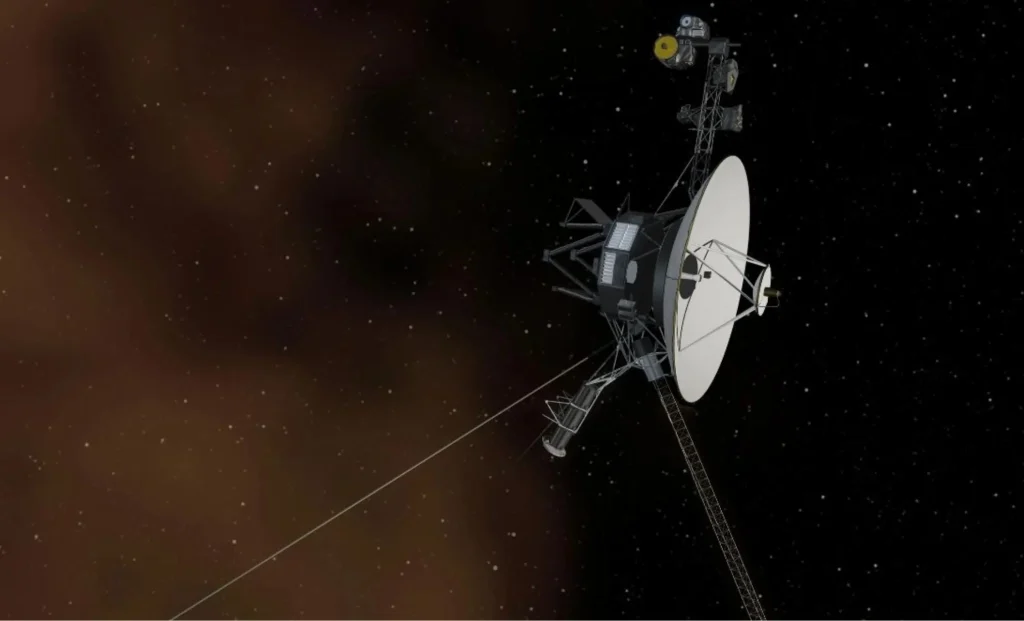
How Voyager 1 overtook its twin before Jupiter
NASA’s mission planners examined more than 10,000 possible flight paths. The first spacecraft to leave Earth needed a route that could carry it well beyond Saturn. Jupiter, Saturn, Uranus and Neptune occupied favorable positions for a sequence of flybys. To take advantage of that alignment, each encounter had to send the spacecraft toward the place the next planet would occupy years later.
Voyager 2 launched on August 20, 1977. On September 5, Voyager 1 followed on a shorter, faster route. NASA dates the overtake to December 15. The probes followed separate paths, so the comparison concerned their distance from the Sun. No close encounter between the twins marked the moment one pulled ahead.
By March 5, 1979, Voyager 1 had reached Jupiter. Voyager 2 made its closest approach on July 9, four months later. Jupiter’s gravity bent both flight paths toward Saturn. Each spacecraft also gained speed relative to the Sun by taking a tiny share of the moving planet’s momentum. Jupiter thus accelerated two probes that already had different arrival dates and different appointments to keep.
At Saturn, one moon decided Voyager 1’s next direction
For the Voyager 1 team, a particularly valuable observation depended on briefly losing sight of the spacecraft from Earth. In November 1980, the probe passed behind Titan. Just before the moon blocked the radio link, the signal traveled through layers of its atmosphere. By measuring how those layers bent the signal, researchers could work out how pressure and temperature changed with altitude.
Titan’s orange haze hid the surface from Voyager’s cameras. Yet the radio measurements helped scientists estimate that pressure at the surface exceeded Earth’s sea-level pressure by roughly half. Together with other instruments, they revealed a world with a thick, nitrogen-rich atmosphere. A photograph alone could never have supplied that pressure reading.
That viewing angle also determined where the spacecraft could go next. The path past Titan and Saturn’s rings swung Voyager 1 north, above the plane where the planets orbit. Uranus and Neptune lay beyond its reach. When Voyager 2 arrived the following August, it approached Saturn from a different angle. This time, Saturn’s gravity sent the spacecraft toward Uranus.
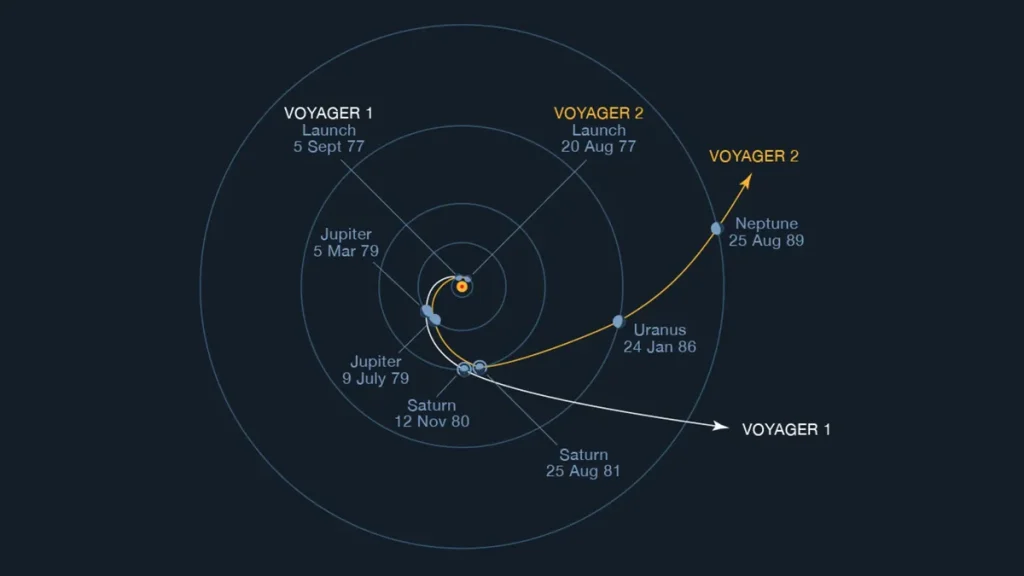
The trajectories of Voyager 1 and 2 through the outer solar system. (Image credit: NASA/JPL-Caltech)
Voyager 2 had just hours at Uranus
Voyager 2 carried no guarantee of a four-planet tour when it left Earth. The original mission covered Jupiter and Saturn. After the Saturn encounter, NASA reviewed the spacecraft’s condition and funded the trip to Uranus. Approval for Neptune followed. The planners’ early decision had given a future mission team a practical choice. When funding came through, the spacecraft already had Uranus in its sights.
Even with Saturn behind it, Voyager 2’s next destination dictated what it could see along the way. Engineers needed to preserve the path from Uranus to Neptune. That constraint left the spacecraft about five and a half hours for close observations at Uranus in January 1986.
The instruments made good use of those hours. Voyager 2 discovered two rings and found that the planet’s magnetic field tilts sharply away from its rotation axis. Scientists also found that the field sits off-center. From Earth, astronomers could watch the planet turn. A spacecraft flying through its magnetic surroundings could measure how little those two axes had in common.
Why Neptune slowed Voyager 2 down
At Neptune in August 1989, the team wanted a close look at Triton. Voyager 2 passed over the planet’s north pole before turning toward the moon. Images from the encounter revealed dark plumes rising above Triton’s icy surface. To this day, those frames come from the only spacecraft ever to visit Neptune or its largest moon.
The turn also cost Voyager 2 some speed relative to the Sun. A moving planet can speed up or slow down a passing spacecraft, depending on the direction of approach and departure. Neptune sent Voyager 2 south of the planetary plane. By then, almost nine years had passed since Voyager 1 finished its own planetary tour at Saturn.
Why Voyager 1 reaches one light-day first
Once both planetary tours ended, a modest difference in cruising speed kept widening the distance gap. NASA puts Voyager 1’s speed at roughly 38,000 miles per hour and Voyager 2’s at about 34,000. At those rounded speeds, the faster twin covers around 35 million extra miles in a year. Over ten years, that adds up to roughly 350 million extra miles along Voyager 1’s path. The probes travel in different directions, so that figure compares the ground each covers. Their actual distances from Earth also depend on where each spacecraft is heading.
The spacecraft have already crossed a more physical boundary. Voyager 1 entered interstellar space in 2012, and Voyager 2 followed in 2018. Each detected a change in its surroundings as it crossed the outer edge of the solar wind’s bubble. The one-light-day milestone measures something else entirely. It uses Earth as the reference point and tells us how far a radio transmission must travel.
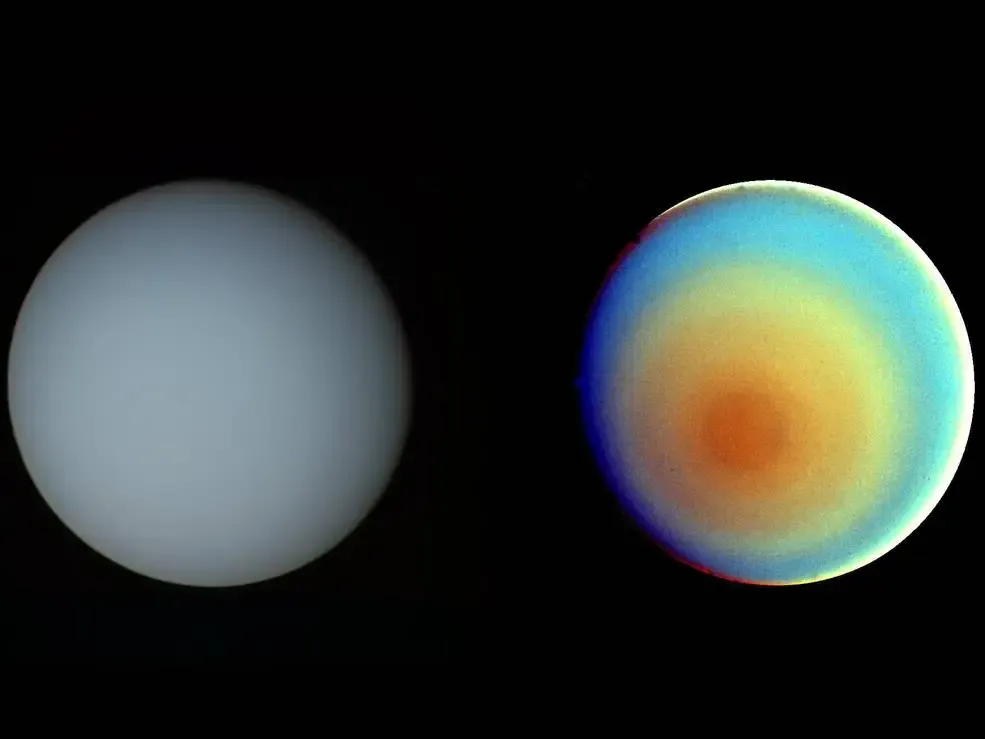
Voyager 2 images of Uranus in natural color, left, and false-color to highlight atmospheric features on an otherwise rather bland looking planet, taken from 5.7 million miles away (9.5 million kilometers). (Image credit: NASA/JPL-Caltech)
One light-day from Earth means two days for a reply
When Voyager 1 reaches one light-day, about 25.9 billion kilometers separate the spacecraft from Earth. Send a command on Wednesday morning and it reaches the probe on Thursday morning. Even if the spacecraft answers immediately, Friday morning brings the earliest possible reply. Both halves of that exchange travel at the speed of light.
NASA expects Voyager 2 to reach the same distance around 2035. By then, a command will face a day’s travel in a different direction, south of the planets that guided the spacecraft outward. We know the pressure beneath Titan’s haze because one team chose a particular path past Saturn. We have close-up pictures of plumes on Triton because the other spacecraft took the turn toward Uranus.
Main sources:
NASA — Voyager mission status
https://science.nasa.gov/mission/voyager/where-are-voyager-1-and-voyager-2-now/
NASA/JPL-Caltech — One light-day infographic and Voyager 2 projection
https://science.nasa.gov/resource/voyager-one-light-day-downloads/
NASA — Planetary voyage and trajectory selection
https://science.nasa.gov/mission/voyager/planetary-voyage/
NASA — Voyager 1 mission history
https://science.nasa.gov/mission/voyager/voyager-1/
NASA — Voyager 1 explores Saturn and Titan
https://www.nasa.gov/history/40-years-ago-voyager-1-explores-saturn/
NASA — Voyager 2 mission history
https://science.nasa.gov/mission/voyager/voyager-2/
NASA — FY 2027 budget estimates, Voyager cruise speeds
https://www.nasa.gov/wp-content/uploads/2026/04/fiscal-year-2027-full-budget-request.pdf
Space.com — Elizabeth Howell’s original coverage
https://www.space.com/space-exploration/voyager/nasas-voyager-1-launched-second-so-how-did-it-beat-voyager-2-to-a-light-day-by-nearly-a-decade
You Might Also Like:
Voyager 2 Neptune Navigation: A 7-Billion-km Feat
Voyager 1 Power Shutdown: NASA Turns Off Instrument to Extend Mission
Voyager 1 signal returns after 48 hours. Why did it fade?