
BY:SpaceEyeNews.
The Mars ‘potato chip’ formations that Curiosity photographed on November 7, 2026, pose a puzzle best seen up close. Small disks stand out from the Martian bedrock at a drill site called Nazca. Some neighboring features look more like needles. Both caught the science team’s attention for the same reason. A crystal can keep its distinctive outline long after another mineral takes its place. If that happened at Nazca, the rover may have photographed the shape of one mineral and collected traces of another. The investigation began weeks before NASA shared the image that gave the disks their nickname.
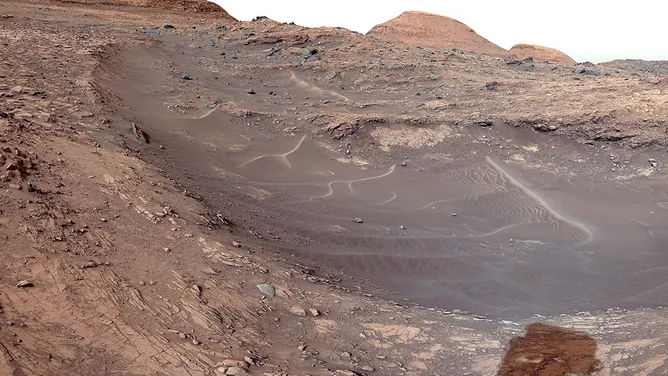
Curiosity Mars rover captured this view of Gediz Vallis channel on March 31. This area was likely formed by large floods of water and debris that piled jumbles of rocks into mounds within the channel.(NASA/JPL-Caltech/MSSS / NASA)
Why Curiosity chose the Nazca drill site
The first promising rock had a different name. At a block called Chiu Chiu, scientists spotted an abundance of disks and needles. They wanted a sample, but the block made a poor drilling target. A few meters away stood another candidate. Curiosity drove over and sent back a view of rock crowded with similar features.
That short drive gave the team a second exposure of the texture it wanted to investigate. Before drilling, engineers checked that all six wheels stood on firm ground. Then the rover pressed its drill bit against Nazca. The pressure test told the team how the block would respond and how much force the arm would experience. Nazca passed both checks and became Curiosity’s 49th drill hole.
A mast camera photographed the hole on October 20. By the time the arm camera captured the chip-shaped features in November, Curiosity had already sampled the rock around them. The two images show different parts of the investigation. One marks the spot where the drill entered. The other shows the texture that made that spot worth choosing.
How the Mars ‘potato chip’ formations could keep their shape
Crystal growth offers one explanation for Nazca’s repeated patterns. The arrangement of atoms within a mineral helps determine the shape it takes as it grows. Ordinary table salt illustrates the principle. Look closely at a few intact grains and their square faces hint at the cubic crystals salt can form. At Nazca, scientists have disks and needles to work with, but their mineral identities remain open.
Geologists have a name for a crystal outline that survives a change in composition. They call it a pseudomorph. Suppose a mineral grows into a disk within a rock. Later, a different mineral replaces it and takes on the same outline. A camera could still pick out the disk. A chemical measurement taken at that spot today could detect the replacement.
That possibility changes how scientists read the close-up. A disk could offer evidence of an early episode of crystal growth. Its present composition could carry evidence of a later change in the same rock. To explore that possibility, the team needed measurements at several scales, from a single exposed feature to the material inside the block.
Reading the disks in three dimensions
In a single photograph, a round patch can mark a shallow bump or the exposed face of a feature that projects farther out. To measure that relief, scientists planned five overlapping views from slightly different angles. Together, those images would let them reconstruct the surface in three dimensions. They also planned finer focus steps to bring out details in the close-ups.
Chemistry offered another way to look below the surface. At a nearby target called Toucan, the team planned to aim 150 laser pulses at one spot. Usually, Curiosity would spread that many pulses across five points. Each pulse removes a little material. By staying in one place, the laser could reach deeper and let scientists compare the exposed surface with what lay beneath it.
What the drill sample adds
Once Curiosity drilled Nazca, its ChemCam instrument examined the loose material around the opening. It also measured the chemistry along the drill hole wall. Those observations gave scientists a view into the block at a known location. Curiosity then delivered portions of the powdered sample to two onboard instruments, CheMin and Sample Analysis at Mars, or SAM.
CheMin directs a narrow beam of X-rays through rock powder. Crystals scatter the rays in characteristic patterns that scientists can use to identify minerals. SAM can heat a portion of powder and measure the gases that escape as the temperature rises. In its November 11 update, NASA said SAM was still analyzing material from Nazca.
Each measurement comes with a question of scale. A close-up preserves the position of an individual disk among its neighbors. A portion of drill powder contains material from the rock the bit passed through. Finding a mineral in that powder tells scientists it occurs in the sample. Connecting it to a particular disk takes additional evidence, which makes the targeted laser measurements especially valuable.
The team also planned to examine a cluster of crystal forms and a harder layer in the side of the block. Comparing those targets would give scientists a local reference for the disks. A chemical signature shared across several textures would call for a different interpretation than one concentrated in the disks alone.
What crystal size could reveal about ancient Mars
Shape earned the Nazca features their nickname, but size may tell scientists more about the setting where they grew. NASA’s geology team singled out the relatively large crystal forms at both Nazca and Chiu Chiu. Their dimensions offer clues to the temperatures during growth and to the salts and fluids available at the time.
The distinction matters on a mountain where rocks record changes across many layers. If the original crystals survive, their shapes and chemistry could help reconstruct one period in the rock’s history. If another mineral took their place, scientists face a different question. Which clues belong to the conditions that allowed the crystals to grow, and which belong to the conditions that changed them?
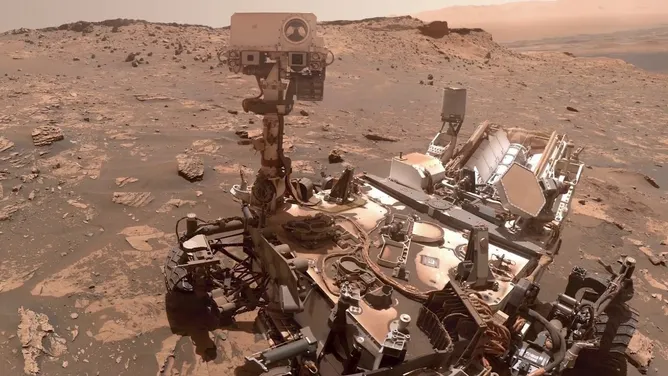
Curiosity leaves Nazca with a question still open
On November 17, NASA reported that Curiosity had resumed its climb up Mount Sharp after examining samples from Nazca and nearby Basque Lakes. The team described the rover’s return to the road and the patterns it encountered farther uphill. It left the identity of the original Nazca mineral open.
That gives the November close-up a lasting significance. The Mars ‘potato chip’ formations preserve a geometry scientists can measure against the chemistry of the surrounding rock. The most revealing detail may be how closely those two records agree. A match could help identify what grew at Nazca. A difference could help explain what happened there afterward.
Main sources:
NASA Science — Preparing to Drill at Nazca
NASA Science — It’s Nazca, Our 49th Drill Hole
NASA Science — Rocks and Chips
NASA Science — The Return of the Polygons
FOX Weather — NASA rover uncovers bizarre ‘potato chip’ formations on Mars
You Might Also Like:
Curiosity Rover Mars Climb Reaches 1 Kilometer
Mars Organic Molecules Discovery: Curiosity Finds Building Blocks of Life
Curiosity’s sulfur discovery: A Mars Mystery Beneath the Wheels