
BY:SpaceEyeNews.
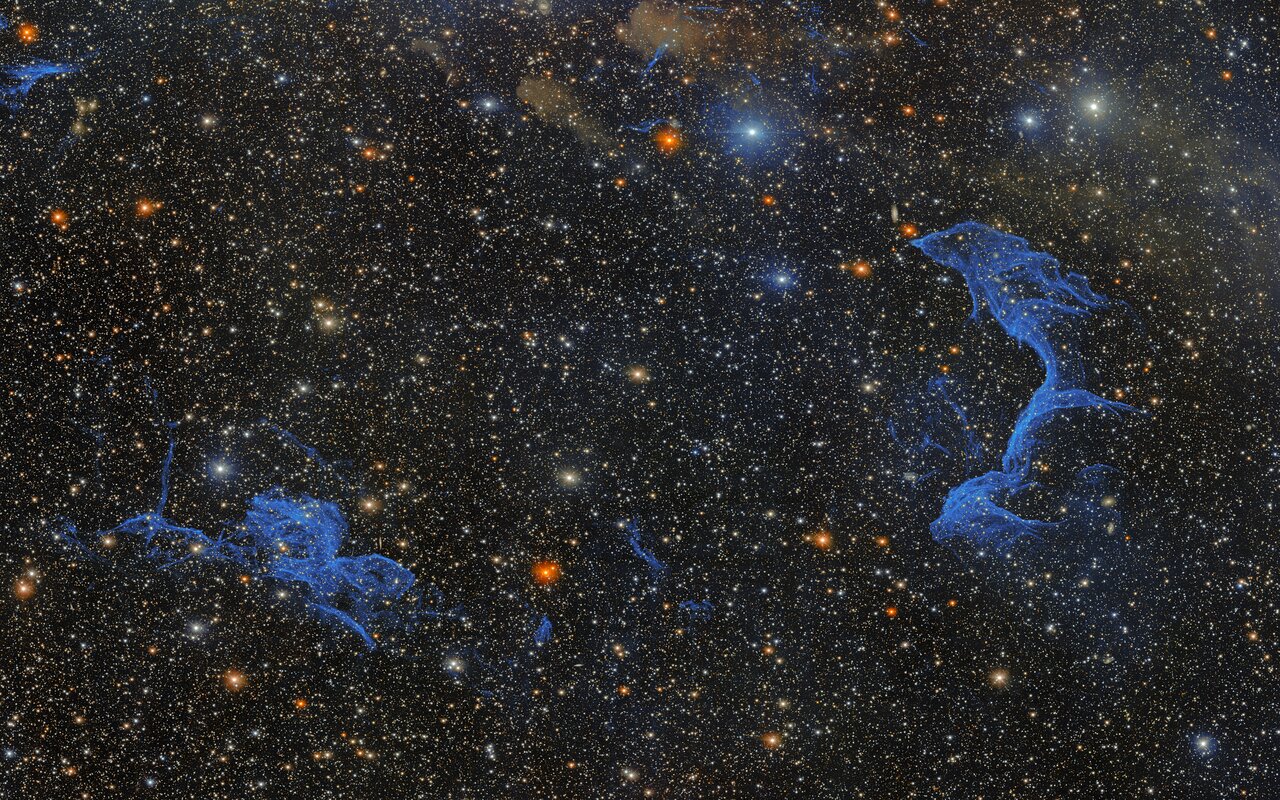
The Betta Fish Nebula looks most like its namesake when you take a step back. Against a field of stars, its blue ribbons suggest the trailing fins of a fish turning in water. Look closer, though, and the outline breaks into folds thin enough for individual stars to show through. On November 23, 2026, NSF NOIRLab released what it calls the most detailed view yet of this supernova remnant. Its portrait captures an encounter still unfolding nearly 6,800 light-years away, where material from a massive star meets the gas around it.
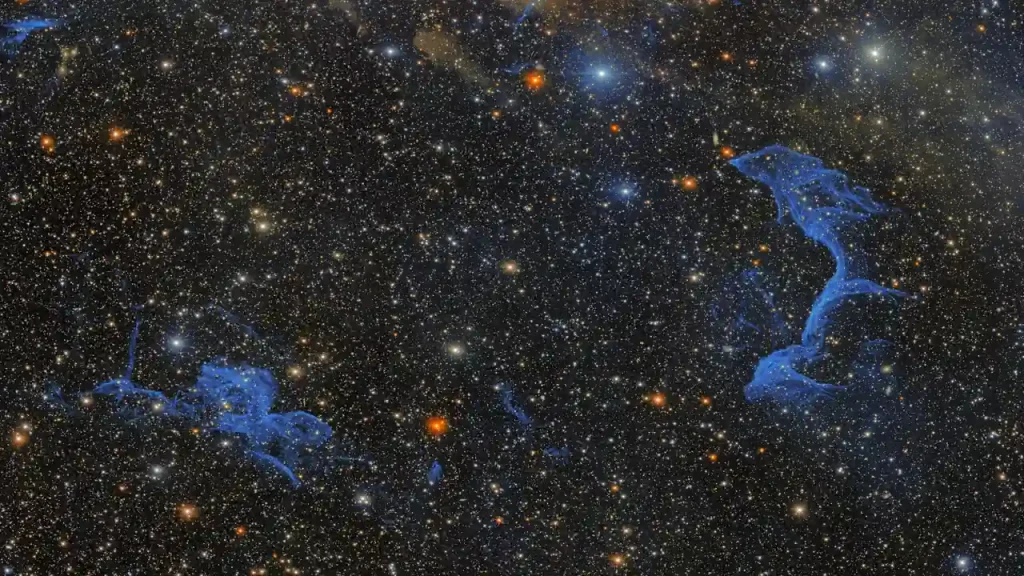
Two wisps of blue gas curve like fish fins across a dense field of stars in the Betta Fish Nebula. Image credit: CTIO/NOIRLab/DOE/NSF/AURA. Image processing by T. A. Rector (University of Alaska Anchorage/NSF NOIRLab), D. de Martin and M. Zamani (NSF NOIRLab). Original photograph
Why the Betta Fish Nebula glows
The star that once occupied this part of the Milky Way ended its life in a supernova. Its outer layers rushed into space, where they encountered gas between the stars. As the expanding material swept into that gas, it supplied the energy that makes the ribbons shine. Some of the light reaching the telescope today therefore comes from the star’s surroundings. Those surroundings helped shape the feature that gives the nebula its name.
Consider what happens where a thin, glowing sheet curves across our line of sight. Looking straight through the sheet, we see light from a shallow layer. Along a fold, our gaze passes through a longer stretch of glowing gas. That edge can appear as a bright, narrow thread even when the gas extends well beyond it. Follow several such edges across the image and the resemblance to the overlapping folds of a fin comes into focus.
NASA points to a similar effect in the Veil Nebula, another supernova remnant. There, a ripple seen edge on can look especially bright. A denser patch of gas can also brighten a filament. That gives us two reasons to pay attention to a ribbon’s brightness, and a reason to be cautious about reading the density of the gas from a photograph alone.
Inside the shell
While the outer layers expanded, the star’s core contracted into a neutron star. Astronomers detect it through its X-rays and have measured its rotation at roughly two turns per second. NASA describes it as radio-quiet and reports that astronomers have yet to confirm a visible-light detection.
That matters when exploring a photograph crowded with bright points. Picking out a star near the apparent center of the shell would tell us little about its identity. The more reliable clue to the core comes from the timing of its X-ray pulses. The glowing shell and the spinning core each preserve a different part of the same star’s history.
Why use the Dark Energy Camera?
The Dark Energy Camera sits on the four-meter Víctor M. Blanco Telescope at Cerro Tololo Inter-American Observatory in Chile. Its original assignment required a wide field of view. For the Dark Energy Survey, astronomers used the camera to map the positions and shapes of distant galaxies. Patterns across those maps helped them study how matter clumps together as the universe expands.
That same design suits an object much closer to home. A tight crop shows the delicate contours of an individual ribbon. Across the full field, you can trace where that ribbon sits within the larger shell and see the stars around it. The camera’s 570 megapixels give readers room to move between those scales in the published image.
The Betta Fish Nebula observation came through NOIRLab’s Legacy Imaging Program. The program sets aside telescope time to create color images for the public. In this case, the observatory released both a wide view and a close-up. Open them side by side and pick a distinctive bend in the gas. Finding it again in the wider frame gives the close-up a sense of scale.
Beyond the ribbons in Centaurus
The nebula lies toward the southern constellation Centaurus, in the Carina–Sagittarius Arm of the Milky Way. Thousands of stars from that arm share the picture. Some appear to sit directly on the blue filaments. Their positions tell us that their light reaches Earth from much the same direction. The photograph alone cannot tell us how close any particular star lies to the gas.
Look away from the brightest ribbons and the field takes on a different texture. Hazy brown patches mark diffuse interstellar clouds elsewhere in the Milky Way. Farther back, light from entire galaxies reaches us through the same field. At the scale of the full portrait, those galaxies are easy to overlook among the far more numerous stars.
Try the observatory’s zoomable version with the blue shell at the edge of the screen. Search the surrounding field for a faint, extended patch and compare it with the compact points nearby. Then widen the view again. A single frame that at first seemed to contain one unusual nebula reaches well beyond our own galaxy.
An earlier Betta Fish Nebula portrait
A different view appeared in NASA’s Astronomy Picture of the Day on June 11, 2026. Its title used another nickname, the Mermaid Nebula. Sy Ming Wong gathered the observations, and Guangyan Gao processed the image. The two colors let readers trace where different gases contribute light across the same stretch of sky. NASA identifies blue in that particular image with doubly ionized oxygen and deep red with hydrogen.
The November release adds fine detail as well as a wider setting to explore. NOIRLab identifies the remnant as SNR G295.5+09.7 and suggests this may be its first portrait from a professional observatory. The June image helps put that claim in perspective. Observers already knew the object and had photographed its distinctive shape before the Blanco telescope delivered this view.
Following the fin
Return to the Betta Fish Nebula and follow one bright fold until it fades into the star field. What first caught the eye as a fish’s fin now marks a place where a star changed the space around it. The gas still shines there. And somewhere inside that expansive shell, the surviving core keeps time in X-rays, turning twice each second.
Main sources
https://noirlab.edu/public/news/noirlab2629
Dark Energy Survey releases most precise look at the universe’s evolution
You Might Also Like:
Cat’s Head Nebula: Webb Uncovers a Hidden Cosmic Landscape
Seagull Nebula: Rubin’s Stunning View Reveals a Bigger Story
Helix Nebula Discovery Reveals Cosmic Recycling