
BY:SpaceEyeNews.
A bright blue eye appears above a dark ridge, surrounded by sweeping pink clouds. The Seagull Nebula offers an arresting subject for the Vera C. Rubin Observatory. Yet the most revealing detail lies behind the camera: this portrait came from Rubin’s smaller testing instrument.
Released in October 2026, the image draws on observations from autumn 2024. It shows how an engineering campaign produced both compelling astronomy and practical lessons for a much larger survey.
For readers following Rubin’s progress, the picture connects two stories: the environments surrounding young stars and the work required to observe them reliably.
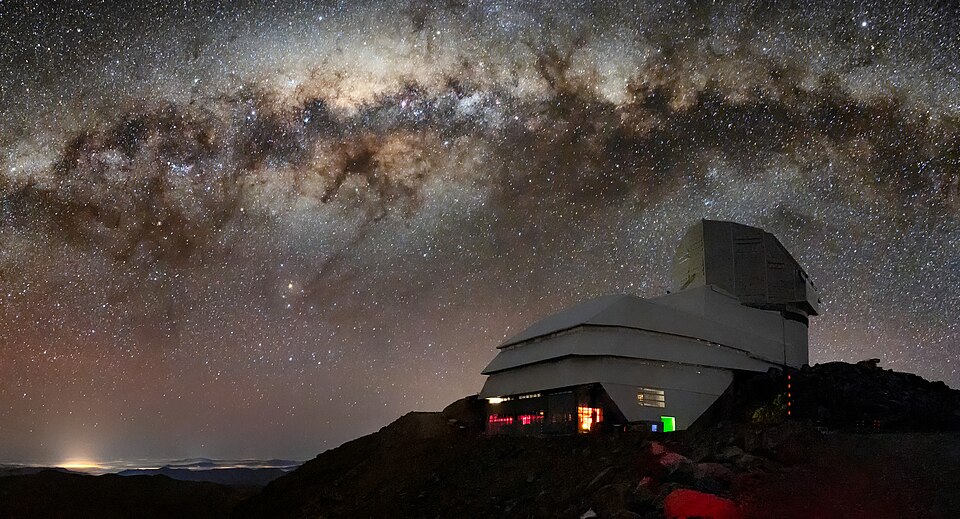
The Vera C. Rubin Observatory. Credit: RubinObs / NOIRLab / SLAC / NSF / DOE / AURA / P. Horálek (Institute of Physics in Opava)
Inside the Seagull Nebula’s Glowing Head
About 3,700 light-years away, the wider Seagull complex stretches between Monoceros and Canis Major. Three prominent gas clouds give it the appearance of a bird in flight.
Rubin’s portrait concentrates on Sharpless 2-292, the apparent head. This framing brings the region’s contrasting textures into focus.
Pink areas trace hydrogen gas that glows under ultraviolet radiation from young stars. Meanwhile, blue haze comes from dust reflecting nearby starlight. Darker features mark material that obscures the bright background.
Near the top of a jagged ridge sits HD 53367. The official release identifies it as a triple system of massive young stars, forming the Seagull’s apparent eye.
Together, these features show how starlight illuminates and reshapes a stellar nursery. The image’s appeal comes partly from that contrast: luminous gas surrounds structures that remain dark and dusty. www.rubin.ac.uk
A New Image From an Earlier Campaign
The portrait’s release date needs a little context. Rubin’s engineering camera, ComCam, observed the sky between October 24 and December 11, 2024. The team collected approximately 16,000 exposures during that seven-week campaign.
That total covers the campaign’s observations, rather than this nebula alone. Likewise, the October 2026 release does not mean the telescope recently captured the underlying data.
These distinctions place the image within Rubin’s development. Before its main camera could begin survey work, engineers needed evidence that the observatory’s components worked together.
ComCam provided that opportunity. Its observations tested the route from incoming light to usable scientific data, linking equipment performance with the software that processes images.
The resulting portrait therefore records an early milestone whose value extends beyond its visual impact. lsst.ac.uk
Why the Seagull Nebula Challenged Rubin’s Software
Photographing a complex stellar nursery requires careful processing. Stars share the frame with extended clouds, faint emission, and sharp changes in brightness.
Rubin’s documentation specifically identifies the Seagull field’s widespread nebulosity as a challenge for its processing pipelines. The cloud structures extend across the camera’s view, complicating the task of turning observations into dependable images. dp1.lsst.io
Turning Detail Into Reliable Data
For researchers, an attractive picture is only part of the goal. They also need measurements that support comparisons between objects and observations.
A bright star and a faint cloud present different demands within the same frame. Processing must preserve scientifically useful information across those contrasting features.
The Seagull observations gave Rubin’s team early experience with these challenges. According to the official release, that experience helped address problems relevant to the larger camera’s images.
The lessons also supported work on the Trifid and Lagoon Nebulae portrait, which appeared during Rubin’s June 2025 First Look.
This connection makes the engineering campaign especially meaningful. Testing with a smaller instrument helped prepare the team for more expansive observations.
ComCam continues to contribute after completing its sky observations. It now serves as a testing platform in the summit clean room. There, the team uses it for camera software tests and checks on spare equipment. Its current role extends the same practical purpose that made the original observing campaign valuable. www.bnl.gov
From ComCam to a 3.2-Gigapixel Camera
ComCam carried nine imaging sensors and recorded 144 megapixels. Rubin’s main LSST Camera increases that total to 3,200 megapixels, or 3.2 gigapixels.
The larger instrument uses 189 science sensors. Together, they cover 9.6 square degrees of sky in a single exposure.
Its field of view spans roughly 21 times the area covered by ComCam. That wider coverage helps Rubin observe large regions repeatedly, a central requirement of its survey. Rubin Observatory
Wider Coverage, More Scientific Context
Field of view and sharpness describe different qualities. A camera that covers more sky does not automatically resolve smaller details.
For Rubin, the advantage comes from combining broad coverage with sensitivity and repeated visits. Researchers can examine many objects within a consistent observing programme.
Six filters also let the camera collect information across different wavelength bands. Those measurements add colour information that supports scientific analysis beyond the appearance of a finished portrait.
Speed matters alongside image size. The camera’s electronics can read its full array in approximately two seconds. That capability helps limit the time spent transferring measurements between exposures. A survey built around repeated visits needs this efficiency throughout the observing process, from collecting light to preparing for the next field.
The main camera’s design therefore serves a larger purpose than producing enormous images. It supplies the observations needed to investigate how objects differ and how they change. LSSTCam
What Young Stars Can Reveal Over Time
A single image captures the arrangement of glowing gas and dust. Repeated observations add another dimension: changes in the stars themselves.
LSST:UK highlights this opportunity for studying young stars and their surrounding disks. Multicolour images provide information about dusty environments where planets form.
Meanwhile, brightness monitoring over ten years can reveal changes within those environments. Researchers can compare observations across time instead of relying on one moment.
This approach gives the Seagull portrait a broader scientific context. Stellar nurseries offer places to investigate the conditions associated with emerging planetary systems.
Such research also informs our understanding of the Sun’s early surroundings. However, the image itself does not establish a new planet discovery. Its immediate significance lies in the stellar environment it records and the observing capability it demonstrates. www.rubin.ac.uk
The Seagull Nebula and Rubin’s Next Decade
Rubin’s wider programme has already moved beyond preparation. The observatory announced the start of its ten-year Legacy Survey of Space and Time on June 30, 2026.
From Chile, the survey combines repeated observations with a wide view of the sky. Its goal is a detailed record of the changing Universe. Rubin Observatory
The Seagull Nebula portrait helps explain the work behind that ambition. Engineers first tested how the telescope, camera, and processing systems handled demanding astronomical scenes.
Now, those early lessons support a sustained observing programme. The blue eye remains the image’s memorable feature, but its lasting contribution reaches further: it links a beautiful stellar nursery with the practical foundations of Rubin’s science.
Main sources
- Brookhaven National Laboratory: Seagull Nebula through Rubin’s commissioning camera
- LSST:UK: Capturing the birth of stars in the Seagull Nebula
- LSST:UK: Test camera delivers images
- Rubin Science Platform: Seagull Nebula observations
- Rubin Observatory: LSST Camera technical documentation
- Rubin Observatory: The ten-year survey begins
You Might Also Like:
Rubin Observatory COSMOS Image Reveals a Vast Galaxy Field
Interstellar Comet 3I/ATLAS Was Hidden in Rubin Observatory Images Before Discovery
South Pole Telescope Galaxy Clusters Reveal a Hidden Cosmic Census