
BY:SpaceEyeNews.
Black hole growth in the early universe left a curious clue in a galaxy called MARTA 3887. We see this small collection of stars as it looked roughly 12 billion years ago. By then, its stars together weighed about 145 million times as much as the Sun. Yet a signal in its light points to a black hole of about 3.3 million solar masses. For every 44 Suns’ worth of stars, the black hole alone would account for another Sun. How did it gain such a head start while the galaxy was still putting its stars together?
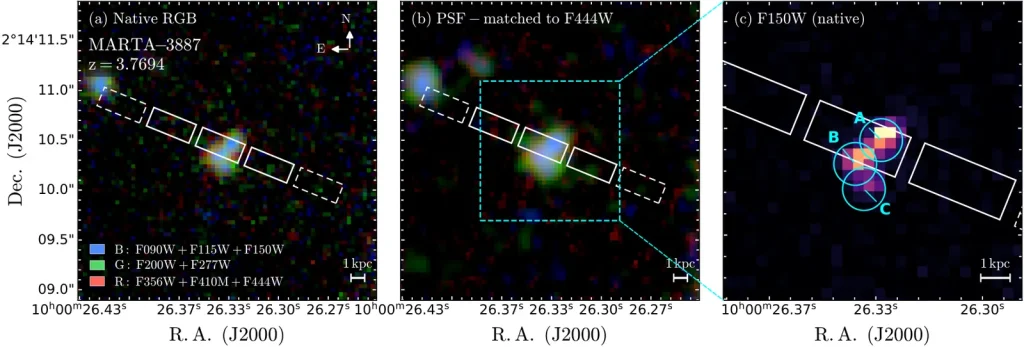
Webb’s NIRCam reveals compact stellar clumps in MARTA 3887. A separate measurement of fast-moving hydrogen in the galaxy points to a possible black hole weighing 3.3 million Suns. Image credit: Mirko Curti et al. (2026), Figure 1, CC BY 4.0. arxiv.org
Webb’s hydrogen clue
The first clue came from hydrogen. Webb’s Near-Infrared Spectrograph recorded the galaxy’s hydrogen-alpha emission and picked up a broad feature beneath the narrow peak. Hydrogen moving toward us shifts some light to shorter wavelengths. Gas moving away shifts it the other way. Together, those shifts gave the feature a width equivalent to about 1,270 kilometers per second.
A black hole could account for that width. Gas moving deep within its gravitational pull can reach high speeds and shine brightly as the black hole feeds. But gas flowing outward through a galaxy can also produce a broad line. To distinguish those possibilities, the astronomers looked at light from oxygen atoms that had lost electrons.
The oxygen showed a much narrower range of speeds. An ordinary galactic outflow would have a harder time explaining why only the hydrogen showed such broad emission. That difference tipped the evidence toward a feeding black hole. It also gave astronomers a way to estimate its mass from the width and brightness of the hydrogen line.
Why 2.3 percent matters
The candidate’s estimated mass amounts to 2.3 percent of the mass in the galaxy’s stars. Gas and dark matter fall outside that comparison. Astronomers chose stellar mass because nearby galaxies offer a benchmark linking their stars to their central black holes.
Extend that local trend down to a galaxy as small as MARTA 3887, and the surprise comes into focus. The candidate weighs roughly 100 times what the trend predicts. That comparison captures the imbalance at the moment the light left the galaxy. Measuring how quickly either the stars or the black hole gained mass requires other clues.
Dating the galaxy’s stars
Hubble and Webb images reveal at least three compact clumps within MARTA 3887. The galaxy was adding roughly five to nine solar masses of new stars each year. Particularly bright young stars dominate its light, giving astronomers a clear view of a recent burst of star formation.
The team’s best estimate places half of the galaxy’s star formation within the final 18 million years before we see it. Pinning down the earlier history proved harder. The researchers estimate that the galaxy had formed its first tenth of stellar mass about 92 million years before the observation. A faint older population could push that milestone considerably further back.
That uncertainty matters because a stellar birthday can serve as a starting point for a calculation. It cannot tell us when a black hole first began to feed. The team explored what happens when those two clocks start together and when the black hole gets an earlier start.
Two timelines for black hole growth in the early universe
Start with a seed black hole weighing 100 Suns. Give it access to gas when the universe was just 100 million years old. In the team’s model, it could reach the inferred mass while averaging about 34 percent of the Eddington rate. That benchmark describes the point where outward radiation balances gravity’s inward pull on surrounding gas.
Now give the same seed only the 92 million years associated with the galaxy’s recent stellar buildup. Reaching the same mass would require an average feeding rate around 5.7 times the benchmark. Even an occasional surge would leave a demanding question. Could the seed maintain a high enough average across that entire period?
A heavier seed
A larger seed has less growing to do. With the early start, a seed of 10,000 solar masses needs about 19 percent of the benchmark rate. Raise its starting mass to 100,000 Suns and the figure falls to about 11 percent. Each calculation follows a single black hole and assumes gas supplies all the extra mass. A merger somewhere in its history would change that arithmetic. Two smaller black holes could bring together mass that each had already accumulated elsewhere.
The faint black holes surveys miss
The European Space Agency has highlighted another Webb discovery, CANUCS-LRD-z8.6, with an unusually massive black hole for its host. Webb caught that galaxy just 570 million years after the Big Bang. In that case, the team found clear evidence for an actively feeding black hole. Such objects raise a question about which galaxies make it into a survey. At a given stellar mass, a bright, actively feeding black hole can announce itself across enormous distances. Its fainter counterparts can slip past the same instruments.
MARTA 3887 takes the search into a small galaxy where young stars contribute much of the light. Finding more candidates in such settings would give astronomers a fairer sample. They could then ask how often a black hole gained an early lead and how often the brightest examples skewed the picture.
Will the signal persist?
One observation leaves room for other explanations. A supernova interacting with dense gas could briefly produce broad hydrogen emission. A compact gas outflow also remains possible. The researchers describe the object as a candidate in their revised preprint. A later spectrum could show whether the feature fades or persists, giving astronomers a way to test the supernova explanation.
For now, MARTA 3887 offers a glimpse of black hole growth in the early universe at a scale Webb can barely discern. If the signal holds up, astronomers will have found a galaxy still building much of its stellar population around a black hole already millions of times the Sun’s mass.
Main sources
Original research by Mirko Curti and colleagues — https://arxiv.org/html/2611.00199v2
Phys.org coverage of MARTA 3887 — https://phys.org/news/2026-11-jwst-black-hole-grew-faster.html
ESA/Webb release on CANUCS-LRD-z8.6 — https://esawebb.org/news/weic2522/
You Might Also Like:
Early Universe Black Holes Raise a Double Growth Mystery
Three Black Holes Reveal an Early Galaxy’s Growth Secrets
Black Hole Growth: A Quiet Path Without Galaxy Mergers