
BY:SpaceEyeNews.
Three black holes inside one ancient galaxy are offering astronomers a revealing glimpse of cosmic growth. Using the James Webb Space Telescope, researchers found evidence for three actively feeding objects in J0148-4214. We see this galaxy as it existed roughly 1.2 billion years after the Big Bang.
The discovery brings two important growth processes into focus: drawing in gas and assembling multiple black holes within one galaxy. It also raises a question. How many distant galaxies hide similar systems behind what appears to be a single bright source?
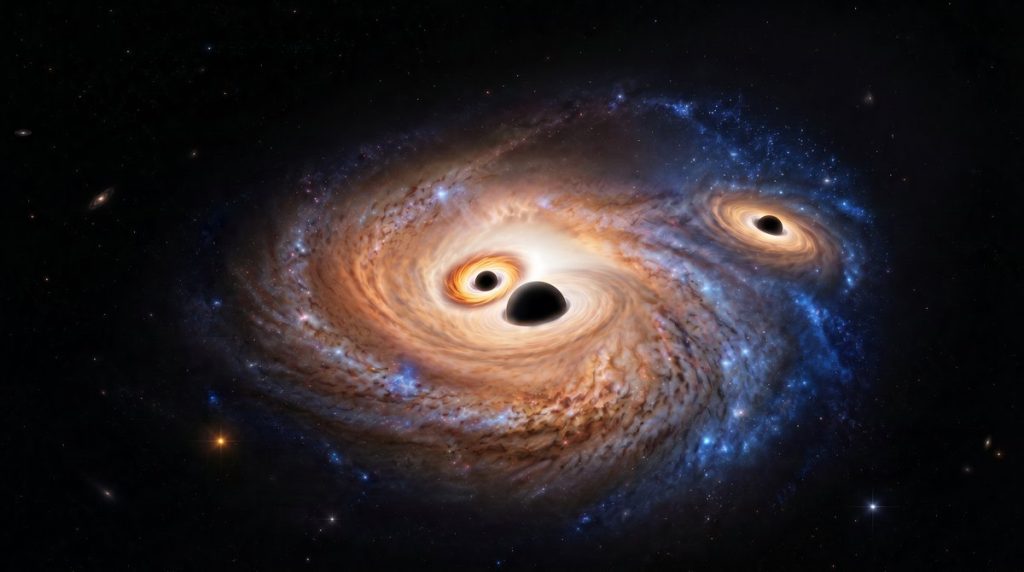
Three Black Holes Share One Young Galaxy
An international team led by the Max Planck Institute for Extraterrestrial Physics investigated the unusual system. Hannah Übler led the study, which examines a galaxy at a redshift of approximately 5.02.
Its light has traveled for about 12.5 billion years. That travel time gives astronomers access to an early chapter of galaxy evolution.
Two active black holes occupy the central region. Their projected separation measures approximately 620 light-years. A third lies farther out, around 5,500 light-years from the center.
These measurements describe separation across the sky. The true distances could be larger because observations do not directly reveal the full three-dimensional arrangement.
Three Very Different Masses
Researchers estimate masses of roughly 80 million, 600,000, and 2 million times the Sun’s mass. The smallest object sits near the largest.
Meanwhile, the galaxy’s stars collectively contain around 1.3 billion solar masses. The black holes therefore account for a notable share of the system’s mass compared with its stars.
However, the black-hole estimates carry substantial uncertainties. They rely on relationships between gas motion, emission strength, and black-hole mass, rather than direct measurements of each object.
How Webb Distinguished the Hidden Sources
The discovery depended on Webb’s Near Infrared Spectrograph, or NIRSpec. Its integral-field mode records spectra across different positions in a galaxy.
That capability let researchers examine both the light’s characteristics and where it originated. Combining those clues revealed structure that a single blended spectrum could hide.
Hydrogen Light Reveals Rapid Gas Motion
Gas close to an active black hole moves rapidly. Its motion broadens particular emission features, including hydrogen’s H-alpha line.
The team identified broad hydrogen emission consistent with gas surrounding three accreting black holes. Near the center, the emission profile showed a complex shape that required closer investigation.
Researchers also examined alternative explanations, including stellar activity and gas flows. Their analysis favored separate regions of gas associated with feeding black holes.
Tiny Positional Shifts Expose the Central Pair
To distinguish the central sources, the scientists used spectro-astrometry. This technique measures small changes in the apparent position of emission across a spectral feature.
Different portions of the hydrogen signal traced slightly different locations. Those shifts helped the team identify two central sources despite their close apparent spacing.
Webb did not produce a conventional photograph showing two separate central black holes. Instead, the researchers extracted their spatial signatures from detailed spectroscopic measurements.
The Smallest Black Hole Has a Growth Clue
The largest object attracts attention through its mass. Yet its smaller neighbor may offer the more revealing clue about rapid growth.
The roughly 600,000-solar-mass black hole appears to feed at an exceptionally high rate relative to its mass. Researchers infer activity beyond the standard Eddington benchmark.
This benchmark describes a balance between inward gravity and outward radiation pressure under simplified assumptions. Exceeding it does not mean an object violates physics.
Rather, the result suggests that simple growth models may not describe every feeding episode. Real accretion flows can behave differently from idealized models.
Such episodes could help explain how some early black holes accumulated mass quickly. However, one observation cannot establish how long this phase lasts or how often it occurs.
Could the Central Black Holes Eventually Merge?
The close central pair provides another possible route toward growth. As galaxies assemble, their black holes can enter a shared environment and gradually move closer.
Interactions with surrounding matter can reduce their orbital energy. Eventually, suitable conditions may allow the black holes to merge.
The research paper estimates a simplified orbital-sinking timescale of approximately 700 million years or less. This estimate is not a precise countdown to a completed merger.
The outcome depends on the system’s structure and subsequent evolution. Furthermore, that predicted evolution starts from the ancient epoch we observe, not from Earth’s present day.
Systems like this could help researchers understand the populations that future gravitational-wave observatories will study.
Why Does the Third Black Hole Sit Farther Out?
The outer object introduces a separate mystery. Researchers cannot yet establish how it reached its current location.
One possibility is that it is moving inward after joining the galaxy during an earlier assembly event.
Alternatively, interactions among three black holes could have displaced it. A previous merger could also have produced gravitational recoil through uneven gravitational-wave emission.
Each explanation implies a different history for the galaxy. The present evidence leaves these possibilities open rather than identifying one definitive sequence of events.
What Three Black Holes Mean for Future Searches
Without spatially resolved spectroscopy, astronomers might have recognized only one active source in this galaxy. That possibility matters beyond this individual discovery.
Other early galaxies may also contain overlapping signals from multiple growing black holes. Larger samples could reveal how frequently such systems occur.
That comparison would also help separate temporary feeding behavior from lasting growth trends. Researchers need to learn whether several black holes commonly remain active together, or whether Webb caught an unusually brief moment. Following the gas across these galaxies could clarify how their surroundings supply material. Together, those measurements would strengthen the connection between individual discoveries and models of galaxy evolution.
For now, three black holes in J0148-4214 provide a valuable case study. They connect rapid feeding, close companionship, and uncertain orbital histories within one young galaxy. The next challenge is determining whether this unusual view represents a broader pattern of early cosmic growth.
Main sources:
Max Planck Institute for Extraterrestrial Physics — Cosmic Trio, August 12, 2026:
https://www.mpe.mpg.de/8218247/news-20260812
Übler and colleagues — BlackTHUNDER: Evidence of three massive black holes in a z~5 galaxy:
https://arxiv.org/abs/2509.21575
ScienceDaily — Three giant black holes discovered in a galaxy from the dawn of time:
https://www.sciencedaily.com/releases/2026/10/261024222000.htm
You Might Also Like:
Little Red Dots Black Hole Stars: JWST Finds Strongest Evidence Yet
STUNNING: Chinese Astronomers Discover a Black Hole That’s Breaking All the Rules!