
BY:SpaceEyeNews.
Black hole magnetic eruptions may share a surprisingly familiar mechanism with flares on our Sun. Researchers studying NGC 3783 have identified an X-ray signature that links these distant events to solar activity. The finding offers fresh evidence about how magnetic energy powers activity near a supermassive black hole.
The crucial clue involves how different X-ray signals change over time. Their relationship resembles the Neupert effect, a pattern familiar from solar flares. Together with an accompanying outflow, it strengthens the case for magnetic reconnection in the surrounding hot gas.
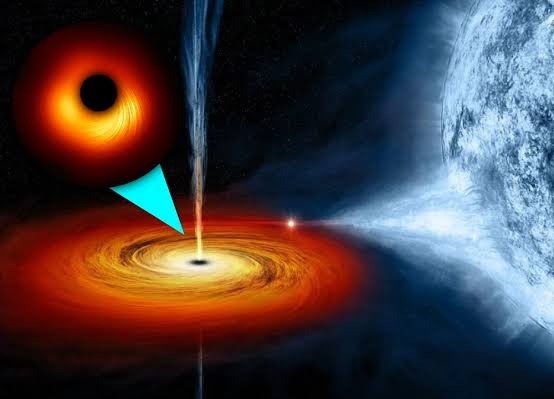
Black hole Cygnus X. NASA/CXC/M.Weiss
What Researchers Found in NGC 3783
Gal Vardi, a doctoral student at the Technion, led the research under Professor Ehud Behar’s supervision. Their international team published the findings in The Astrophysical Journal Letters. Technion announced the results in October 2026.
The researchers examined radiation from the black hole’s corona, the hot plasma surrounding its accretion environment. They identified an eruption with behaviour resembling events in the Sun’s atmosphere.
The comparison concerns the surrounding material, rather than the black hole’s interior. Nothing in this finding suggests that matter escaped from beyond the event horizon. Instead, it reveals how gas outside that boundary gains energy and moves outward. www.technion.ac.il
What Makes This Result New?
Earlier research had already connected an outflow in NGC 3783 with a solar-like eruption. ESA and JAXA reported those findings in December 2025.
The newer study adds a specific diagnostic: the Neupert effect. That distinction matters because observing an outflow and identifying its likely energy source answer different questions. www.xrism.jaxa.jp
How X-Ray Telescopes Tracked the Eruption
The observations came from a coordinated campaign in July 2024. XRISM and ESA’s XMM-Newton followed the galaxy’s changing emission.
For the timing analysis, researchers used XRISM’s Xtend instrument and XMM-Newton’s EPIC-pn camera. They compared lower-energy, or soft, X-rays with higher-energy, or hard, X-rays.
During the unusual flare, those signals followed different patterns. The harder emission declined sharply, while the softer emission faded more gradually. arxiv.org
Following Light and Moving Gas
A separate instrument, XRISM’s Resolve, helped establish the outflow’s properties in the earlier research. Its detailed spectra allowed scientists to investigate the gas’s speed and structure.
These measurements serve complementary purposes. Changing brightness traces the event’s development, while spectral features reveal moving material. Together, they connect the flare with the surrounding flow of gas. esa.int
The Neupert Effect Reveals the Solar Connection
The Neupert effect provides the central link between this event and solar flares. Scientists first identified it on the Sun in 1968, according to Technion.
Its defining feature involves a relationship between signals, rather than simply matching peaks. The hard X-ray brightness tracks the rate at which the soft X-ray brightness changes.
That difference helps researchers follow energy through the event. In the solar interpretation, accelerated particles deliver energy rapidly. Heated material then produces a more sustained response.
Why the Timing Matters
Imagine tracking both the delivery of heat and the response of the material receiving it. Those measurements relate to each other, but they need not rise and fall together.
The researchers found this characteristic relationship in the NGC 3783 flare. XMM-Newton data also supported the pattern seen with XRISM.
The team interprets the result as evidence for magnetic reconnection. The telescopes measured radiation; they did not directly photograph magnetic field lines rearranging. www.technion.ac.il
Black Hole Magnetic Eruptions Drive a Rapid Outflow
Magnetic reconnection releases stored energy as magnetic fields rearrange. That energy can heat plasma and accelerate charged particles. On the Sun, this process contributes to flares and associated eruptions.
Near NGC 3783’s black hole, the observed outflow offers a striking counterpart. The earlier study measured a radial velocity of approximately 57,000 kilometres per second. That approaches one-fifth of light speed.
Researchers detected the prominent outflow during the decline of a soft X-ray flare. They also found that radiation pressure alone could not explain its rapid acceleration. Magnetic driving therefore offered a stronger explanation for the event. doi.org
The solar comparison concerns the underlying mechanism. It does not imply identical conditions or equal scales. Around a supermassive black hole, familiar magnetic processes operate within a very different environment.
Why This Discovery Matters
Black hole magnetic eruptions could help explain how coronae receive energy. Researchers have long considered magnetic reconnection a possible heating mechanism. This study supplies observational evidence that supports that idea.
It also connects two areas of astronomy. Solar observations offer detailed examples of magnetic activity nearby. Distant active galaxies test whether related processes operate under more extreme conditions.
Connecting Local Events to Galactic Questions
Outflows from active galactic nuclei can influence their host galaxies and the conditions for star formation. Understanding what accelerates those flows therefore matters beyond the immediate black hole environment.
However, this particular study does not measure a galaxy-wide transformation. Its contribution concerns the physical mechanism behind one observed event. arxiv.org
What Scientists Still Need to Establish
A single event cannot show how frequently this mechanism operates elsewhere. Additional observations can test whether other coronae display similar timing signatures and accompanying outflows.
Future comparisons should also separate different kinds of flares. Similar changes in brightness do not automatically establish identical causes.
The strongest conclusion remains specific: this flare provides evidence for a solar-like magnetic process near a supermassive black hole.
A Familiar Process in an Extreme Setting
Black hole magnetic eruptions offer a new connection between solar activity and distant galactic environments. By studying X-ray timing alongside moving gas, researchers have strengthened the magnetic-reconnection explanation.
The next challenge is to find comparable evidence elsewhere. Each additional example could clarify how widely this mechanism heats plasma and drives outflows across the universe.
Main sources
- Technion: Solar Storms Around a Black Hole
- Research paper: Observation of a Solar-like Magnetic Reconnection Event in an AGN Corona with XRISM
- ESA: Flaring Black Hole Whips Up Ultra-fast Winds
- JAXA: XRISM Finds Black Hole Outburst Similar to Outbursts on the Sun
- Earlier outflow study in Astronomy & Astrophysics
- Phys.org :Black hole observations uncover evidence of solar storm–like magnetic eruptions
You Might Also Like:
Black hole jet reveals a 27-year mystery
Dying Radio Galaxies Reveal How Black Hole Jets Fade
JWST Black Hole Feeding Discovery Reveals a Cosmic Fuel Cycle