
BY:SpaceEyeNews.
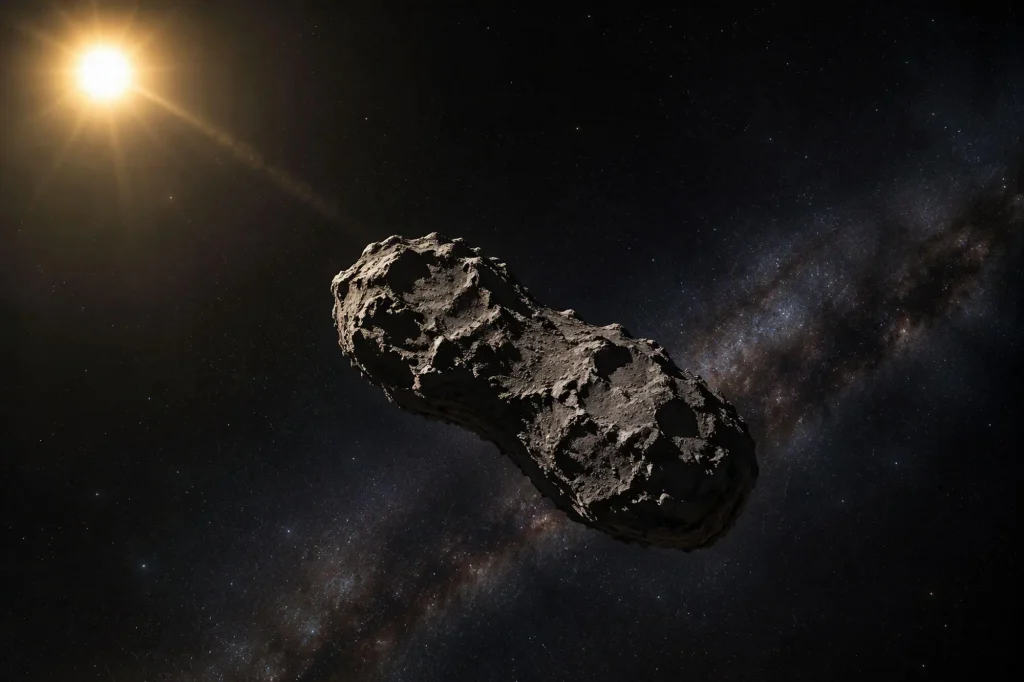
Comet Encke’s nucleus has revealed an intriguing combination: an elongated shape and a surface temperature of roughly 55°C. Scientists reached these estimates by studying heat captured with Japan’s Subaru Telescope. Their findings offer a clearer picture of the small body behind the comet’s activity.
The measurements also connect to a longstanding puzzle: Encke’s changing orbit. Escaping gas can gently push a comet, and its physical shape helps determine how that process works.
However, this discovery comes from observations made in November 2003. The new analysis extracts useful information from those older measurements without claiming to solve the orbital mystery completely.
How Subaru Measured Comet Encke’s Nucleus
Reading heat through the surrounding haze
Observing a comet’s nucleus from Earth presents a familiar obstacle. Surrounding gas and dust can overwhelm the signal from its solid centre. For Encke, researchers used mid-infrared observations to isolate the nucleus’s thermal contribution.
Subaru collected the data with its Cooled Mid-Infrared Camera and Spectrometer, known as COMICS. The instrument observed wavelengths near 10 micrometres, where warm surfaces emit detectable radiation.
Encke appeared as a compact point source during these observations. That appearance indicated that surrounding dust contributed relatively little to the measured signal. Consequently, the team could examine the nucleus with less interference from its coma.
A changing glow reveals an elongated body
The thermal brightness varied during the observing period. Researchers interpreted this variation as the changing view of an elongated, rotating nucleus.
As such a body turns, it presents different apparent areas to an observer. A broader view can contribute more thermal emission than a narrower view. Tracking those changes therefore provides clues about its proportions.
The resulting estimate describes an elongated ellipsoid, approximately seven kilometres long and three kilometres across. Earlier visible-light and radar observations had already suggested an elongated shape. This analysis adds an independent estimate using heat from the nucleus itself.
Crucially, Subaru did not resolve individual cliffs, depressions or surface features. The dimensions describe a model that fits the observations, rather than a detailed geographical map.
What Encke’s Surface Temperature Reveals
Why the measured temperature matters
Measurements across multiple infrared wavelengths yielded a temperature of 328 ± 7 kelvin, equivalent to approximately 55°C. During the observations, Encke stood about 1.1 astronomical units from the Sun.
That distance places it slightly farther from the Sun than Earth’s average orbital distance. Yet distance alone does not determine the temperature inferred from a comet’s thermal emission.
The surface absorbs sunlight and releases energy into space. Measuring that outgoing heat helps researchers examine its thermal behaviour. In this case, the result closely matched an earlier empirical prediction of approximately 327 kelvin.
That agreement provides a useful consistency check. The observations support the expected thermal behaviour under those conditions, rather than revealing an unexplained heating source.
The quoted uncertainty matters, too. The team gives a range around its temperature estimate, rather than an exact value. Readers should therefore treat 55°C as an approximate result, not a precise thermometer reading from the comet.
A warm surface does not mean a warm interior
The 55°C figure needs careful interpretation. It comes from the observed thermal emission and does not establish a uniform temperature throughout the comet.
Nor does it describe Encke’s temperature today. Its distance from the Sun changes along its orbit, altering the energy reaching its surface.
A warm emitting surface also does not mean that every buried icy region shares that temperature. These measurements do not provide a direct temperature profile beneath the surface.
Keeping those distinctions clear preserves the discovery’s real value. Researchers gained a thermal constraint on the nucleus, without measuring every part of its interior.
How Shape Connects to Encke’s Changing Orbit
Small gas flows can influence motion
Encke circles the Sun approximately every 3.3 years. Historical measurements showed that its orbital period was gradually shortening, making it an important case in comet research.
The explanation involves forces beyond gravity alone. When gas escapes from a nucleus, the remaining body experiences a small recoil.
This effect resembles the push produced by a thruster. Although gravity still governs the comet’s broad motion, escaping material can gradually alter its path.
However, the push does not depend only on how much gas leaves. Its direction also matters. Rotation changes the orientation of active regions, while the nucleus’s shape influences the geometry of escaping flows.
That connection makes physical measurements valuable. A better estimate of the body’s dimensions gives researchers firmer information when investigating its activity and orbital evolution.
What the study leaves unresolved
The new shape estimate does not directly explain Encke’s changing orbital period. Researchers would also need information about where gas escapes and how that activity changes.
An elongated body alone cannot establish the strength or direction of the resulting force. Likewise, a thermal brightness curve does not identify every active region.
The findings therefore provide part of the physical picture. They strengthen the basis for future studies while leaving the detailed relationship between activity and orbital change open.
Why Older Subaru Observations Still Matter
Archived measurements offer fresh scientific value
The gap between observation and publication highlights the lasting usefulness of astronomical archives. Data collected in 2003 can still help answer questions about a comet’s physical properties.
For this study, the observing conditions mattered. Mid-infrared radiation faces absorption by water vapour in Earth’s atmosphere. Meanwhile, the atmosphere and telescope produce their own thermal emission.
Maunakea’s dry summit environment helps reduce the atmospheric obstacle. Subaru’s 8.2-metre aperture also supported sensitive observations with high spatial resolution.
Together, these advantages allowed COMICS to collect measurements that remain scientifically useful decades later.
The prospect of renewed infrared observations
COMICS ended observations on Subaru in 2020. The observatory now describes a plan to restart the instrument, rather than a completed return to service.
Renewed access could allow researchers to study the shapes, temperatures and surface materials of additional cometary nuclei. Comparisons across several objects could broaden the scientific value of individual measurements.
Comets preserve material associated with the Solar System’s early history. Understanding their present surfaces and activity helps researchers investigate how these ancient bodies have changed over time.
Comet Encke’s Nucleus Offers Clues, Not a Final Answer
Comet Encke’s nucleus now has a stronger observational foundation for studies of its shape and thermal behaviour. Subaru’s measurements support an elongated body and quantify its thermal emission under specific conditions.
The broader significance lies in connecting physical properties with activity. Shape and rotation help frame questions about how escaping gas influences motion.
This study leaves that orbital explanation unfinished. Even so, it demonstrates how archived infrared observations can reveal useful details about a nucleus that remains difficult to examine directly.
Main sources:
Subaru Telescope, National Astronomical Observatory of Japan — official research announcement:
https://subarutelescope.org/en/results/2026/11/08/3773.html
Universe Magazine — Subaru telescope revealed the shape and temperature of сomet Encke’s nucleus
You Might Also Like:
Planet Nine Mystery Deepens as New Discovery Challenges Hidden Planet Theory
TOI-1883 b May Be Solving the Neptunian Desert Mystery
Jupiter Trojan Asteroids Discovery: Subaru Finds Hidden Pattern