
BY:SpaceEyeNews.
Early black hole pairs could hold clues to one of astronomy’s biggest puzzles: how cosmic giants grew so quickly. Some supermassive black holes already existed within the Universe’s first billion years. Their enormous sizes leave researchers searching for a clearer growth history.
Now, a new analysis offers a way to investigate possible ancient pairs through gravitational waves. Researchers used pulsar observations to constrain how massive certain binaries could be. They did not discover an ancient pair. Instead, they identified extreme systems that the observations can exclude under their search assumptions.
The result opens another route into a period that telescopes alone cannot fully explain.
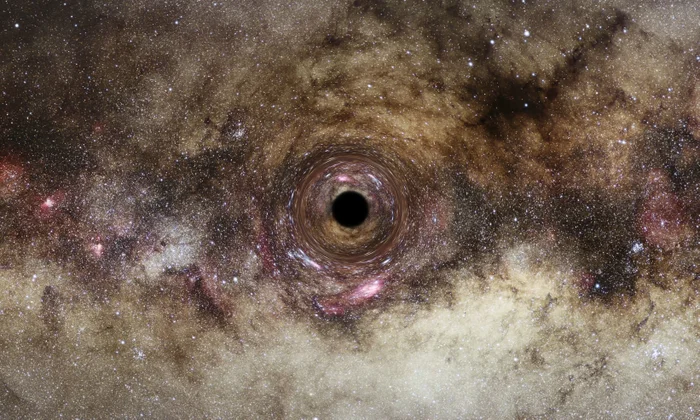
An artist’s impression of a black hole in the Milky Way galaxy. Photograph: ESA/Hubble/PA
Why Early Black Hole Pairs Matter
Astronomers still debate the balance between three growth routes. Black holes may have started with massive seeds, accumulated gas rapidly, or gained mass through mergers. Different systems could have followed different combinations of these paths.
Early black hole pairs matter because they represent a stage before two black holes merge. Studying their masses and abundance could help researchers assess how much mergers contributed to early growth.
However, the presence of an enormous black hole does not automatically reveal its history. A bright quasar shows active growth, but brightness alone cannot establish whether a companion exists.
Gravitational waves offer complementary evidence. An orbiting pair produces a signal that carries information about its masses and motion. Detecting such signals from cosmic dawn would give astronomers another way to test competing explanations.
For now, the challenge involves separating individual sources from noise and other signals.
That is why researchers must distinguish a broad gravitational-wave background from one identifiable binary. A background can combine contributions from many systems. An individual source would offer a more specific test. This study addresses that next challenge by examining the signals that particular distant pairs could produce.
A New Approach to Ancient Gravitational Waves
The team analyzed 18 years of observations covering 30 pulsars from Australia’s Parkes Pulsar Timing Array. These records let researchers search for small, coordinated changes in pulse arrival times.
The study’s main advance concerns how astronomers interpret signals from extremely distant sources. Cosmic expansion stretches gravitational waves during their journey. Therefore, the frequency reaching Earth differs from the frequency at emission.
Ignoring that difference can distort estimates of a distant binary’s intrinsic properties. The researchers developed a framework that includes cosmological redshift, extending the analysis toward the earliest galaxies.
Why Greater Distance Is Not Always a Disadvantage
Consider two binaries whose waves reach Earth at the same frequency. The more distant system emitted its waves at a higher frequency because expansion stretched them more.
For comparable masses, that higher emitted frequency corresponds to a tighter orbit and stronger gravitational-wave emission. Under suitable conditions, this effect can outweigh the usual weakening associated with greater distance.
Expansion does not add energy to the waves. Rather, the comparison selects binaries at different stages of orbital evolution.
That distinction prevents a misleading conclusion. The research does not show that every distant binary becomes easier to detect. It shows that sensitivity changes in a more complicated way than distance alone suggests.
Two Targets from Cosmic Dawn
To apply their method, the researchers examined two distant systems with known positions and redshifts. Those measurements helped connect the gravitational-wave analysis to specific locations and periods in cosmic history.
The Quasar J0100+2802
The first target, J0100+2802, is an exceptionally luminous quasar. Astronomers observe it as it existed less than 900 million years after the Big Bang.
Its estimated black hole mass makes it especially relevant to questions about rapid early growth. However, that estimate does not establish the presence of two orbiting black holes.
The Galaxy JADES-GS-z14-0
The second target, JADES-GS-z14-0, is a distant galaxy that Webb discovered. Its light reveals an era less than 300 million years after the Big Bang.
Here, too, choosing the galaxy as a target does not confirm a supermassive binary. The researchers tested what kinds of hypothetical pairs the pulsar observations could constrain at its location.
Together, these targets demonstrate how telescope measurements can guide gravitational-wave searches across very different early epochs.
What the New Mass Limits Actually Mean
The headline result concerns binaries with chirp masses around 10 billion times the Sun’s mass or higher. The analysis excludes certain such systems in the searched frequency range, subject to its assumptions.
Chirp mass needs careful explanation. It combines the two component masses into a quantity that controls important features of their gravitational-wave signal. It is not simply their total mass, nor the mass of either black hole alone.
Consequently, describing the result as a universal ceiling on early black hole masses would be incorrect.
A Useful Result Without a Detection
A missing signal can still provide information. If a proposed binary would produce a sufficiently strong signal, its absence can constrain that possibility.
However, weaker sources can remain hidden. Lower-mass pairs may produce signals below the current sensitivity. Other orbital properties and observing conditions also affect what a search can establish.
The observations therefore do not determine whether either target actually contains a binary. They narrow the allowed possibilities at the extreme end.
This makes the result a measurement of observational limits, rather than evidence that astronomers have directly weighed an ancient pair.
What Better Pulsar Observations Could Reveal
Future progress will depend on more precise timing and larger combined datasets. Bringing observations from different pulsar timing collaborations together could strengthen searches for individual sources.
Facilities such as the Square Kilometre Array should also improve the measurements available to researchers. Better sensitivity could bring less extreme systems within reach, although no detection timetable is certain.
An eventual discovery would allow comparisons between a binary’s gravitational-wave properties and its host galaxy’s light. Those complementary measurements could help test models of early black hole assembly.
Even before that happens, stronger limits can sharpen future searches. Researchers can identify which masses and frequencies remain accessible, then compare those ranges with theoretical predictions.
Early Black Hole Pairs: Narrowing the Mystery
Early black hole pairs remain elusive, but astronomers now have a clearer framework for investigating them across cosmic time. The Parkes analysis shows how accounting for expansion changes the search and constrains exceptionally massive possibilities.
It does not resolve how the first cosmic giants formed. Instead, it establishes a practical step toward testing their growth through a different observational channel. As pulsar timing improves, researchers may move from excluding extreme systems to identifying individual pairs and tracing their place in cosmic history.
Main Sources:
Physical Review Letters — Nanohertz Gravitational-Wave Constraints on Supermassive Binary Black Holes at Cosmic Dawn, published November 2, 2026: https://journals.aps.org/prl/abstract/10.1103/5z5g-shly
American Physical Society, Physics — Using Pulsars to Probe Early Growth of Black Holes, published November 2, 2026: https://physics.aps.org/articles/v19/146
Universe Magazine — Original coverage supplied for this article: https://universemagazine.com/en/what-might-the-masses-of-vapor-around-supermassive-black-holes-in-the-early-universe-have-been/
You Might Also Like:
Microblazar Candidate Reveals a Remarkable Black Hole Jet
Hidden Black Hole Populations Revealed by Gravitational Waves
Hidden Supermassive Black Hole Pairs May Finally Be Detectable Through Repeating Stellar Flashes