
BY:SpaceEyeNews.
Eight-minute radio signals have led astronomers to an unusual stellar partnership more than 5,000 light-years away. One member is a white dwarf. Its companion belongs to the same stellar class as our Sun. Together, they offer fresh clues about some of the Milky Way’s most puzzling radio sources.
The system, GPM J071507−114153, does more than repeat a distinctive rhythm. Its pulses carry information about the white dwarf’s movement and the environment around its companion. Researchers can now place the emission close to the white dwarf, narrowing a longstanding uncertainty about these strange signals.
Yet identifying the source opens another question: what powers its radio emission?
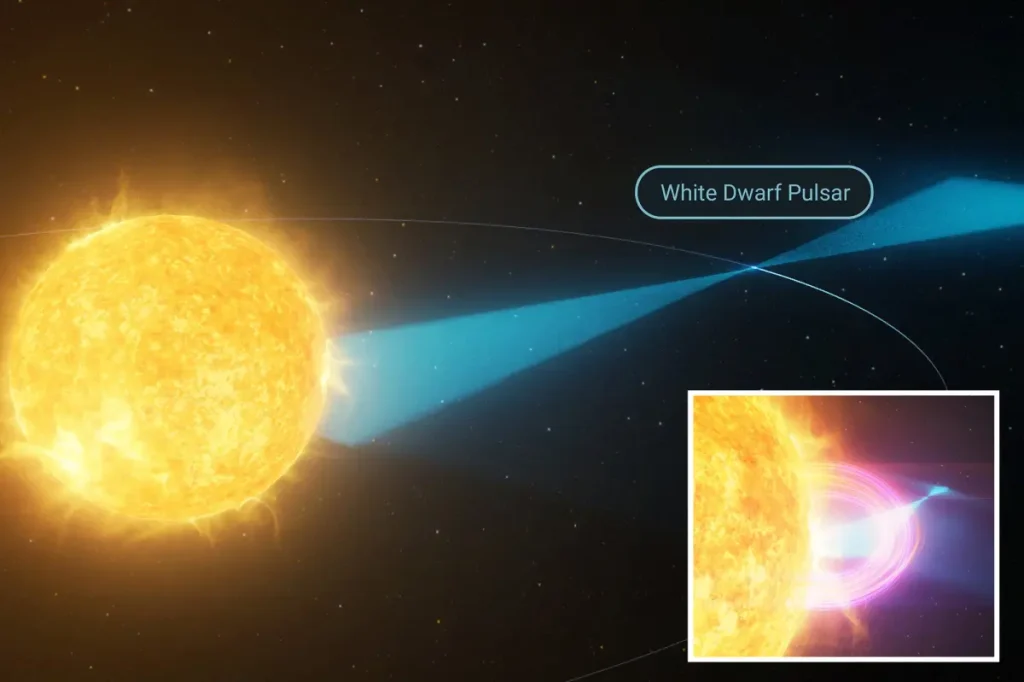
Scientists find rare system that emits radio singles in space.
How astronomers tracked the eight-minute radio signals
Researchers at Curtin University’s node of the International Centre for Radio Astronomy Research investigated the unusual source. Their search began with the Murchison Widefield Array, or MWA, in Western Australia.
The telescope surveyed the Milky Way visible from Australia and detected the repeating emission. However, finding a signal and identifying its stellar counterpart require different kinds of evidence.
South Africa’s MeerKAT telescope helped determine the source’s precise position. Optical observations with the W. M. Keck Observatory in Hawaiʻi then identified the G-type companion.
Each instrument answered a different question. The MWA revealed the repeating source, MeerKAT located it, and Keck helped establish what kind of star occupied that position.
The team also processed more than 100 hours of radio data. That extended record allowed researchers to investigate the white dwarf’s motion, rather than simply measure the spacing between pulses.
For this discovery, the pattern across many observations mattered as much as the initial detection.
Combining radio and optical evidence also avoids relying on a single observational clue. A position identifies where to look. A spectrum helps classify the visible companion. Timing then tests how the radio source moves within the pair.
Two clocks reveal the stellar system’s motion
The research paper gives the pulse repetition period as 7.9 minutes. The official announcement associates that rhythm with the white dwarf’s rotation.
A separate modulation lasts approximately 1.3 days. Researchers interpret this longer cycle as the binary’s orbital period. The distinction matters: the eight-minute pulse interval does not mean the stars circle each other every eight minutes.
Timing helps locate the emitting region
As a radio source moves around an orbit, its distance from Earth changes slightly. Those changes affect how long its signal takes to arrive. Tracking pulse arrival times therefore offers a way to investigate orbital movement.
In this case, the timing evidence places the radio emission near the white dwarf, or possibly on the object itself.
That finding addresses a central difficulty with similar systems. When two stars share an orbit, detecting radio emission alone does not necessarily reveal which star produces it.
Here, researchers gained a clearer location for the source. They have not, however, established every detail of the process that generates the pulses. Identifying an emitting region and explaining its physics remain separate scientific tasks.
The observations also show why a repeating signal should not automatically suggest a fully understood source. Regularity makes the system measurable. It does not, by itself, reveal which physical process supplies the energy or converts that energy into detectable radio waves.
Why the Sun-like companion matters
The companion makes this discovery particularly useful. Previously identified examples of these radio-emitting binaries commonly paired white dwarfs with smaller, cooler red dwarfs.
GPM J071507−114153 instead contains a G-type star. That difference broadens the range of stellar partnerships astronomers must consider when investigating slowly repeating radio sources.
Calling the companion Sun-like describes its stellar classification. It does not establish that the system resembles our solar system or contains similar planets.
The source belongs to an emerging category called long-period transients. These objects produce radio signals that appear and disappear over intervals ranging from minutes to hours.
The official discovery announcement places the known population at roughly a dozen. Such a small sample leaves considerable room for unexpected combinations and competing explanations.
This new pairing gives researchers another configuration to examine. It also helps connect studies of long-period transients with research into white dwarf pulsars. However, one system cannot explain every member of the wider population.
Radio pulses probe a magnetic atmosphere
The observations also reveal information about material around the companion. Radio waves can change as they travel through magnetized plasma, leaving measurable clues about their path.
The paper reports polarization changes consistent with the signal passing through the companion’s corona. This outer atmosphere therefore becomes part of the investigation, alongside the radio source itself.
A possible stellar prominence
The team also describes evidence for a strongly magnetized region, possibly a stellar prominence. Such structures contain plasma shaped by magnetic fields.
That interpretation requires careful wording. Astronomers did not obtain a detailed photograph of a distant stellar storm. Instead, they inferred conditions from changes in the radio signal.
The distinction strengthens the story. A repeating source can provide information about both its own motion and material along the signal’s route.
What the repeating radio pulses still cannot explain
Several questions remain open. Most directly, researchers need to establish how the emitting region generates its distinctive pulses.
The companion’s role also deserves further investigation. Its presence changes the system’s environment, but that alone does not settle how the radio emission works.
Another question concerns the wider population. Are comparable white dwarf and G-type pairs exceptionally uncommon, or have existing surveys missed many examples?
Future observations can help researchers compare systems, refine orbital measurements, and test proposed explanations. Larger samples will also show whether apparently similar radio rhythms arise under different physical conditions.
The upcoming Square Kilometre Array telescopes offer opportunities to find additional sources and examine their signals in greater detail. However, improved sensitivity will provide evidence to evaluate, rather than an automatic answer to every mystery.
Eight-minute radio signals bring a clearer picture
Eight-minute radio signals have revealed an unusual partnership and helped astronomers locate its emitting region. The Sun-like companion adds a valuable new example to a small, puzzling population.
Meanwhile, changes in the pulses provide clues about the companion’s magnetic atmosphere. The same observations therefore connect stellar motion with conditions around another star.
The discovery leaves the emission mechanism open, but it gives researchers a more precise starting point. A regular rhythm from deep space now offers a practical way to investigate an extraordinary stellar system.
Main sources:
ICRAR — Researchers discover rare star system that emits radio signals every eight minutes:
https://www.icrar.org/binary-lpt/
Nature Astronomy — A long-period transient with a Sun-like companion:
https://www.nature.com/articles/s41550-026-03016-z
FOX Weather — Original supplied coverage:
https://www.foxweather.com/earth-space/scientists-discover-star-system-sending-strange-signals-every-eight-minutes
You Might Also Like:
Most Distant Fast Radio Burst Reveals a Surprising Galaxy
Exoplanet magnetic field revealed by radio bursts
Fast radio bursts reveal dark universe clues