
BY:SpaceEyeNews.
An exomoon candidate in the CD-35 2722 system is challenging how astronomers describe distant worlds. The suspected object has a Jupiter-class mass, yet it circles a brown dwarf rather than a star directly. That brown dwarf, in turn, travels around a small star.
The arrangement gives this enormous companion a moon-like role. However, researchers still need further observations to establish its properties and strengthen the discovery. The result offers a promising step toward identifying moons beyond our Solar System. It also raises an intriguing question: what qualifies as a moon?
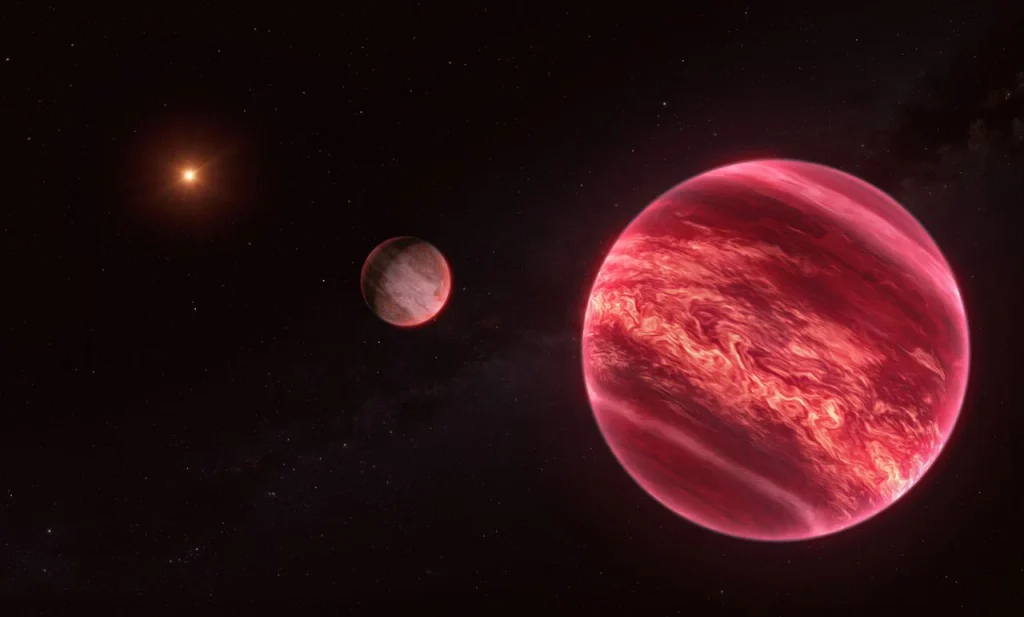
Exomoon Candidate Orbiting Brown Dwarf CD-35 2722
Inside an Unusual Three-Level System
At the center of the system sits the star CD-35 2722. Its brown dwarf companion has approximately 37 times Jupiter’s mass. The proposed satellite occupies the next level of this orbital arrangement, circling the brown dwarf.
Unlike an ordinary star, the brown dwarf cannot sustain the hydrogen fusion that powers the Sun. Nevertheless, its substantial mass makes it a very different host from the planets whose moons we know best.
This distinction matters when interpreting the discovery. Astronomers have not simply located a distant version of Earth and its Moon. Instead, they have identified evidence for a much more massive pairing within a wider stellar system.
How Astronomers Detected the Exomoon Candidate
Kevin Hoy and his colleagues investigated the brown dwarf using CRIRES+, an instrument on ESO’s Very Large Telescope. Their approach focused on changes in the host’s motion, rather than a photograph of the suspected satellite.
An orbiting companion pulls on its host through gravity. Consequently, both objects move around their shared center of mass. Astronomers can trace that movement through tiny shifts in the host’s spectrum.
For this study, the important target was the brown dwarf itself. Tracking its motion allowed the researchers to search for the gravitational influence of a smaller companion.
The technique, known as radial velocity, already has a long history in planet discovery. Researchers used it to find the first exoplanet orbiting a Sun-like star. Applying it to a brown dwarf offers another route toward detecting companions that would otherwise remain hidden.
A Repeating Signal in the Data
The measurements revealed a recurring signal consistent with an orbital period of roughly 170 days. This pattern provides the central evidence for the proposed satellite.
However, an indirect detection does not reveal everything about an object. The observations constrain its orbit and minimum mass, but they do not supply a surface image or measured diameter. ESO’s accompanying illustrations therefore show an artist’s interpretation, not the companion’s photographed appearance. ESO
Why Jupiter-Class Mass Needs Careful Wording
The mass estimates require particular care. ESO’s announcement describes an object at least as massive as Jupiter. However, the linked manuscript gives about 0.7 Jupiter masses in its abstract. Its favored single-satellite model gives approximately 0.9 Jupiter masses.
These figures describe minimum masses, rather than a securely measured true mass. The unknown orbital inclination leaves room for a heavier companion.
For that reason, “Jupiter-class mass” offers a useful description without overstating the measurement. Calling it “larger than Jupiter” would introduce another problem: mass and physical size are different properties. eso.org
Why Confirmation Still Matters
A repeating signal makes the case compelling, but scientists must also test how reliably an orbital model explains it. Here, the measurements allow more than one interpretation.
The manuscript considers both a single satellite and a configuration involving two satellites. Their predicted signals currently resemble each other closely. However, computer simulations favor the single-satellite explanation because that arrangement remains stable more readily.
Additional observations could help separate these possibilities as their predictions diverge over time. They could also improve estimates of the companion’s orbit. www.eso.org
Two questions therefore remain distinct. Researchers must strengthen the physical interpretation of the signal. Separately, astronomers must decide whether “exomoon” accurately describes the resulting object.
A Planet, a Moon, or an Exosatellite?
Mass alone does not resolve the naming problem. A world can possess a planetary mass while occupying an orbital position that resembles a moon’s.
Researchers use “exosatellite” to describe the proposed companion without settling that debate. The term emphasizes its relationship with a larger object outside our Solar System.
Meanwhile, astronomers lack a universally accepted definition of an exomoon. That uncertainty becomes especially relevant when the host is a brown dwarf rather than a conventional planet.
The discussion goes beyond choosing an appealing headline. Classification helps scientists compare systems and organize evidence about their origins. Yet categories developed around our Solar System may need refinement when observations reveal unfamiliar arrangements.
What This Giant Satellite Could Reveal
The candidate’s value extends beyond any claim to being first. A confirmed companion could help researchers investigate how massive satellites develop and survive within larger systems.
Its orbit would provide clues about the system’s history. Comparing similar discoveries could eventually reveal whether such arrangements represent unusual exceptions or a broader population.
For now, the observations do not establish a complete formation story. The immediate opportunity is to connect a measurable orbital signal with questions that future research can test.
The Next Chapter in the Exomoon Search
ESO announced the research on July 22, 2026, before ScienceDaily’s October coverage. The announcement also highlighted earlier tentative satellite evidence in the HD 206893 system. That separate investigation used ESO’s Very Large Telescope Interferometer, but did not establish a firm detection.
Looking ahead, ESO expects its Extremely Large Telescope to expand the search for smaller satellites. Its 39-meter mirror and advanced instruments should help astronomers investigate companions beyond current observational limits. ESO
An Exomoon Candidate With Lasting Significance
The CD-35 2722 exomoon candidate remains a promising finding with unresolved details. Confirming its nature would deepen our understanding of distant planetary systems. Just as importantly, it could show why familiar astronomical labels need room for worlds that resemble nothing in our own neighborhood.
Main sources
- ESO: New ‘exomoon’ detection challenges cosmic labels
- Research manuscript hosted by ESO
- ScienceDaily: Astronomers may have discovered the first moon beyond our Solar System
You Might Also Like:
Possible First Exomoon Challenges the Definition of a Moon
Jupiter and Saturn Moon Mystery Finally Explained by Magnetic Fields