
BY:SpaceEyeNews.
apan’s MMX mission has begun a five-year journey with a surprisingly small target: at least 10 grams of material. Those grains from Phobos could help answer a major question about Mars. How did its two moons form?
The spacecraft launched aboard an H3 rocket from Japan’s Tanegashima Space Center on October 20, 2026, at 4:41 a.m. local time. Now, scientists face the longer challenge of reaching Phobos, collecting samples, and bringing them home in 2031.
Moment Japan launches historic mission to collect rocks from Mars’s moon.
Japan’s MMX mission begins its journey
The successful launch moves Martian Moons eXploration, or MMX, into its flight phase. Japan’s space agency, JAXA, leads the project. NASA, the European Space Agency, France’s CNES, and the German Aerospace Center contribute to the mission.
Arrival at Mars is planned for August 2027. However, the spacecraft will spend considerable time studying its surroundings before attempting surface operations. www.esa.int
Detailed observations will help researchers examine Phobos and identify promising landing areas. This preparation matters because the team must balance scientific value with safe access.
Launch success therefore marks the beginning of a demanding sequence, rather than the completion of its greatest challenges.
Why Phobos could resolve a lasting mystery
Two explanations for the Martian moons
Scientists have two leading explanations for the origins of Phobos and Deimos.
One suggests that Mars captured asteroids through its gravity. The other proposes that an ancient collision scattered material into orbit, where it gathered into moons.
Each explanation points to a different history for the Martian system. Yet observations from a distance have not settled the question.
Actual samples could provide the evidence that images and remote measurements cannot supply alone.
What returned material could reveal
Researchers will compare laboratory findings with observations from the spacecraft. Together, these measurements could help establish which formation process best explains Phobos.
The answer would also place the moons within the broader story of planetary formation. Understanding their origins could clarify how material moved and changed around early Mars.
MMX will also observe Deimos, providing another perspective on the same unresolved history. MMX – Martian Moons eXploration
Idefix will explore Phobos before the main landing
A small French-German rover called Idefix will investigate the surface before the main spacecraft lands.
According to DLR, deployment is planned around late 2028 or early 2029. The rover should explore Phobos for approximately 100 days.
Its arrival will look very different from a conventional planetary landing. MMX will release Idefix from roughly 40 to 100 metres above the surface.
After contact, the rover may bounce before settling. It must then turn itself upright, deploy its solar panels, and begin operations.
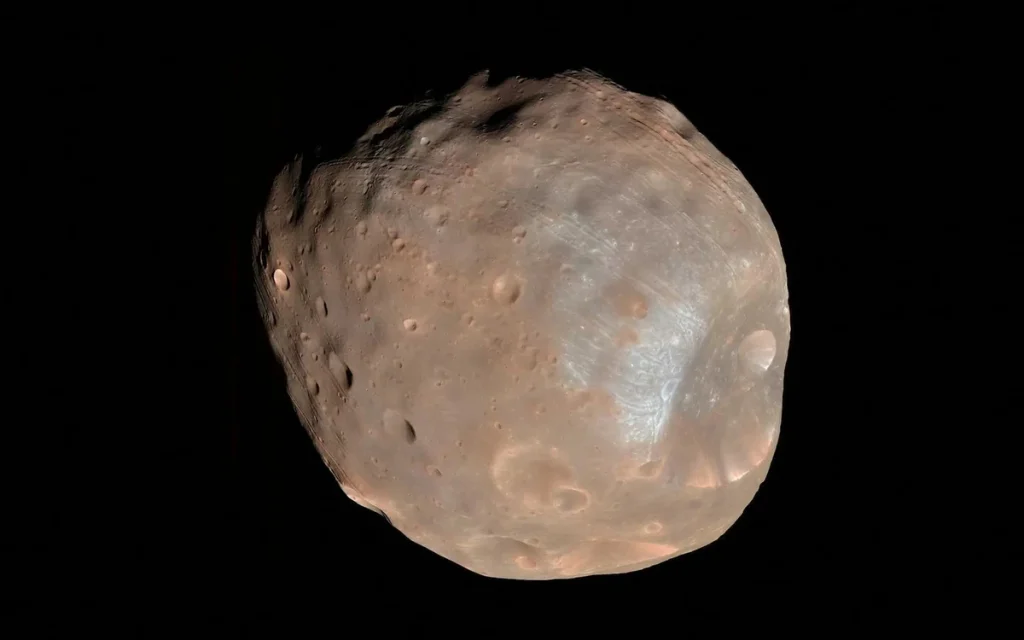
Phobos: The Destination of Japan’s MMX Mission.
A scout for surface conditions
Idefix will examine the surface’s mechanical, thermal, and mineral properties. These measurements will support decisions about the main spacecraft’s landing and sampling operations.
Weak gravity makes this work unusually demanding. Surface temperatures also change sharply, while communication delays limit immediate guidance from Earth.
Crucially, Idefix will operate on Phobos itself. It will not explore the surface of Mars. www.dlr.de
Collecting Phobos samples is the crucial test
Japan’s MMX mission aims to gather at least 10 grams of surface material. ESA’s mission overview describes planned sampling at two sites.
Before that can happen, the spacecraft must approach carefully and establish suitable conditions for contact.
Phobos offers lower gravity than Mars, which helps make sample return practical. Nevertheless, that advantage introduces unfamiliar conditions for landing and surface operations.
The team must manage uncertain terrain, limited fuel, changing temperatures, and delayed communications. Every stage must support the next, including a safe departure after collection. www.mmx.jaxa.jp
Bringing the material home
The return system must preserve the collected material throughout the journey to Earth. Near the end, a capsule will separate and enter Earth’s atmosphere.
JAXA plans recovery in Australia. Researchers can then begin the laboratory investigations that give sample return missions their scientific value. www.mmx.jaxa.jp
The collection target may sound small. However, the mission’s purpose is detailed analysis, rather than returning large quantities of rock.
What MMX could reveal about habitable worlds
The connection to life concerns the conditions that make planets habitable.
JAXA identifies the transport of water and organic materials as an important scientific theme. Understanding that movement could clarify how suitable environments developed across the early solar system.
Phobos may preserve information about processes that shaped the Martian system. Its history could therefore contribute to wider questions about planetary evolution. www.mmx.jaxa.jp
Keeping expectations grounded
Scientists have not discovered life through MMX. Nor does the mission promise to explain exactly how life began on Earth.
Instead, researchers hope to improve their understanding of the materials and environments associated with habitability.
These investigations could connect the moons’ formation with the wider evolution of Mars. Their value lies in testing explanations against physical evidence, including results that challenge current ideas.
Japan’s MMX mission targets a 2031 return
The planned schedule combines years of observations with demanding surface operations.
After reaching Mars in 2027, MMX will study the moons, deploy Idefix, and collect samples. Departure from the Martian system is planned for 2030, followed by Earth return in 2031.
Those dates remain mission targets. Successful completion depends on the spacecraft and its systems performing throughout the journey.
Japan brings experience from its earlier Hayabusa missions. MMX extends that sample return expertise to the Martian system, while developing capabilities for future exploration. www.mmx.jaxa.jp
A small sample with lasting scientific value
Japan’s MMX mission now has a clear destination and an ambitious scientific purpose.
Its greatest achievement would come when researchers can examine Phobos material directly in Earth laboratories. Those samples could help resolve the moons’ origins and deepen our understanding of planetary history.
For now, the launch opens that opportunity. The next five years will determine whether a few grams from Phobos can deliver the answers scientists seek.
Main sources:
- DLR: MMX successfully launches with the Idefix rover
- JAXA: MMX mission overview and timeline
- JAXA: MMX scientific objectives
- ESA: The Martian Moons eXploration mission
- The Guardian: Original news report
You Might Also Like:
MMX mission: NASA Technology Could Unlock Phobos’ Secrets
Deimos asteroid impact may explain its smooth surface
Phobos Destruction: Mars May Tear Its Moon Apart Sooner